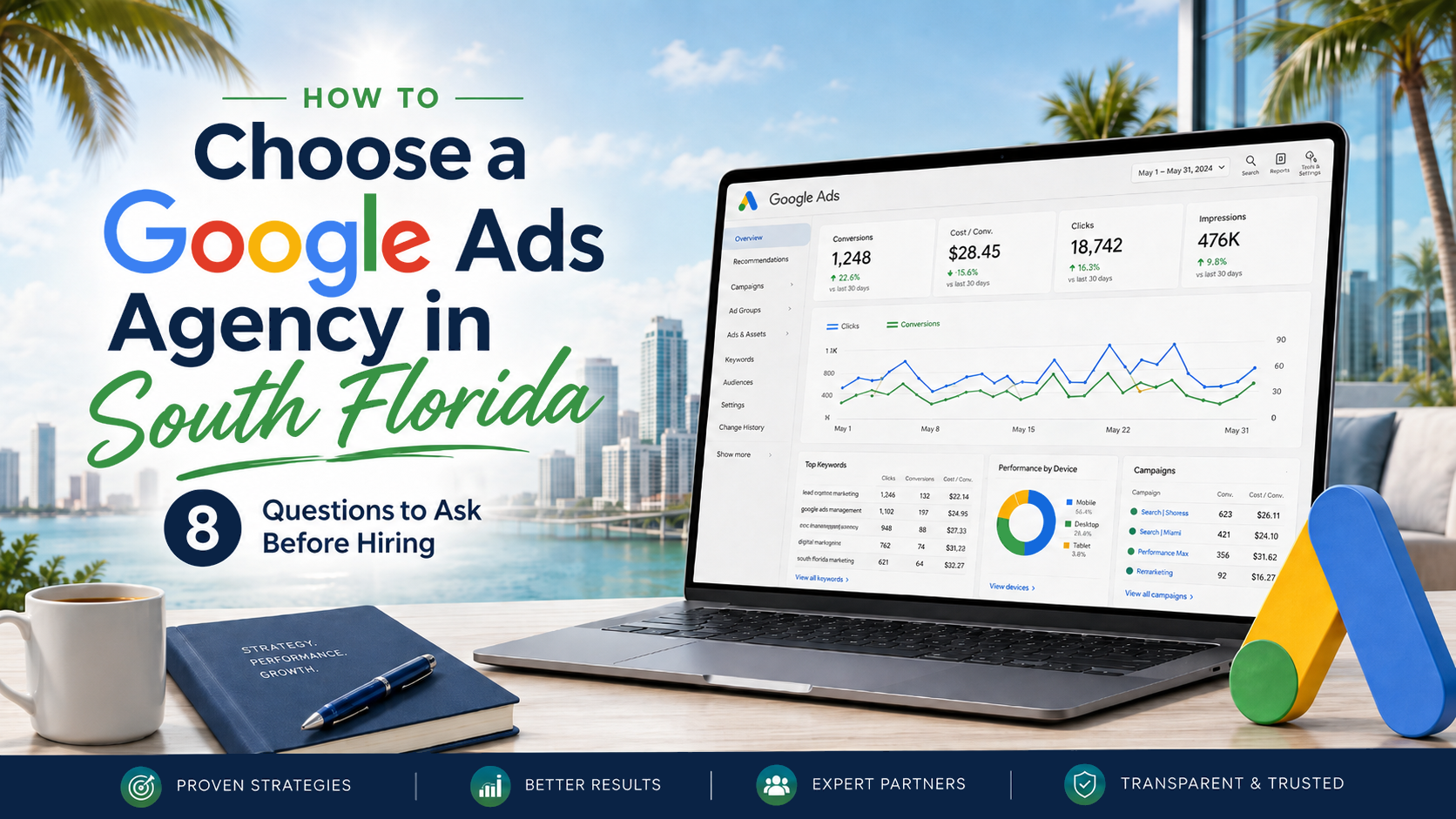
How to Choose a Google Ads Agency in South Florida: 8 Questions to Ask Before Hiring
Share this article
Hiring a Google Ads agency can feel a little overwhelming.
One company talks about clicks. Another talks about conversions. Someone else promises “top placement” and throws a bunch of acronyms at you until your eyes glaze over. The truth is, choosing the right agency should be much simpler than that. You want a team that understands your goals, tracks what actually matters, explains where your money is going, and continuously improves your campaigns instead of just launching them and walking away.
In this guide, we'll walk through 8 questions every business owner should ask before hiring a Google Ads agency in South Florida so you can compare your options, avoid common red flags, and make a more informed decision. If you're already comparing providers and want to see how professional campaign management works, explore our Google Ads management services for service-based businesses throughout South Florida.
1. How Will You Track Whether the Campaign Is Actually Working?
A Google Ads agency should track conversions and business outcomes—not just clicks, impressions, and traffic. The goal is to understand whether your advertising is generating qualified leads and meaningful opportunities for your business.
Good Signs
- They explain exactly what will be tracked. You should know whether the campaign is measuring calls, form submissions, appointments, purchases, or another meaningful action.
- They review conversion tracking regularly. Tracking should not be set up once and forgotten. It needs to be checked to make sure the data remains accurate.
- They connect campaign performance to your business goals. The conversation should go beyond traffic and focus on whether the campaign is creating real opportunities.
Red Flags
- They only talk about clicks and impressions. Traffic is useful, but it does not automatically mean the campaign is producing leads.
- They cannot clearly explain how conversions will be measured. If the agency cannot tell you what success looks like, it will be difficult to evaluate performance later.
- They never mention the landing-page experience. The advertisement gets someone to your website, but the landing page still has to encourage that visitor to take action.
For lead-generation campaigns, proper conversion tracking typically requires a dedicated landing page and thank-you page. The landing page gives visitors a focused place to take action, while the thank-you page allows that completed action to be tracked as a conversion. If your website was built outside of The Business Theory, you’ll be responsible for providing the landing page and thank-you page before the campaign launches. If we designed your website, we can create the necessary landing page and thank-you page for an additional fee.
Once those pages are in place, our Google Ads Management Services include conversion tracking setup and ongoing conversion tracking audits so we can measure the actions that matter most to your campaign.
2. How Do You Choose the Right Keywords?
A Google Ads agency should choose keywords based on search intent, relevance, competition, and the likelihood that a searcher can become a qualified customer. Ask how the agency identifies high-intent searches, uses match types, reviews search terms, and prevents your budget from being spent on irrelevant traffic.
Good Signs
- They perform keyword research before launching the campaign. This helps identify the phrases potential customers are actually using when they search.
- They consider search intent, not just search volume. A keyword may get a lot of searches but still be a poor fit if those users are not likely to become customers.
- They use negative keywords. Negative keywords help prevent your ads from appearing for irrelevant searches that could waste your advertising budget.
- They refine keywords over time. Search behavior changes, so keyword targeting should be reviewed and adjusted as campaign data comes in.
Red Flags
- They target broad keywords without explaining why. Broad targeting can quickly attract clicks that have little chance of converting.
- They never mention negative keywords. Without exclusions, your ads may appear for searches that have nothing to do with your actual services.
- They choose keywords once and never revisit them. Keyword performance should be monitored and optimized throughout the campaign.
At The Business Theory, our Google Ads Management Services include keyword research and negative keyword management as part of the campaign setup and ongoing optimization process. That helps us focus the campaign on searches that are more relevant to your business while reducing wasted ad spend.
3. How Often Will You Optimize the Campaign?
Google Ads campaigns should be monitored and optimized regularly based on performance data rather than launched and left unattended. Ongoing optimization can include reviewing search terms, keywords, bids, targeting, ads, conversions, and budget allocation.
Good Signs
- They review campaign performance regularly. Ongoing monitoring helps identify issues before they become expensive.
- They test different ads and audiences. Testing helps reveal which messages and targeting options are producing stronger results.
- They adjust budgets based on performance. Your advertising budget should be managed strategically rather than divided equally without considering results.
- They look for ways to improve over time. A campaign should evolve as more data becomes available.
Red Flags
- They launch the campaign and rarely touch it again. Google Ads requires ongoing attention to remain efficient.
- They never test new ad variations. Without testing, it is difficult to know whether better messaging could improve performance.
- They cannot explain what they changed during the month. You should have a clear understanding of how your campaign is being managed and improved.
At The Business Theory, our Google Ads Management Services include weekly performance reviews and enhancements, ad testing, audience testing, budget management, ad copy optimization, and ongoing performance analysis to help campaigns improve over time.
4. How Will You Manage the Budget?
A Google Ads agency should manage your budget around campaign performance, search demand, business priorities, and the opportunities most likely to generate qualified leads. Your budget should be actively monitored rather than distributed without considering which parts of the campaign are producing meaningful results.
Good Signs
- They explain how your budget will be allocated. You should understand how much is being spent and why.
- They consider keyword costs and competition. Some industries and search terms are much more expensive than others, so your budget should reflect the reality of your market.
- They adjust spending based on performance. Stronger-performing campaigns, keywords, or audiences may deserve more of the budget over time.
- They distinguish ad spend from management fees. Your agency fee and the amount paid directly to Google should be clearly separated.
Red Flags
- They promise results without discussing your budget. A campaign strategy should take your available ad spend into account.
- They cannot explain where the money is going. You should never feel confused about how your advertising budget is being used.
- They treat every campaign the same regardless of industry or competition. Budget recommendations should be based on your specific market and goals.
At The Business Theory, our Google Ads Management Services include budget recommendations and ongoing budget management so spending can be adjusted based on campaign performance. Your Google Ads budget is paid separately from our management fee, giving you a clear understanding of what is being invested in advertising and what is being paid for professional campaign management.
5. What Kind of Reporting Will You Receive?
Google Ads reporting should clearly explain where your advertising budget is going and what results the campaign is generating. Useful reports should go beyond clicks and impressions to include metrics such as conversions, cost per lead, conversion rate, search terms, and overall campaign performance.
Good Signs
- They provide regular performance reports. You should not have to wonder how your campaign is doing.
- They explain the numbers in plain language. Reports should be understandable, not filled with unexplained marketing jargon.
- They focus on meaningful metrics. Conversions, cost per lead, campaign performance, and budget usage are usually more useful than vanity metrics alone.
- They provide context for changes. If performance improves or declines, the agency should help explain what may be contributing to the change.
Red Flags
- They only send screenshots with no explanation. Numbers without context are not very helpful.
- They focus heavily on impressions and clicks without discussing leads. Traffic matters, but the campaign should ultimately support your business goals.
- They avoid discussing poor performance. A trustworthy agency should be willing to explain challenges as well as successes.
At The Business Theory, our Google Ads Management Services include monthly progress reporting and ongoing performance insights so clients can see how their campaigns are performing and understand the adjustments being made over time.
6. What Happens After Someone Clicks the Ad?
What happens after someone clicks your Google Ad can be just as important as the ad itself. The landing page should match the searcher's intent, clearly explain the service or offer, build trust, and make the next step easy to complete.
Good Signs
- They review the landing-page experience. A strong agency understands that campaign performance does not stop at the advertisement itself.
- They make recommendations when the landing page needs improvement. That may include clearer messaging, stronger calls-to-action, better mobile usability, or a more focused layout.
- They make sure the page matches the advertisement. The message someone sees after clicking should closely align with what they were promised in the ad.
- They understand how the thank-you page supports conversion tracking. For lead-generation campaigns, a thank-you page can help confirm when a visitor has completed the desired action.
Red Flags
- They send every ad to the homepage without considering the customer journey. A homepage may not always be the best destination for a highly specific campaign.
- They never discuss your landing page. If the page is not converting visitors, increasing ad spend alone may not solve the problem.
- They blame every performance issue on the ads. Sometimes the campaign is attracting the right traffic, but the website experience is preventing those visitors from converting.
At The Business Theory, our Google Ads Management Services include landing-page recommendations as part of ongoing campaign management. For lead-generation campaigns, clients need to have a landing page and thank-you page available for conversion tracking.
If your website was built outside of The Business Theory, you are responsible for providing those pages. If we designed your website, we can create the landing page and thank-you page for an additional fee.
7. Who Owns the Google Ads Account and Campaign Data?
Your business should retain ownership of and access to its Google Ads account, campaign history, and performance data. Before hiring an agency, make sure you understand how account access is managed and what happens to your campaigns and historical data if the relationship ends.
Good Signs
- They clearly explain how account access works. You should understand who can view and manage the campaign from the beginning.
- You can access your campaign information. An agency should be transparent about what is happening inside your account.
- They explain what happens if the relationship ends. There should not be confusion about your historical campaign data or account access later.
- They are comfortable discussing account structure. Transparency should be part of the relationship from day one.
Red Flags
- They refuse to give you visibility into your campaigns. You should not feel like your advertising is happening behind a curtain.
- They avoid questions about account ownership or access. Those details should be clear before advertising begins.
- You have no way to review campaign performance outside of agency reports. Reports are useful, but transparency into the underlying campaign is important too.
- They make leaving unnecessarily difficult. Your decision to change providers should not mean losing valuable historical advertising information.
The goal is not to micromanage your agency. It is simply to understand how one of your business's important advertising assets is being handled. A trustworthy Google Ads agency should be comfortable answering questions about account access, reporting, campaign history, and how your information is managed throughout the relationship.
8. What Results Are You Promising?
A Google Ads agency should set realistic expectations based on your budget, market, competition, targeting, and available campaign data rather than guaranteeing a specific number of leads or sales. Ask how the agency establishes performance expectations and how it evaluates results as real campaign data becomes available.
Good Signs
- They set realistic expectations. A trustworthy agency should explain what can be measured and optimized without promising outcomes they cannot control.
- They talk about testing and improvement. Strong campaigns are refined over time as more performance data becomes available.
- They focus on measurable progress. The conversation should include conversions, lead quality, cost efficiency, and other meaningful business metrics.
- They are willing to discuss challenges. Not every campaign performs perfectly from day one, and a good agency should be comfortable explaining what needs to change.
Red Flags
- They guarantee a specific number of leads. There are too many outside factors for any agency to promise exact results.
- They guarantee the #1 ad position. Ad placement changes constantly based on the auction, competition, relevance, and other factors.
- They promise instant success. Campaigns often need time to gather data, test variations, and improve.
- They avoid discussing risk. Advertising always involves testing and uncertainty, and that should be explained honestly.
A good Google Ads agency should make you feel informed, not pressured. The goal is not to sell you on unrealistic promises — it is to build a strategy, measure what happens, and continuously improve the campaign based on real performance data.
At The Business Theory, our Google Ads Management Services focus on campaign setup, tracking, testing, optimization, and transparent reporting so clients can clearly understand how their advertising is performing over time.
Frequently Asked Questions About Hiring a Google Ads Agency
Choosing a Google Ads agency involves more than comparing management fees. These quick answers cover a few additional questions businesses often have when deciding whether professional Google Ads management is the right fit.
Choose a Google Ads Agency That Gives You Clarity
Hiring a Google Ads agency should make your marketing feel easier to understand, not more confusing.
The right agency should be transparent about how your budget is being used, what they are tracking, how often they optimize the campaign, and what results you should realistically expect. They should also be willing to explain the strategy behind the campaign instead of hiding behind technical language or vague reports.
At The Business Theory, our Google Ads Management Services include campaign setup, keyword research, negative keyword management, conversion tracking, audience targeting, ad copy creation, weekly performance reviews, testing, budget management, landing-page recommendations, and monthly reporting. Our goal is to help businesses understand what is happening with their campaigns while continuously improving performance over time.
If you're looking for professional campaign management, learn more about our Google Ads management services in South Florida.
Ready to learn more? Explore our Google Ads Management Services or Contact The Business Theory to schedule a consultation and discuss your goals.