Meta Instant Forms vs Website Forms: Which Brings Better Leads?
Share this article
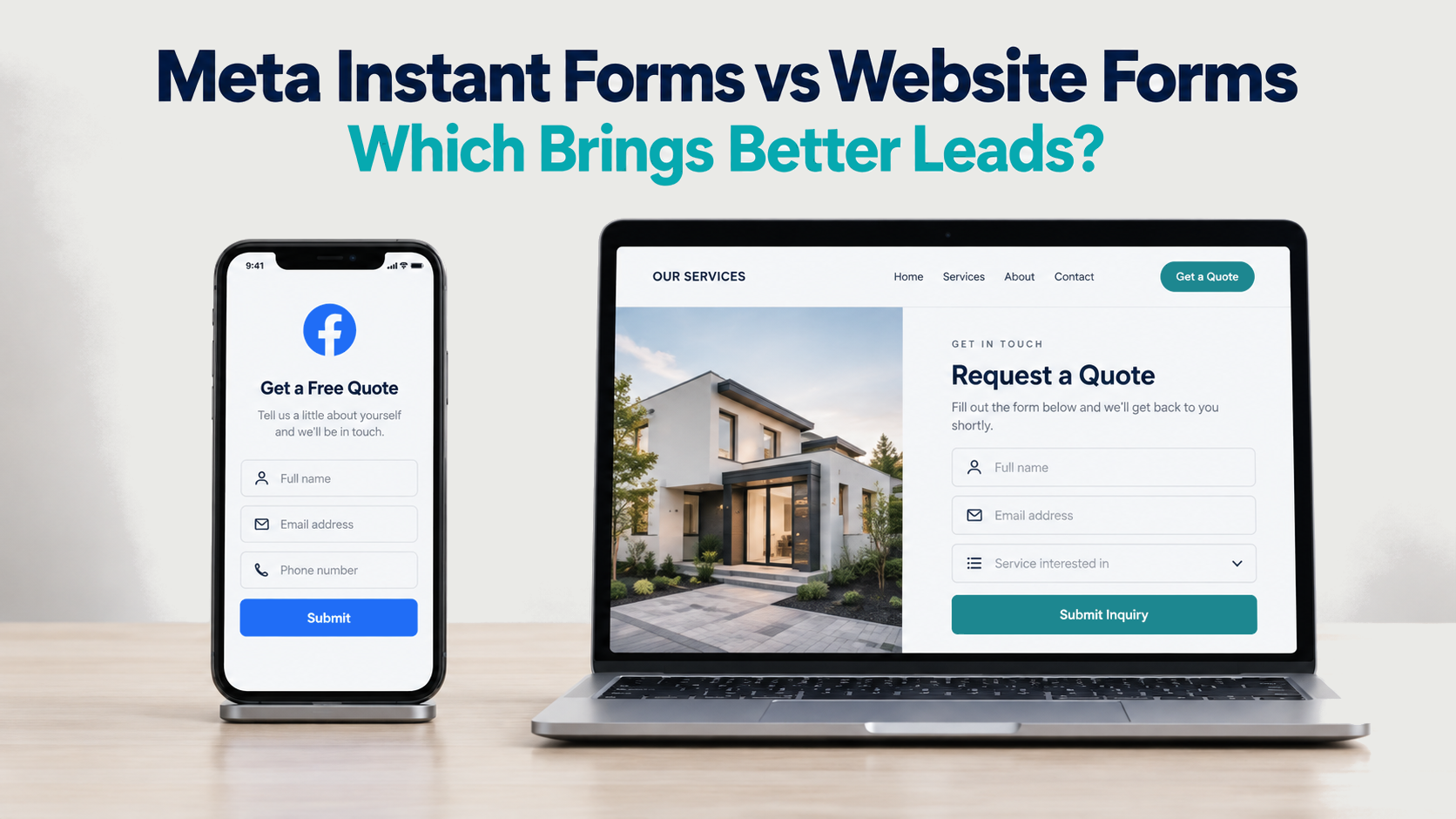
Meta instant forms collect inquiries within the advertising experience, while website forms send people to your own page before they inquire. Neither route guarantees better leads. Choose based on how much explanation customers need, what makes an inquiry qualified, the quality of your website, and your team's ability to follow up.
For a small service business, the useful comparison is not simply which option produces the cheapest submission. It is which route creates suitable conversations, appointments, and customers at a cost the business can support.
This guide explains how to choose a starting approach and evaluate it fairly. It focuses on inquiry forms for Facebook and Instagram advertising rather than general website traffic or social engagement.
What is the difference between an instant form and a website form?
An instant form lets someone share contact details without first visiting your website. A website form sits on a page you control, where visitors can read about the service before submitting an inquiry. The difference changes the path to contact and the amount of information a prospect encounters along the way.
Meta's lead-generation guide identifies both instant forms and website forms as lead-generation routes. Choosing one is a campaign decision, not proof that the other is ineffective.
With an instant form, your ad and form need to communicate enough context for the request to be meaningful. With a website form, the landing page takes on more of that explanation, but it also creates another step that must work well.
If you are still deciding whether the platform suits your business, start with our guide to whether Facebook Ads are worthwhile for small businesses. Once advertising makes sense, the inquiry path becomes a more specific choice.
When might Meta instant forms make sense for a service business?
Instant forms are worth considering when the offer is straightforward, the request can be explained clearly, and your team can respond reliably. They can also provide an inquiry route while a website is not ready for campaign traffic. They still require suitable messaging, qualification, and a functioning lead-handling process.
A hypothetical class provider promoting an introductory visit might need the program, location, participant age range, and contact details before arranging the next step. That can be a relatively contained request if expectations are clear.
Make the request clear before asking for contact details
Someone should understand what they are requesting and what happens after submission. Avoid making a consultation request sound like a confirmed appointment or using an offer whose restrictions appear only during the follow-up call.
- Name the specific service or program.
- Explain where it is available.
- State meaningful eligibility or scheduling limitations.
- Clarify whether the next step is a call, quote, or appointment request.
- Use a confirmation that matches your team's actual process.
Meta describes different instant-form types, including options oriented toward volume or intent. Available settings should be checked in the account. A form label alone does not establish that a submission is a qualified buyer.
When is a website form the better starting point?
A website form is worth prioritizing when customers need substantial information before requesting service, the offer involves important conditions, or the page helps people determine whether the business is a fit. The page must be useful and easy to complete on a phone. Sending traffic to an unprepared website adds friction without adding clarity.
Consider a hypothetical commercial service provider whose customers need to understand project scope, property types, coverage areas, and the estimate process. A focused page can answer those questions before asking for details.
Give the page a clear job
The landing page should continue the promise of the ad. A visitor who clicks an offer for one service should not have to search a broad homepage to work out what is available.
Useful page content can include:
- What the service includes and excludes.
- The locations or customer types served.
- Relevant credentials and genuine customer feedback.
- Important pricing factors or project requirements.
- A short explanation of what happens after an inquiry.
If the website needs a broader rebuild, The Business Theory's custom Duda website design services provide a separate option to discuss. Campaign management and website work should have clearly defined scopes.
How should you define a qualified lead before comparing forms?
Define a qualified lead using facts relevant to your business, such as the requested service, service area, customer type, and realistic timing. Apply the same definition to both routes. Otherwise, a campaign may look successful because it produces many submissions while the sales team spends time handling unsuitable requests.
Keep qualification practical. A person can be a suitable prospect without being ready to purchase immediately. Distinguish poor fit from a longer decision timeline so valuable inquiries are not dismissed prematurely.
Ask questions that change your next action
Choose form questions based on what your team needs to route or evaluate the request. Every required field should have a purpose you can explain.
For example, a hypothetical home-service company might ask for the service needed and ZIP code. A project-based business may also need a rough timeline. Asking ten questions about details staff will confirm on the first call may create unnecessary effort.
Review actual inquiry records before adding more fields. If most unsuitable requests come from outside the service area, a location question and clearer offer may address the problem more directly than a longer general questionnaire.
Which metrics show whether one form route works better?
Compare valid inquiries, qualified leads, booked appointments, and resulting customers alongside advertising spend. Cost per submission is a useful starting measurement, but it does not show whether the people submitting are appropriate prospects. Review enough follow-up information to distinguish cheap activity from useful business opportunities.
Record the form route in your lead tracker and agree on consistent status definitions. Keep duplicate inquiries and test submissions from inflating the results.
A hypothetical comparison shows why submission cost is incomplete
Imagine two campaigns each spend $600. One generates 60 inquiries, of which 12 meet the business's qualification criteria. The other generates 30 inquiries, of which 15 qualify. These numbers are illustrative, not platform benchmarks or client results.
The first route costs $10 per inquiry and $50 per qualified lead. The second costs $20 per inquiry and $40 per qualified lead. The route with fewer submissions produces more qualified opportunities in this example.
Appointments and customers may change the final conclusion again. Allow time for outcomes to develop, especially when the service has a longer sales cycle. Keep advertising-only calculations separate from total acquisition costs that include management and other expenses.
How can you test instant forms against website forms fairly?
Use comparable offers, qualification criteria, targeting, follow-up, and outcome windows, and document differences that could affect the comparison. A test is difficult to interpret if one route receives a stronger promotion or a faster sales response. Decide what success means before reviewing which version has the lower cost.
A formal experiment may be appropriate when account options and budget support it. Otherwise, treat comparisons as directional rather than claiming that every difference was caused by the form itself.
Keep the first comparison manageable
Start with one priority service and a defined area instead of dividing a small budget across many offers and destinations. Choose a primary business measure, such as cost per qualified appointment, and supporting measures that explain it.
- Use the same qualification definition for both routes.
- Record when staff attempted contact.
- Check that lead delivery works before spending increases.
- Log offer, creative, budget, and page changes.
- Review incomplete follow-up before declaring a route unsuccessful.
There is no universal testing duration that guarantees a reliable answer. The volume of relevant inquiries, normal sales cycle, and size of the performance difference all affect how much evidence you need.
Why can both form types produce poor leads?
Both routes can underperform when the offer is misleading, the service fit is unclear, targeting is unsuitable, or follow-up fails. A different form cannot correct every problem in the customer journey. Identify where the mismatch happens before replacing the entire campaign.
Review conversations, not just dashboard totals. Are people requesting a service you do not provide? Do they misunderstand the price? Are they in a location your team cannot serve? Are suitable prospects waiting for a response?
Then adjust the part responsible for the issue. An expectation problem may need clearer advertising. A technical problem may need form testing. A response problem may need a staff workflow. Professional Meta Ads management can help assess campaign strategy, tracking, creative, and performance, while your business remains responsible for delivering the service and handling inquiries.
Frequently asked questions about Meta lead forms
Before redesigning your website, you may wonder what happens to your rankings, existing pages, and SEO work. These common questions explain what to preserve, what to review, and how to prepare for a smoother launch.
Choose the inquiry path around your customers and your team
The right form route gives prospective customers enough information to make a meaningful request and gives your business a manageable process for responding. Define qualification, check delivery, and compare outcomes before deciding that the cheapest submission is the best result.
The Business Theory helps service-based businesses plan and manage Facebook and Instagram advertising around their offers, audiences, and goals. Schedule a free consultation with your current offer, website, advertising budget, and lead-quality concerns so we can discuss a suitable campaign approach.
About The Business Theory
The Business Theory is an award-winning website design and digital marketing agency helping service-based businesses build stronger online presences and attract more qualified customers. We specialize in custom website design, Search Engine Optimization (SEO), directory listings, Google Ads, Meta Ads, social media posting, content marketing, and link building, with strategies tailored to each business rather than a one-size-fits-all approach. Whether you need a new website, stronger search visibility, or a more coordinated digital marketing strategy, explore our services or schedule a free consultation to learn how The Business Theory can support your business goals.