How Healthy Is Your Website’s SEO? 12 Things You Should Check
Share this article
Your website can look perfectly fine to visitors and still have SEO problems hiding underneath the surface.
A missing title tag, multiple H1 headings, unoptimized images, weak internal linking, missing structured data, or technical issues may not stop your website from working, but they can make it harder for search engines to understand your pages and harder for potential customers to find your business.
The problem is that most of these issues aren't obvious when you're simply looking at your website.
That's why checking the overall SEO health of your website is so important.
An SEO audit examines many of the signals search engines use to understand how your website is structured, what your pages are about, and whether your site provides a solid technical foundation for search visibility.
In this guide, we'll walk through 12 important SEO signals every business website should check, explain why each one matters, and show you how to identify potential problems before they become bigger obstacles to your organic growth.
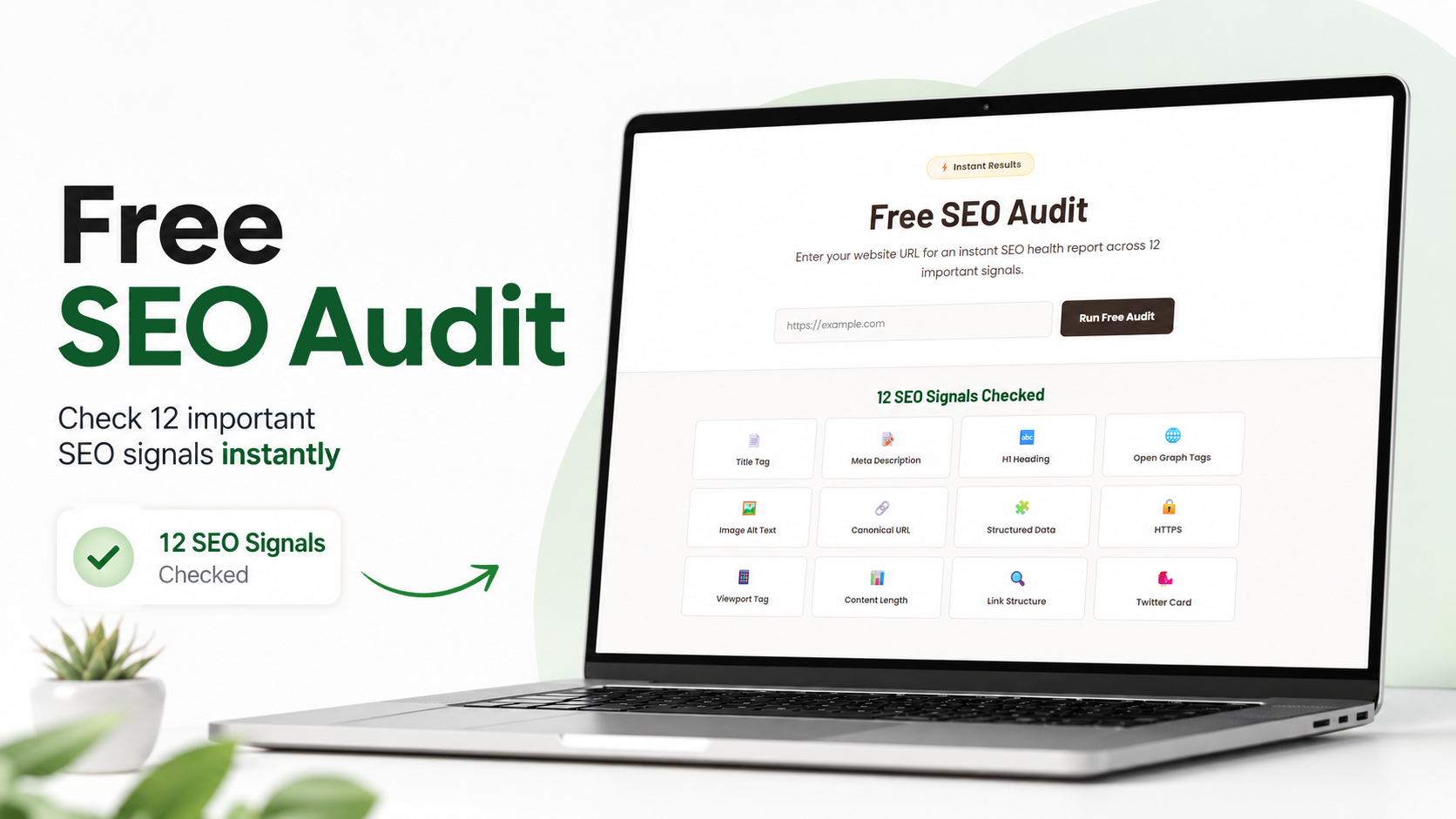
And if you'd rather see how your own website performs while you're reading, you can run your website through our Free SEO Audit Tool. It instantly analyzes these 12 signals, provides an overall SEO health score, highlights warnings or failures, and gives you actionable recommendations for areas that may need improvement.
What Does a Free SEO Audit Actually Check?
An SEO audit looks beneath the surface of your website to identify issues that may affect how search engines understand your pages and how visitors experience your site.
Rather than focusing on just one ranking factor, a useful audit reviews several important signals across your website. These signals can reveal technical problems, missing optimization elements, weak content structure, and other issues that may be limiting your visibility.
Our Free SEO Audit Tool checks 12 important SEO signals and organizes the results into an easy-to-read report so you can quickly see what’s working and what may need attention.
| SEO Signal | What It Checks |
|---|---|
| Title Tag | Whether your page has a properly formatted title tag. |
| Meta Description | Whether your page includes a search-friendly meta description. |
| H1 Heading | Whether your page has a clear primary heading structure. |
| Open Graph Tags | Whether your page is properly prepared for social sharing. |
| Image Alt Text | Whether your images include descriptive ALT attributes. |
| Canonical URL | Whether your page identifies the preferred URL for search engines. |
| Structured Data | Whether schema markup is present on the page. |
| HTTPS | Whether your website is served securely. |
| Viewport Tag | Whether your website is configured properly for mobile devices. |
| Content Length | Whether your page contains enough content for search engines to understand its purpose. |
| Link Structure | Whether your page includes a healthy internal linking structure. |
| Twitter Card | Whether your page includes metadata used when content is shared on X. |
These signals don’t tell the entire story of SEO, but they provide a useful snapshot of your website’s current foundation. A page can pass most of these checks and still need improvement in areas such as keyword targeting, content quality, backlinks, local SEO, or competition.
The value of an audit is that it gives you a starting point. Instead of guessing what might be wrong with your website, you can identify specific areas that deserve a closer look.
If you want to see how your own website performs, run your domain through our Free SEO Audit Tool and review your score, warnings, and actionable recommendations in just a few moments.
How to Read Your SEO Audit Results
Running an SEO audit is only useful if you understand what the results are telling you.
Our free SEO audit is designed to make that easier by organizing your results into clear scores, warnings, and recommendations. Instead of giving you a long list of technical issues, the report helps you quickly identify which areas of your website are performing well and which ones may need attention.
At the top of your report, you’ll see an Overall SEO Score, along with separate scores for areas such as On-Page SEO, Technical SEO, Content, and Social Tags. You’ll also see your Domain Rating, page statistics, and a breakdown of each SEO signal that was checked.
| Result | What It Means |
|---|---|
| Pass | The signal was detected and appears to meet the audit’s criteria. |
| Warning | The element exists, but something may need to be reviewed or improved. |
| Fail | An important SEO element may be missing or not configured correctly. |
| Actionable Recommendation | A specific issue the audit believes deserves your attention. |
For example, a warning about your H1 structure doesn’t necessarily mean your website is performing poorly. It simply gives you a specific area to review. Likewise, a high overall score doesn’t guarantee that your website will rank at the top of Google. Factors such as competition, keyword targeting, content quality, backlinks, and local SEO also play an important role in search visibility.
Think of your SEO score as a health check, not a Google ranking score.
The goal is to help you understand your website’s current foundation, identify obvious issues, and decide which improvements may be worth prioritizing.
If you haven’t already, run your website through our Free SEO Audit Tool and use your results as a starting point for reviewing your SEO health. Then focus first on any failed signals, followed by warnings and recommendations that may be limiting your website’s performance.
What Should You Do If Your SEO Audit Finds Problems?
Seeing warnings or failed checks in an SEO audit can feel a little intimidating, but the good news is that most issues can be addressed once you know what to look for.
The key is to prioritize. Not every warning carries the same weight, and trying to fix everything at once can make the process more confusing than it needs to be. Start with the issues that may directly affect how search engines understand or access your website, then work through the remaining recommendations.
| Priority | What to Focus On |
|---|---|
| High Priority | Missing title tags, missing H1 headings, HTTPS issues, canonical problems, or other technical issues that may affect crawlability or page structure. |
| Medium Priority | Weak meta descriptions, missing image ALT text, limited internal linking, or content that may need improvement. |
| Lower Priority | Social sharing elements such as Open Graph tags or Twitter Cards that improve how your pages appear when shared online. |
Once the obvious issues are corrected, it’s worth looking beyond the audit itself. A website can pass every technical check and still struggle to rank if the content doesn’t match what customers are searching for, the site lacks authority, or competitors have stronger SEO strategies.
That’s why an SEO audit should be viewed as a starting point, not the entire strategy.
If your audit reveals several issues or you’re not sure which improvements to prioritize, our Search Engine Optimization (SEO) Services can help identify what’s holding your website back and create a more complete strategy for improving search visibility over time.
A Good SEO Score Doesn’t Always Mean High Rankings
Getting a high score on an SEO audit is a great sign, but it doesn’t automatically mean your website will rank at the top of Google.
An audit score reflects the signals the tool is checking. It can show that your title tags are in place, your site uses HTTPS, your headings are structured properly, your images have ALT text, and other technical or on-page elements are configured correctly.
But rankings depend on much more than technical health.
Google also considers factors such as how well your content matches what people are searching for, the quality and usefulness of your pages, the authority of your website, your backlink profile, local relevance, and the strength of the competitors already ranking for your target keywords.
| A Strong SEO Audit Score Can Tell You... | It Cannot Guarantee... |
|---|---|
| Your basic SEO foundation is healthy | First-page Google rankings |
| Important technical signals are present | That you're targeting the right keywords |
| Your page structure is generally organized | That your content is better than your competitors |
| Major on-page issues may be limited | That your website has enough authority |
| Your website is ready for deeper optimization | Immediate increases in traffic or leads |
Think of it this way: a strong audit score means your website has a better foundation to build on. It doesn’t mean the work is finished.
That distinction is important because SEO is not a single checklist. Technical optimization, content strategy, keyword targeting, backlinks, local SEO, and ongoing improvements all work together over time.
If your website receives a strong score but you’re still struggling to generate organic traffic or rank for important searches, that’s usually a sign that the next step is to look beyond the technical basics and evaluate your broader SEO strategy.
And if you haven’t checked your website yet, you can run your domain through our Free SEO Audit Tool to get a quick snapshot of your current SEO foundation and identify any obvious areas that may need attention.
Frequently Asked Questions About SEO Audits
If you’ve never run an SEO audit before, it’s normal to have questions about what the results mean and how often you should check your website. Here are answers to some of the most common questions.
Start With a Clear Picture of Your Website’s SEO Health
You don’t need to guess whether your website has SEO problems.
A simple audit can give you a much clearer picture of what’s working, what may need attention, and where your website could be improved. From missing metadata and weak heading structure to technical issues and content gaps, even small problems can add up over time.
The most important thing is to use your audit as a starting point. A score gives you direction, but the real value comes from understanding the issues behind that score and deciding which improvements will have the greatest impact on your website.
If you haven’t checked your site yet, run it through our Free SEO Audit Tool and review your results. You’ll receive an instant snapshot of your website’s SEO foundation, along with warnings and recommendations that can help you identify potential opportunities for improvement.
If your audit uncovers several issues or you’re not sure what to fix first, our Search Engine Optimization (SEO) Services can help you build a more complete strategy around technical optimization, content, authority, and long-term search visibility.
Ready to see how your website performs? Run Your Free SEO Audit and get your results in just a few moments.