
Clicks Aren’t Customers: How to Know If Your Google Ads Are Actually Making Money
Share this article
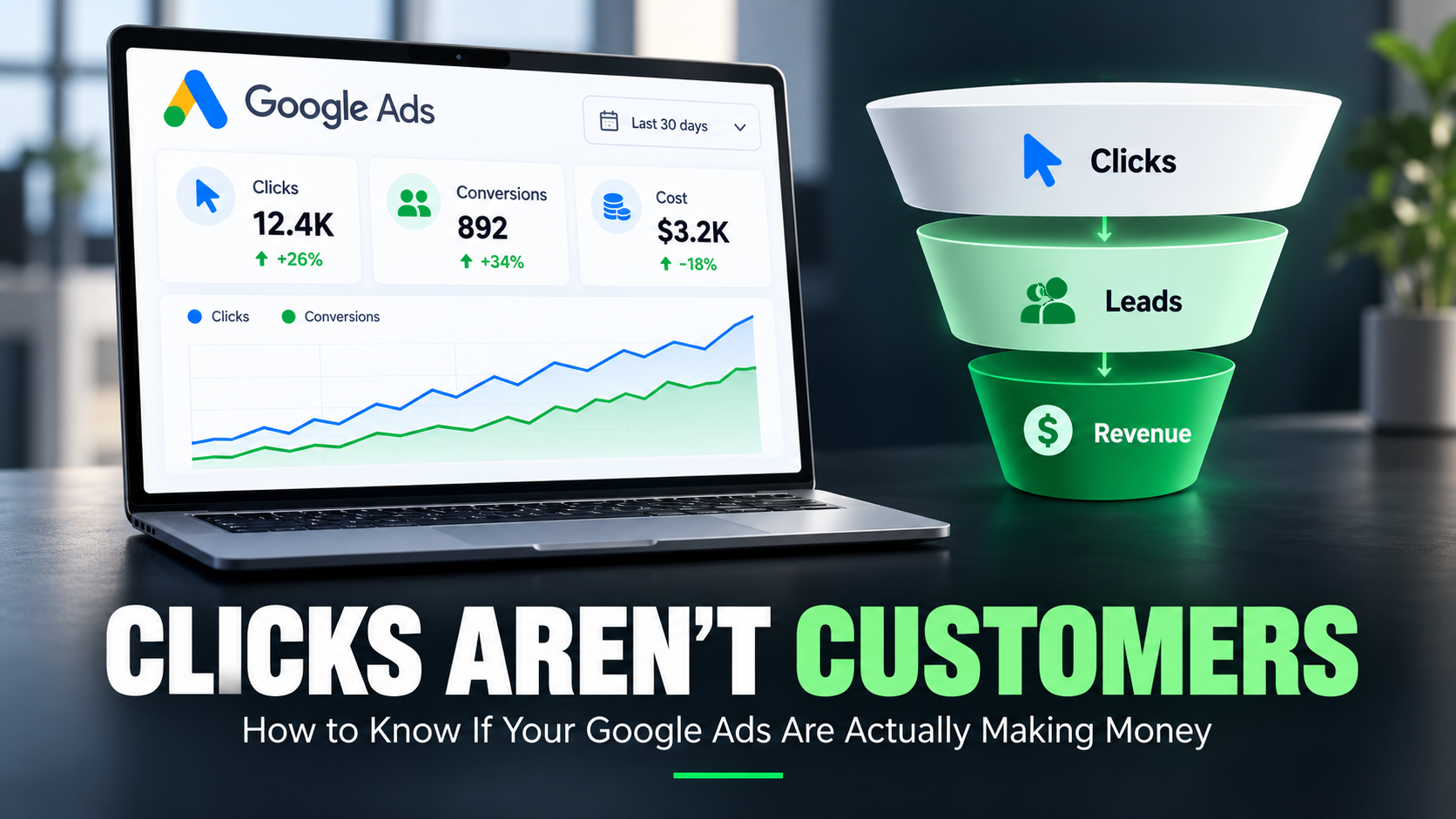
Google Ads can generate clicks, phone calls, form submissions, and other conversions, but those numbers do not always tell you whether the campaign is actually profitable. For service businesses, the real question is whether those conversions are turning into qualified leads, booked appointments, and paying customers. A campaign can look successful inside Google Ads while still producing weak lead quality, spam, missed calls, or inquiries that never become revenue.
That is why measuring Google Ads performance requires looking beyond surface-level metrics. Businesses need to understand what counts as a meaningful conversion, how quickly leads are being followed up with, how many inquiries are actually qualified, and what it ultimately costs to acquire a new customer. When those pieces are connected, it becomes much easier to understand whether your advertising budget is generating real business growth.
In this guide, we’ll explain how to measure Google Ads ROI from the first click through the final sale, including conversion tracking, lead quality, response time, offline sales, and customer acquisition cost. If you are already running paid campaigns and want a more complete strategy for tracking and improving performance, our Google Ads Management Services can help connect campaign data with the actions that matter most to your business.
What Counts as a Google Ads Conversion?
A Google Ads conversion is an action a potential customer takes after interacting with your ad. For service businesses, that can include a phone call, contact form submission, appointment request, quote request, or another action that shows genuine interest in your services.
Not every conversion has the same value. A qualified lead who is ready to book is much more valuable than a spam form, accidental call, or inquiry for a service you do not offer. That is why businesses should define conversions around the actions that are most closely connected to revenue.
Common Google Ads Conversions for Service Businesses
- Phone Calls: especially important for businesses that rely on direct inquiries.
- Contact Form Submissions: useful for quote requests, consultations, and service questions.
- Appointment Requests: valuable for healthcare, legal, fitness, and professional services.
- Landing Page Conversions: when a visitor completes the specific action the campaign was built to generate.
- Qualified Leads: prospects who meet your business criteria and are worth following up with.
- Closed Customers: the most important outcome when measuring whether the campaign is actually profitable.
A strong Google Ads strategy should go beyond counting the first action. The real goal is to understand which campaigns, keywords, and ads are producing qualified leads and paying customers, not just activity inside the dashboard.
For lead-generation campaigns, accurate conversion tracking often depends on having a dedicated landing page and thank-you page in place. If your website was built by The Business Theory, we can create those pages for an additional fee. Once those pages are available, our Google Ads Management Services include conversion tracking setup and ongoing conversion tracking audits so performance can be measured more accurately.
Why Are My Google Ads Getting Conversions but Not Customers?
If Google Ads is reporting conversions but your business is not seeing more customers, the problem may be happening after the conversion. A tracked action such as a phone call or form submission only shows that someone responded to the ad. It does not prove that the lead was qualified, contacted quickly, booked an appointment, or completed a purchase.
For service businesses, this is one of the most important distinctions to understand. A campaign can generate plenty of activity while still producing weak business results if the leads are poor quality, the follow-up process is slow, or the conversion being tracked is too broad.
Common Reasons Conversions Do Not Become Customers
- The lead was not qualified. The person may be outside your service area, looking for a service you do not offer, or unable to afford the service.
- The response time was too slow. Many leads contact more than one business, so delayed follow-up can cause a good lead to choose a competitor instead.
- The conversion was too easy to trigger. A click-to-call or form interaction may be counted even if the person never becomes a serious prospect.
- The landing page attracted the wrong expectation. If the ad promises one thing but the page communicates something different, lead quality can suffer.
- Spam or duplicate leads were counted. Not every tracked form or call represents a real customer opportunity.
- The sales process broke down after the lead came in. Even strong leads can be lost if calls are missed, follow-up is inconsistent, or there is no clear process for moving prospects toward a sale.
The Difference Between a Conversion and a Qualified Lead
A conversion is the action Google Ads records.
A qualified lead is a prospect who actually fits your business and has a realistic chance of becoming a customer.
That difference matters because ten conversions can look impressive in a report, but if only two are qualified, the business should be evaluating those two leads rather than treating all ten conversions equally.
This is why good Google Ads measurement should follow the customer journey beyond the initial click or form submission. The closer you can connect campaign data to qualified leads, booked appointments, and actual sales, the better you can understand whether your advertising is producing meaningful results.
Our Google Ads Management Services include conversion tracking setup and ongoing tracking audits so campaigns can be evaluated using more than surface-level metrics.
How Do You Measure Google Ads ROI for a Service Business?
Google Ads ROI measures whether the revenue generated from your advertising is greater than what you spent to acquire those customers. For service businesses, that means looking beyond clicks and form fills and connecting ad spend to qualified leads, booked jobs, and actual sales.
The simplest way to think about it is:
Google Ads ROI = Revenue Generated From Google Ads − Total Google Ads Cost
Your total cost should include both the money paid to Google for ad spend and, if applicable, the agency management fee.
What Numbers Should You Track?
To understand whether your campaign is actually profitable, monitor the full path from ad click to customer:
- Ad Spend — how much you paid Google to run the campaign.
- Conversions — tracked actions such as calls, forms, or appointment requests.
- Qualified Leads — conversions that actually match your business criteria.
- Booked Appointments or Jobs — leads that move forward.
- Closed Sales — customers who actually purchase.
- Revenue — the money generated from those customers.
- Cost Per Acquired Customer — how much it cost to gain one paying customer.
Why Cost Per Lead Is Not Enough
Cost per lead can be useful, but it can also be misleading.
A campaign that generates leads at $30 each may look stronger than one generating leads at $70 each. But if the $30 leads are mostly spam or low quality and the $70 leads regularly turn into paying customers, the more expensive leads may actually be far more profitable.
That is why the most valuable metric is often cost per acquired customer, not simply cost per conversion.
Example of Google Ads ROI
Imagine a service business spends:
- $2,000 in Google Ads
- $750 in management fees
- $2,750 total advertising cost
The campaign generates five new customers who each produce $1,000 in revenue.
That is $5,000 in revenue from a $2,750 investment.
Looking at the full customer journey gives the business a much clearer picture than simply saying the campaign generated 25 conversions.
Our Google Ads Management Services help businesses track and evaluate campaign performance using meaningful conversion data so decisions can be based on lead quality and business results, not clicks alone.
How Does Lead Response Time Affect Google Ads ROI?
Lead response time can have a major impact on whether a Google Ads conversion ever turns into revenue.
For service businesses, many prospects are contacting more than one company at the same time. If someone fills out a form or calls after clicking your ad and does not receive a timely response, they may simply move on to the next business.
Why Fast Follow-Up Matters
A lead is often most valuable when the person is still actively looking for help.
Fast follow-up can improve the chances of:
- Reaching the prospect before a competitor
- Answering questions while interest is still high
- Booking an appointment sooner
- Confirming whether the lead is qualified
- Moving the customer further into the sales process
This is especially important for urgent service industries such as plumbing, restoration, pest control, legal services, medical appointments, and other businesses where customers may be looking for immediate help.
What Happens When Follow-Up Is Too Slow?
A campaign may appear to be producing strong results inside Google Ads while the business sees very little revenue if leads are not being handled quickly.
Common problems include:
- Missed phone calls
- Contact forms sitting unanswered
- No follow-up after the first attempt
- Slow appointment scheduling
- No clear process for tracking whether a lead became a customer
In those situations, the advertising campaign may not be the only issue. The lead-handling process may also be affecting ROI.
Track What Happens After the Conversion
To understand the real value of your Google Ads campaigns, your tracking should not stop when a form is submitted or a phone call comes in.
Whenever possible, businesses should also monitor:
- Whether the lead was contacted
- How quickly the lead was contacted
- Whether the lead was qualified
- Whether an appointment was booked
- Whether the appointment was completed
- Whether the lead became a paying customer
That information helps separate marketing performance from sales follow-up performance.
A strong campaign can generate good opportunities, but the business still needs a reliable process for turning those opportunities into revenue. Our Google Ads Management Services can help you measure campaign performance more accurately, while your internal follow-up process determines how many of those leads ultimately become customers.
Why Offline Conversion Tracking Matters for Service Businesses
For many service businesses, the most valuable part of the customer journey happens after the initial Google Ads conversion.
A person may submit a form, call the business, or request an appointment online, but Google Ads does not automatically know whether that lead was qualified, booked, or became a paying customer. Offline conversion tracking helps connect those later outcomes back to the original ad interaction.
What Is Offline Conversion Tracking?
Offline conversion tracking connects real-world sales activity back to your advertising data.
For example, a customer may:
- Click a Google Ad
- Submit a contact form
- Speak with your team
- Book an appointment
- Complete the service
- Become a paying customer
Without offline tracking, Google Ads may only see the form submission.
With a stronger tracking setup, the business can record which leads became qualified or closed customers and use that information to better understand which campaigns are producing real revenue.
Why This Matters for Lead-Generation Businesses
Better Data Can Lead to Better Decisions
When you know which leads actually became customers, you can start answering more valuable questions:
- Which keywords generated the best customers?
- Which campaigns produced the most revenue?
- Which ads attracted low-quality leads?
- Which service areas performed best?
- What was the true cost to acquire a customer?
That gives you a much clearer picture of Google Ads ROI than simply looking at clicks or form submissions.
Our Google Ads Management Services include conversion tracking setup and ongoing tracking audits to help ensure important campaign actions, such as form submissions and other defined conversions, are being recorded accurately.
How Do You Calculate Cost Per Acquired Customer From Google Ads?
Cost per acquired customer tells you how much you spent to gain one actual paying customer from your Google Ads campaigns. For service businesses, this is often a more useful profitability metric than cost per click or cost per lead because it connects advertising spend to real revenue.
The basic formula is:
Cost Per Acquired Customer = Total Google Ads Cost ÷ Number of New Customers
Your total Google Ads cost should include the ad spend paid to Google and, if you are working with an agency, the management fee as well.
Example of Cost Per Acquired Customer
Why Cost Per Lead Can Be Misleading
A low cost per lead can look impressive, but it does not automatically mean the campaign is profitable.
For example:
- Campaign A generates 20 leads at $40 per lead, but only 2 become customers.
- Campaign B generates 10 leads at $70 per lead, but 5 become customers.
Campaign B has the higher cost per lead, but it may actually produce a much lower cost per acquired customer and stronger revenue.
That is why businesses should avoid judging campaign performance based on one metric alone.
What Is a Good Cost Per Acquired Customer?
There is no universal “good” cost per acquired customer.
The right number depends on:
- Your average customer value
- Profit margins
- Repeat business
- Lifetime customer value
- Service type
- Geographic market
- Sales close rate
The goal is to understand how much you can afford to spend to acquire a customer while still maintaining a healthy return.
Our Google Ads Management Services include budget management, conversion tracking, performance reviews, and reporting so campaign decisions can be based on more than clicks and impressions alone.
How Do You Know If Your Google Ads Leads Are Actually Good Quality?
A Google Ads campaign can generate plenty of leads and still underperform if those leads are not a good fit for your business. For service companies, lead quality matters just as much as lead volume because the goal is not simply to generate more inquiries — it is to generate more opportunities that can realistically become customers.
A good-quality lead usually matches your service, location, budget, and timing requirements. A low-quality lead may be outside your service area, looking for something you do not offer, submitting spam, or simply not ready to buy.
What Makes a Lead Qualified?
A lead is generally more valuable when:
- They need a service you actually provide
- They are located within your service area
- They have a realistic budget
- They are ready to take the next step
- They provide valid contact information
- They respond to follow-up
The exact definition of a qualified lead will vary by business, which is why it is important to decide what “qualified” means before judging campaign performance.
Why Spam and Irrelevant Leads Matter
Spam leads and irrelevant inquiries can make campaign reports look better than the business results actually are.
For example, if Google Ads reports 30 conversions but 10 are spam and another 8 are outside your service area, the campaign did not really generate 30 useful opportunities.
That is why businesses should review lead quality alongside conversion volume.
Questions to Ask About Lead Quality
When reviewing campaign performance, ask:
- How many leads were real?
- How many were qualified?
- How many were contacted?
- How many booked?
- How many became paying customers?
- Which keywords or campaigns produced the strongest leads?
Those questions give you a much clearer picture than simply looking at the conversion count.
Our Google Ads Management Services include conversion tracking setup, tracking audits, budget management, campaign optimization, and performance reporting so you can better understand how your ads are performing beyond clicks alone.
Which Google Ads Metrics Actually Matter for ROI?
Google Ads gives you a lot of data, but not every metric deserves the same amount of attention.
For service businesses, the most useful metrics are the ones that help connect advertising activity to real business outcomes. Clicks and impressions can show whether people are seeing and interacting with your ads, but they do not tell you whether the campaign is generating qualified leads or profitable customers.
Metrics Worth Paying Attention To
- Click-Through Rate (CTR) — shows how often people click your ad after seeing it.
- Cost Per Click (CPC) — tells you how much you are paying, on average, for each click.
- Conversion Rate — shows how often clicks turn into tracked actions such as calls or form submissions.
- Cost Per Conversion — helps you understand what you are paying for each tracked conversion.
- Qualified Lead Rate — shows how many conversions are actually useful opportunities.
- Booked Appointment or Job Rate — helps connect leads to meaningful next steps.
- Cost Per Acquired Customer — shows what it costs to gain an actual paying customer.
- Revenue From Google Ads — helps determine whether the campaign is generating enough value to justify the investment.
Why Clicks and Impressions Are Not Enough
Clicks and impressions are still useful, but they are best viewed as early-stage signals.
A campaign can generate thousands of impressions and hundreds of clicks without producing profitable results. That is why businesses should avoid treating traffic alone as proof that Google Ads is working.
The more important question is:
What happened after the click?
Did the visitor become a lead? Was the lead qualified? Did they book? Did they buy?
That is the chain that ultimately determines ROI.
Use Metrics Together, Not in Isolation
No single metric tells the whole story.
A high CTR may mean your ad is compelling, but if conversion rate is low, the landing page or offer may need attention. A low cost per lead may look great, but if those leads never become customers, the campaign may still be inefficient.
The strongest analysis looks at the full funnel from ad visibility to final sale.
Our Google Ads Management Services include ongoing performance reviews, budget management, conversion tracking audits, and monthly reporting so campaign data can be evaluated with more context than clicks alone.
What Should You Do If Your Google Ads Are Getting Conversions but Not Making Money?
If your Google Ads campaign is generating conversions but not enough revenue, the solution is not always to increase the budget. The better approach is to identify where the funnel is breaking down between the click, the lead, and the final sale.
For service businesses, that usually means reviewing both the advertising data and what happens after the lead reaches the business.
Start With Lead Quality
Look at the conversions coming in and ask:
- Are these real inquiries?
- Are they within your service area?
- Are they asking for services you actually provide?
- Are they qualified to buy?
- Are they becoming appointments or estimates?
If most conversions are poor quality, the campaign may need changes to keyword targeting, negative keywords, audience settings, ad copy, or location targeting.
Review the Landing Page
If people are clicking but not converting, the landing page may be creating friction.
Check whether the page:
- Matches the message in the ad
- Clearly explains the service
- Loads quickly
- Works well on mobile
- Includes a strong call-to-action
- Makes the next step obvious
Our Google Ads Management Services include landing-page recommendations as part of ongoing campaign management.
Check the Follow-Up Process
If good leads are coming in but not turning into customers, the issue may be happening after the campaign has done its job.
Review:
- How quickly leads are contacted
- Whether missed calls are followed up
- How many contact attempts are made
- Whether appointments are being booked
- Whether someone is tracking why leads do not close
That helps separate an advertising problem from a sales-process problem.
Make Sure Conversion Tracking Is Accurate
Incorrect tracking can make a campaign appear stronger or weaker than it actually is.
For example, if Google Ads is counting actions that do not represent real leads, your conversion numbers may look healthy even when the business is not receiving enough meaningful inquiries.
Our Google Ads Management Services include conversion tracking setup and ongoing tracking audits to help ensure defined campaign actions, such as form submissions, are being recorded correctly.
Optimize for Business Results, Not Just More Activity
The goal is not simply to generate more clicks or more conversions.
The goal is to improve the quality of the funnel:
Click → Conversion → Qualified Lead → Appointment → Customer → Revenue
When you understand which stage is underperforming, it becomes much easier to decide what needs to change.
Frequently Asked Questions About Measuring Google Ads ROI
For service businesses, Google Ads performance can look confusing when the dashboard shows conversions but the business is not seeing the same number of customers. These are some of the most common questions business owners ask when trying to understand whether their campaigns are actually profitable.
Measure Google Ads by Customers and Revenue, Not Just Conversions
Google Ads can generate useful activity, but the real value of a campaign is determined by what happens after the click.
For service businesses, that means looking beyond impressions, clicks, and even conversions. A successful campaign should ultimately help produce qualified leads, booked appointments, paying customers, and enough revenue to justify the total advertising investment.
The most useful way to evaluate performance is to follow the entire customer journey:
Click → Conversion → Qualified Lead → Appointment → Customer → Revenue
When you can see where leads are dropping off, it becomes much easier to understand whether the issue is the campaign itself, the landing page, lead quality, follow-up speed, or the sales process.
At The Business Theory, our Google Ads Management Services include conversion tracking setup, ongoing tracking audits, campaign optimization, budget management, landing-page recommendations, and monthly reporting to help businesses understand how their campaigns are performing beyond surface-level metrics.
Ready to Get a Clearer Picture of Your Google Ads Performance?
If your Google Ads account shows conversions but you are not seeing enough customers, it may be time to look more closely at what those conversions actually represent and where the customer journey is breaking down.
Explore our Google Ads Management Services or Contact The Business Theory to learn more about how we manage, track, and optimize campaigns for lead-generation businesses.