Service Pages vs. Blog Posts: Which One Helps Local Businesses Get More Leads?
Share this article
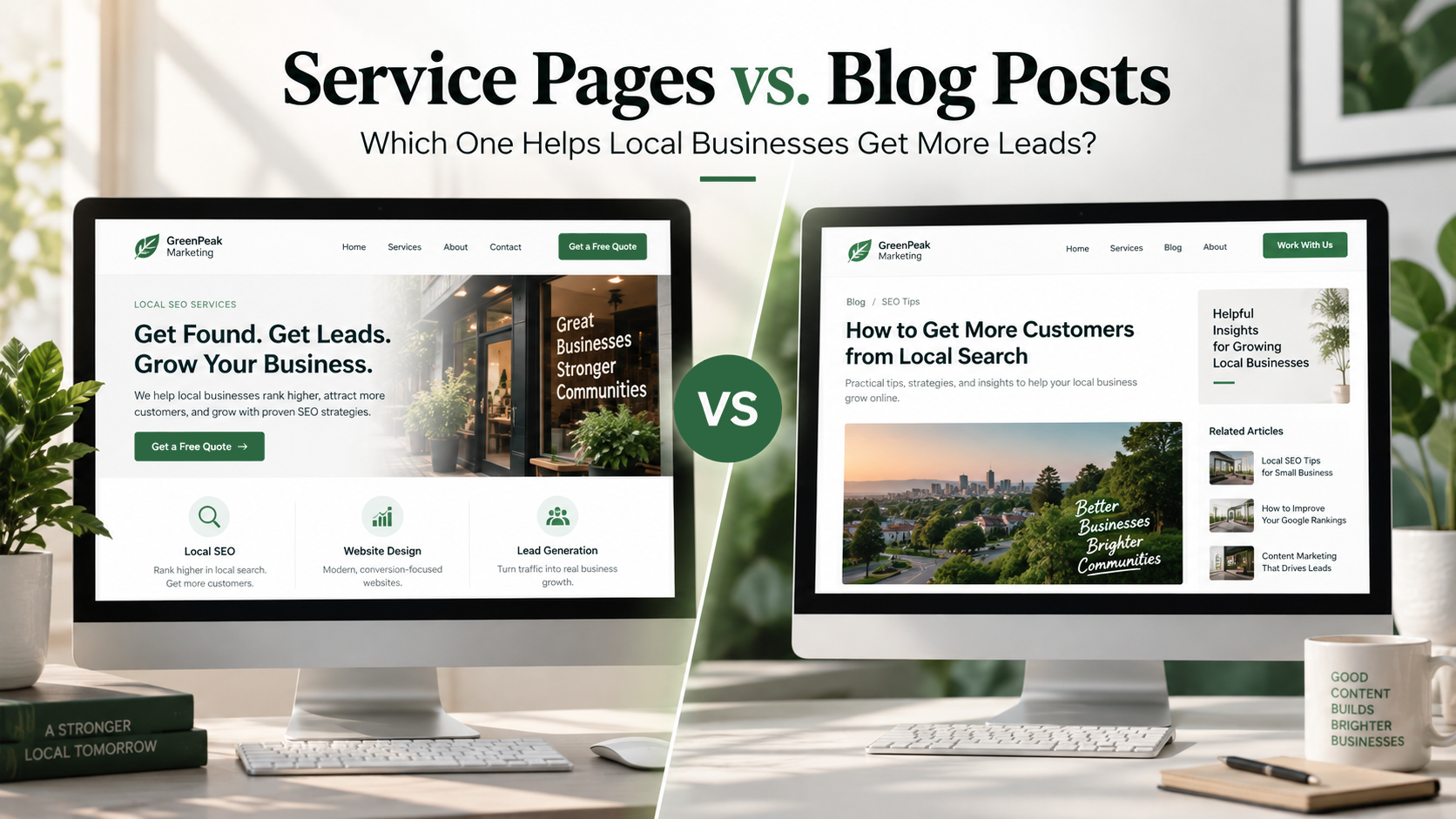
If you’re investing in SEO, one of the most common questions is whether you should keep adding blog articles or focus on building out more service pages.
The answer depends on what your website is missing. Service pages are typically designed to target high-intent searches from people looking for a specific service, while blog posts help answer questions, build topical authority, and attract visitors earlier in the decision-making process.
In this guide, we’ll break down the difference between service pages and blog content, explain how each one supports SEO and lead generation, and help you decide where your next marketing dollar is likely to have the biggest impact.
What Is the Difference Between a Service Page and a Blog Post?
A service page explains a service your business offers and is usually designed to attract people who may be ready to contact or hire you. A blog post is educational content that answers questions, explains topics, and helps attract people who are still researching.
Both can support SEO, but they serve different purposes in the customer journey.
What Is a Service Page?
A service page is a core website page focused on one specific service your business provides.
For example, a mold inspection company may have separate service pages for:
- Mold inspection
- Mold testing
- Indoor air quality testing
- Moisture mapping
- Post-remediation verification
Each page gives search engines and potential customers a clearer understanding of what the business actually offers.
A strong service page should explain:
- What the service is
- Who needs it
- What the process involves
- Where the service is available
- Common questions
- What action the visitor should take next
Because service pages target people who are actively looking for help, they often have stronger commercial intent than blog posts.
What Is a Blog Post?
A blog post is usually designed to answer a specific question or explain a topic related to your services.
For example:
- How much does mold testing cost?
- What is the difference between mold inspection and mold testing?
- Can mold grow behind drywall?
- How long does remediation take?
These searches may come from people who are not ready to hire a company yet, but they are actively researching a problem that your business can solve.
That gives blog content an important role in answer engine optimization (AEO) because it allows your website to provide clear answers to the exact conversational questions people are asking in Google Search, AI Overviews, voice search, and other AI-driven experiences.
Which One Is Better for SEO?
Neither one is automatically better.
Service pages help your website compete for searches with strong buying intent, while blog posts help expand your visibility around questions, problems, and informational searches.
The strongest local websites usually use both:
- Service pages attract people looking for a provider.
- Blog posts attract people looking for answers.
When those pages are connected through thoughtful internal linking, they reinforce each other and create a stronger content ecosystem.
If your website is missing important service pages, our Website Design Services can help strengthen the structure of your site. If the pages already exist but need better visibility, our Search Engine Optimization (SEO) Services can help improve how those pages are optimized and connected.
When Should a Local Business Create More Service Pages?
A local business should create more service pages when important services are missing from the website or when multiple services are being forced onto one broad page. Separate service pages give customers clearer information and give search engines a better understanding of what the business actually offers.
They are especially valuable when each service has its own search demand, process, customer questions, or geographic relevance.
Signs You May Need More Service Pages
- Several services are combined onto one page. If one page tries to explain five or six different services, none of them may get enough depth.
- Customers frequently ask about a specific service. That usually means the topic deserves its own dedicated page.
- A service has strong buying intent. People searching for a specific service are often closer to contacting a provider.
- You serve multiple service categories. Giving each category its own page can make the website easier to navigate and understand.
- Your competitors have dedicated pages for services you only mention briefly. That can be a sign your website needs more depth in those areas.
Why Service Pages Can Be Strong Lead Generators
Service pages are built around intent.
Someone searching for “mold inspection company near me” or “commercial pest control services” is usually much closer to making a decision than someone reading a general educational article.
A strong service page should make it easy for that visitor to understand the offer, trust the business, and take the next step. That is why service pages often become some of the most important conversion pages on a local business website.
If your website is missing dedicated pages for important services, our Website Design Services can help build a stronger site structure, while our Search Engine Optimization (SEO) Services can help optimize those pages for search visibility and local intent.
When Should a Local Business Invest in More Blog Content?
A local business should invest in more blog content when its core service pages are already in place and the website needs to expand its visibility around customer questions, search intent, and related topics. Blog articles help attract people earlier in the decision-making process and give your website more opportunities to appear for conversational searches.
They are especially useful for answering the exact questions potential customers ask before they are ready to call, book, or request a quote.
Signs Your Website Needs More Blog Content
- Your service pages are already complete. If your main services are clearly represented, blog content can help expand your reach beyond direct service searches.
- Customers ask the same questions repeatedly. Those questions can become articles that answer real search demand.
- You want to build topical authority. Publishing helpful content around your services can strengthen the overall relevance of your website.
- You need more AEO opportunities. Question-based articles are well suited for AI search, voice search, and answer-driven results.
- You want to support existing service pages. Blog content can internally link back to your core services and help reinforce the relationship between topics.
Blog articles usually do not convert at the same rate as high-intent service pages, but they can play an important role in bringing the right people into your website earlier.
For example, someone searching “How much does mold testing cost?” may not be ready to schedule immediately. But if your article answers the question clearly, builds trust, and naturally links to your mold testing service page, that visitor now has a much easier path from research to action.
That is why strong blog content should never exist in isolation. It should connect back to your Search Engine Optimization (SEO) Services, core service pages, and relevant conversion pages so the educational content supports the larger customer journey.
Which Generates More Leads: Service Pages or Blog Posts?
For most local service businesses, service pages usually generate leads more directly because they target people who are already searching for a specific service. Blog posts tend to attract people earlier in the research process, so their value often comes from building trust, answering questions, and guiding visitors toward a service page.
The best-performing content strategy usually does not choose one over the other. It uses service pages for conversion-focused searches and blog posts to support those pages with helpful information.
Why Service Pages Usually Convert Better
Service pages are designed around commercial intent.
Someone searching for terms such as “mold inspection company,” “pest control near me,” or “website design Miami” is usually closer to contacting a business than someone searching for a general question.
A strong service page gives that visitor the information they need to make a decision, including:
- What the service includes
- Who the service is for
- Where the service is available
- Why the business is qualified
- Common questions and concerns
- Reviews or trust signals
- A clear way to contact the company
That makes service pages an important part of a website’s lead-generation structure.
Why Blog Posts Still Matter for Leads
Blog content often reaches customers before they begin searching for a specific provider.
For example, someone may first search:
“What are the signs of mold behind drywall?”
After learning more about the problem, that same person may realize they need professional mold testing. A well-written article can then guide them naturally to the appropriate service page.
This creates a simple content journey:
Question → Helpful Answer → Relevant Service → Lead
That journey is especially important for AEO because AI-driven search increasingly surfaces content that directly answers detailed, conversational questions.
The Strongest Strategy Connects the Two
A blog should not become a collection of articles that never lead anywhere, and service pages should not exist without supporting information around them.
The strongest approach is to build content clusters where educational articles naturally support your core services through relevant internal links.
For example:
Blog: “How Much Does Mold Testing Cost?”
↓
Service Page: Mold Testing
↓
CTA: Schedule an Inspection
That structure helps customers move from research to action while also giving search engines clearer relationships between the topics on your website.
If you already have strong service pages but need a more strategic content plan around them, our Search Engine Optimization (SEO) Services can help strengthen internal linking, content structure, and topic coverage so your website works as one connected system.
Should You Spend Your Next SEO Dollar on a Service Page or a Blog Post?
If your budget only allows you to create one new piece of content, the right choice depends on what your website is missing. A local business with thin or incomplete service pages should usually strengthen those first, while a business with solid service coverage may get more value from publishing educational content that answers real customer questions.
The goal is not to choose one format forever. It is to invest in the type of page that fills the biggest gap in your current website.
Choose a Service Page First If:
- You offer a service that does not have its own page. Important services should not be buried inside a paragraph on a general Services page.
- You want to target a high-intent search. Dedicated service pages are better suited for people actively looking to hire.
- Your existing page is too broad. One page covering multiple unrelated services can make it harder for both customers and search engines to understand the offer.
- You are expanding into a new service category. A dedicated page gives that service a clear place in your website structure.
- You need a stronger conversion page. Service pages are built to move visitors toward calls, forms, appointments, or quotes.
Choose a Blog Post First If:
- Your core services already have strong pages. Once the foundation is covered, blog content can expand your reach.
- Customers are asking the same questions over and over. Those questions are strong candidates for AEO-focused articles.
- You want to support an existing service page. A blog post can answer a specific question and internally link back to the related service.
- You need more topical depth. Helpful articles can show search engines that your website covers a subject beyond a single sales page.
- You want to reach people earlier in the buying journey. Educational content can introduce your business before the customer is ready to hire.
A Simple Rule of Thumb
If the service does not have a strong dedicated page, build the service page first.
If the service page is already strong, create blog content around the questions, problems, costs, comparisons, and concerns customers have before they buy.
That approach keeps your website balanced between commercial pages that convert and educational content that attracts and nurtures potential customers.
Our Search Engine Optimization (SEO) Services can help identify which type of content your website needs most and build a strategy around service-page structure, supporting articles, internal links, and long-term search visibility.
What Happens If You Only Publish Blog Posts and Ignore Your Service Pages?
Publishing blog content without strengthening your core service pages can create a visibility gap. Your website may attract informational traffic, but if there is no strong page for the actual service someone needs, that traffic has nowhere clear to convert.
For local businesses, this can lead to a site that gets attention but not enough qualified inquiries.
Blog Traffic Does Not Automatically Equal Leads
A blog article can rank well and still produce very few conversions if it is not connected to a relevant service.
For example, an article about:
“How Often Should You Have Your Home Inspected for Mold?”
may attract useful traffic, but the visitor still needs a clear path to:
Mold Inspection Services
If that service page is weak, missing, or difficult to find, the opportunity can be lost.
Service Pages Give Search Engines a Clear Commercial Destination
Service pages help define the exact services your business provides.
They give search engines a clear place to understand:
- What the service is
- Who it is for
- Where it is offered
- What customers should expect
- How to contact the business
Without those pages, blog content may answer questions without clearly establishing that your company provides the solution.
Blogs Should Support the Service, Not Replace It
A strong content strategy uses blog posts to support the service pages that matter most.
For example:
Blog Post: “How Much Does a Home Inspection Cost?”
→
Service Page: Home Inspection Services
→
CTA: Request an Inspection
That relationship helps both customers and search engines understand how your educational content connects to your business.
If your website has a lot of blog content but weak service pages, our Website Design Services can help strengthen the structure of your site, while our Search Engine Optimization (SEO) Services can help connect your content and service pages more strategically through internal linking and topic coverage.
What Happens If You Only Build Service Pages and Never Publish Blog Content?
A website made up only of service pages may do a good job targeting people who are ready to hire, but it can miss a large part of the customer journey. Many potential customers begin with questions, comparisons, pricing research, and problem-based searches before they ever look for a specific provider.
That is where blog content helps expand your reach and gives your website more opportunities to appear for conversational, AEO-friendly searches.
You Miss Informational Search Opportunities
Service pages are usually focused on direct buying intent, while blog posts can answer the questions people ask before they are ready to contact a business.
For example, a service page may target:
“Mold Testing Services”
while blog content can answer:
- How much does mold testing cost?
- What is the difference between mold inspection and mold testing?
- Can mold make you sick?
- How long does mold testing take?
- What should you do after finding mold?
Those questions can bring in potential customers earlier and introduce them to your business before they are ready to make a decision.
You Lose AEO Opportunities
Answer-driven search relies heavily on content that clearly responds to specific questions.
Blog articles are especially useful for this because they give you room to provide concise, detailed answers in natural language. That makes them well suited for Google AI Overviews, voice search, featured snippets, and other answer-focused search experiences.
A service page can explain what you do.
A blog post can explain everything your customer wants to know before hiring you.
Your Service Pages Lose Supporting Content
Blog content can strengthen your service pages by creating relevant internal links and deeper topic coverage.
For example:
Blog: “How Much Does Pest Control Cost?”
→
Service Page: Residential Pest Control
→
CTA: Request a Quote
That structure gives customers a clear next step while helping search engines understand the relationship between the educational topic and the commercial service.
The strongest websites use blog content to support their service pages rather than treating the two as separate strategies. Our Search Engine Optimization (SEO) Services can help build that connection through AEO-focused content, internal linking, and a content strategy designed around the questions your customers are actually searching for.
Frequently Asked Questions About Service Pages vs. Blog Posts
Service pages and blog posts both support SEO, but they serve different purposes. Understanding when to use each one can help local businesses spend their content budget more strategically and build a website that attracts traffic while still generating leads.
Service Pages and Blog Posts Work Best Together
For most local businesses, the strongest SEO strategy is not choosing between service pages and blog posts. It is using both in a way that supports the customer journey from the first question to the final decision.
Service pages help attract people who are actively looking for a provider, while blog posts answer the questions that come before the sale. When those pages are connected through thoughtful internal linking, they can strengthen both search visibility and lead generation.
A simple strategy is to build your core service pages first, then create supporting blog content around the questions, costs, comparisons, and concerns customers have before they hire. That creates a natural path from question → helpful answer → service page → lead.
At The Business Theory, our Search Engine Optimization (SEO) Services can help identify the content gaps on your website, strengthen your service pages, build supporting blog content, and create a more connected internal linking strategy.
If your website structure itself needs improvement, our Website Design Services can also help create a stronger foundation for both SEO and future content growth.
If you are not sure whether your next investment should be a service page, a blog post, or a combination of both, Contact The Business Theory to discuss your goals and determine which content opportunities make the most sense for your website.