
What Is Google Ads? A Beginner's Guide for Small Businesses
Share this article
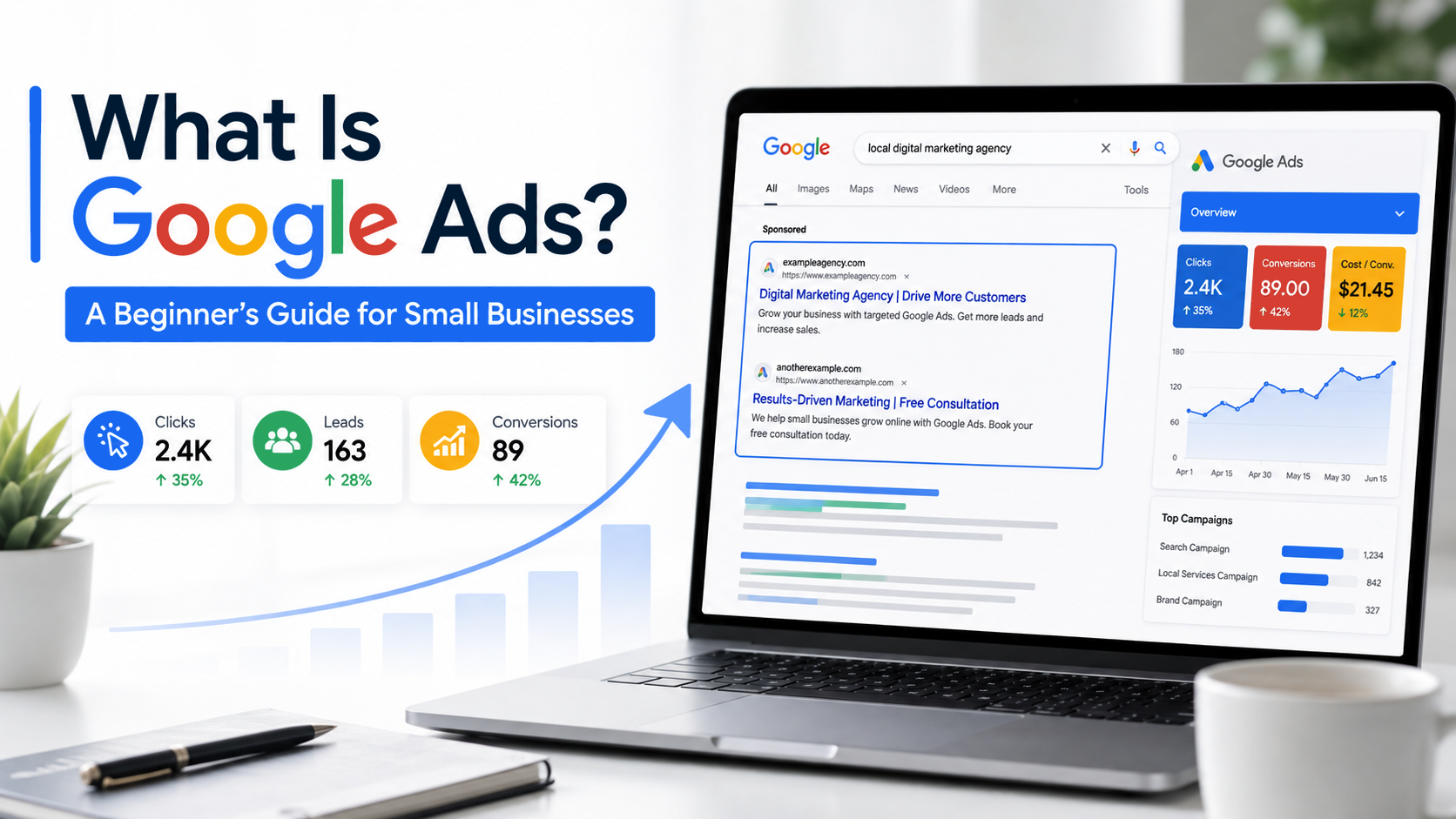
Imagine your business appearing at the very top of Google exactly when someone is searching for the products or services you offer.
That's the goal of Google Ads.
Every day, millions of people use Google to search for everything from plumbers and attorneys to restaurants, website designers, and healthcare providers. Google Ads gives businesses the opportunity to appear in front of those potential customers at the exact moment they're looking for a solution.
Unlike Search Engine Optimization (SEO), which focuses on earning visibility over time, Google Ads allows businesses to reach potential customers almost immediately by placing paid advertisements throughout Google's search results, websites, YouTube, Google Maps, and other platforms within the Google network.
For many small businesses, Google Ads can be one of the fastest ways to generate qualified leads, increase website traffic, and grow revenue. However, understanding how the platform works is essential before investing your marketing budget.
In this beginner-friendly guide, we'll explain what Google Ads is, how it works, the different types of campaigns available, and how businesses can determine whether Google Ads is the right marketing strategy for their goals.
How Does Google Ads Work?
Every time someone searches on Google, an auction happens in just a fraction of a second.
If you've ever searched for something like "website designer near me," "emergency plumber," or "personal injury lawyer," you've probably noticed that some of the first results are labeled Sponsored. Those businesses are using Google Ads to appear at the top of the search results for keywords that are relevant to their products or services.
However, Google doesn't simply give the top position to the business willing to spend the most money.
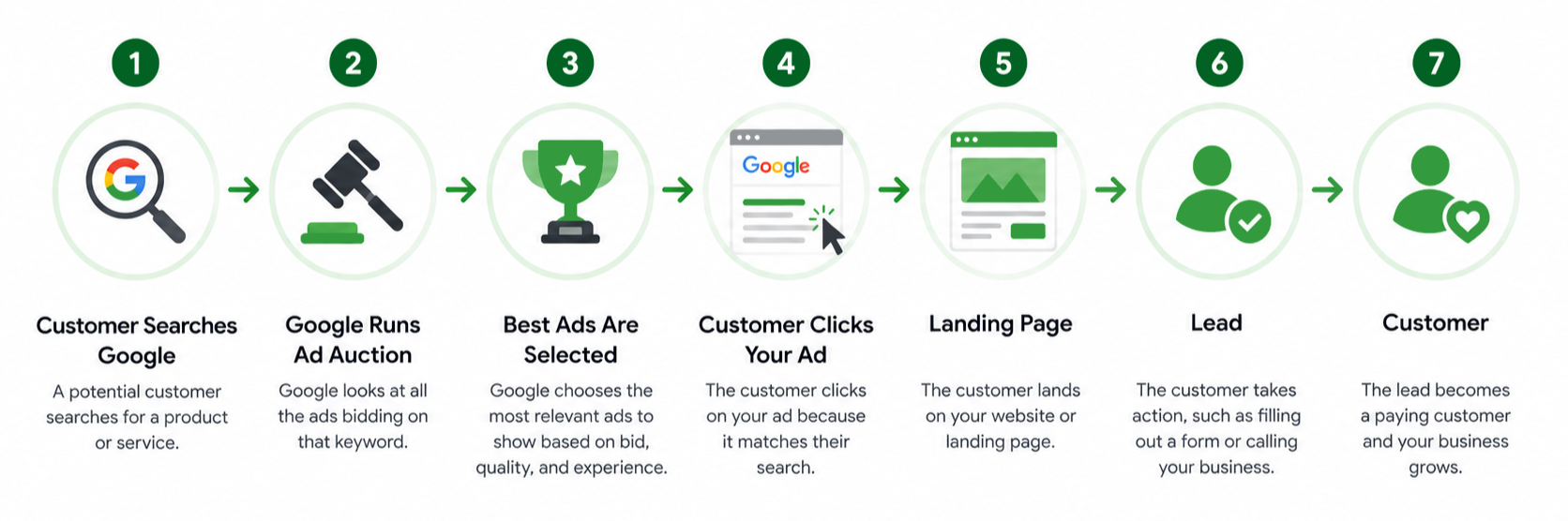
Instead, Google evaluates several factors, including your bid, the quality and relevance of your advertisement, and the quality of the page visitors are sent to after clicking your ad. The goal is to show users advertisements that are both helpful and relevant to what they're searching for.
Here's a simplified version of how the process works:
| Step | What Happens |
|---|---|
| 1. Someone Searches | A potential customer searches for a product or service on Google. |
| 2. Google Runs an Auction | Google identifies advertisers bidding on keywords related to that search. |
| 3. Ads Are Evaluated | Google considers your bid, ad quality, and landing page experience to determine which ads should appear. |
| 4. Your Ad Appears | If your ad is competitive, it may appear above or below the organic search results. |
| 5. Someone Clicks | When a user clicks your ad, they're directed to your website or landing page. |
| 6. You Pay Per Click | You're generally charged only when someone clicks on your advertisement—not simply because it was displayed. |
One of the biggest misconceptions about Google Ads is that businesses can simply spend more money to guarantee the top position. While your budget is certainly important, Google also rewards advertisers who create relevant ads and provide a positive experience after someone clicks.
That's why a successful Google Ads campaign isn't just about the advertisement itself. The page visitors land on should be fast, mobile-friendly, easy to navigate, and clearly encourage them to take the next step. A great advertisement can bring people to your website—but it's your website that ultimately helps convert those visitors into customers.
If you're planning to invest in Google Ads, having a professionally designed Website or dedicated Landing Page can significantly improve your campaign's performance and help you get more value from your advertising budget.
The Different Types of Google Ads Campaigns
When most people think about Google Ads, they picture the sponsored results that appear at the top of Google Search.
While Search Ads are one of the most popular campaign types, they're only one part of the Google Ads platform. Google offers several campaign types designed to help businesses reach potential customers at different stages of the buying journey.
Choosing the right campaign depends on your business goals, your target audience, and the products or services you offer.
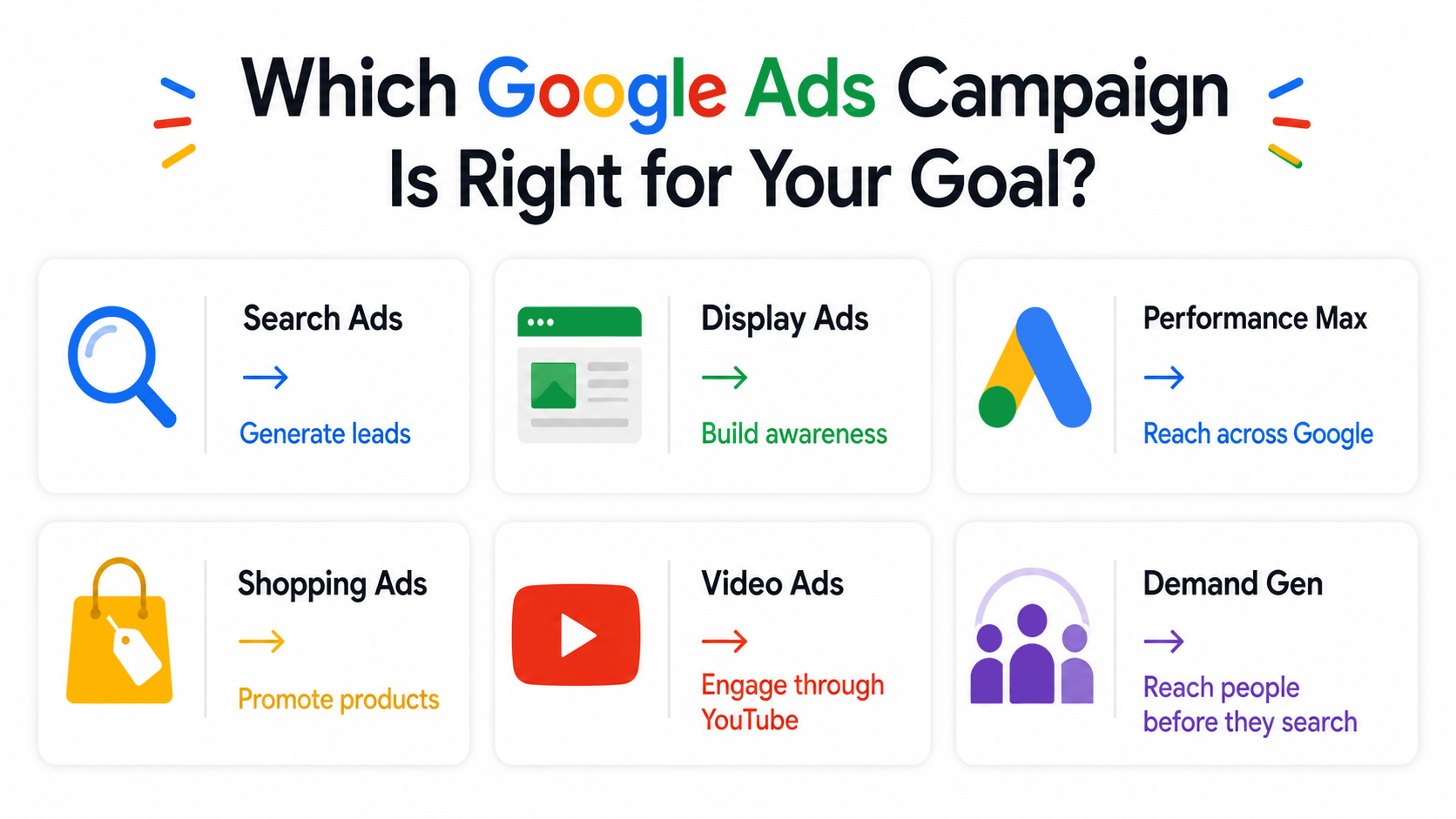
| Campaign Type | Best For | Where Ads Appear |
|---|---|---|
| Search Campaigns | Generating leads from people actively searching for your services | Google Search results |
| Display Campaigns | Building brand awareness and remarketing to previous website visitors | Millions of websites across the Google Display Network |
| Performance Max Campaigns | Maximizing conversions across multiple Google platforms with AI-driven optimization | Google Search, Display, YouTube, Gmail, Discover, and Maps |
| Shopping Campaigns | Promoting physical products with images and pricing | Google Shopping and Google Search |
| Video Campaigns | Increasing brand awareness and engagement through video advertisements | YouTube and Google video partners |
| Demand Gen Campaigns | Reaching potential customers with visually engaging ads before they actively search | YouTube, Discover, and Gmail |
Not every business needs every campaign type.
For example, a local plumber or attorney will often benefit most from Search Campaigns, since potential customers are actively looking for those services. An eCommerce business may prioritize Shopping Campaigns, while companies focused on increasing brand awareness may invest in Video, Display, or Demand Gen campaigns.
The key is choosing the campaign type that aligns with your business goals rather than trying to advertise everywhere at once.
At The Business Theory, our Google Ads Management Services include everything needed to build, launch, and optimize successful advertising campaigns. From keyword research and campaign setup to audience targeting, conversion tracking, ad copy creation, ongoing optimization, and monthly performance reporting, we help businesses maximize the value of their advertising investment while focusing on generating meaningful results.
How Does Google Decide Which Ads Show First?
Many people assume that the business with the biggest advertising budget automatically appears at the top of Google Search.
In reality, Google uses a much more sophisticated system.
Every time someone performs a search, Google runs an instant auction to determine which advertisements should appear and in what order. While your maximum bid plays a role, it's only one piece of the equation. Google also evaluates how relevant your advertisement is to the user's search and whether the page visitors land on provides a positive experience.
Google's goal is to show users the advertisements that are most likely to answer their search—not simply the advertisers willing to spend the most money.
| Factor | Why It Matters |
|---|---|
| Your Bid | The maximum amount you're willing to pay for a click. |
| Ad Relevance | How closely your advertisement matches the user's search intent. |
| Landing Page Experience | Whether your landing page is helpful, easy to navigate, mobile-friendly, and relevant to the advertisement. |
| Expected Click-Through Rate (CTR) | Google's estimate of how likely people are to click your advertisement. |
| Overall Ad Quality | Google combines multiple signals to determine which ads provide the best experience for users. |
This means a well-managed campaign with relevant keywords, compelling ad copy, and a high-quality landing page can often outperform a competitor that's simply spending more money.
That's why successful Google Ads campaigns aren't built around budget alone. They're built around strategy. Choosing the right keywords, writing compelling advertisements, creating effective landing pages, and continuously optimizing performance all work together to improve results over time.
If your website or landing page doesn't provide a great experience after someone clicks your ad, even the best advertisement may struggle to generate meaningful results. That's why Google Ads and Website Design often work hand in hand to create campaigns that attract visitors and convert them into customers.
How Much Does Google Ads Cost?
One of the biggest advantages of Google Ads is that you control how much you spend.
Unlike traditional advertising, Google Ads doesn't require a fixed monthly advertising budget. Instead, you decide how much you're comfortable investing, and Google will never exceed the budget you set for your campaigns.
However, it's important to understand that there are two separate costs involved when working with a Google Ads management company:
- Your advertising budget (ad spend) — the amount paid directly to Google each time someone clicks your advertisements.
- Your management fee — the amount paid to your marketing agency for planning, building, managing, optimizing, and reporting on your campaigns.
These are separate investments, and understanding the difference helps you set realistic expectations for your campaign.
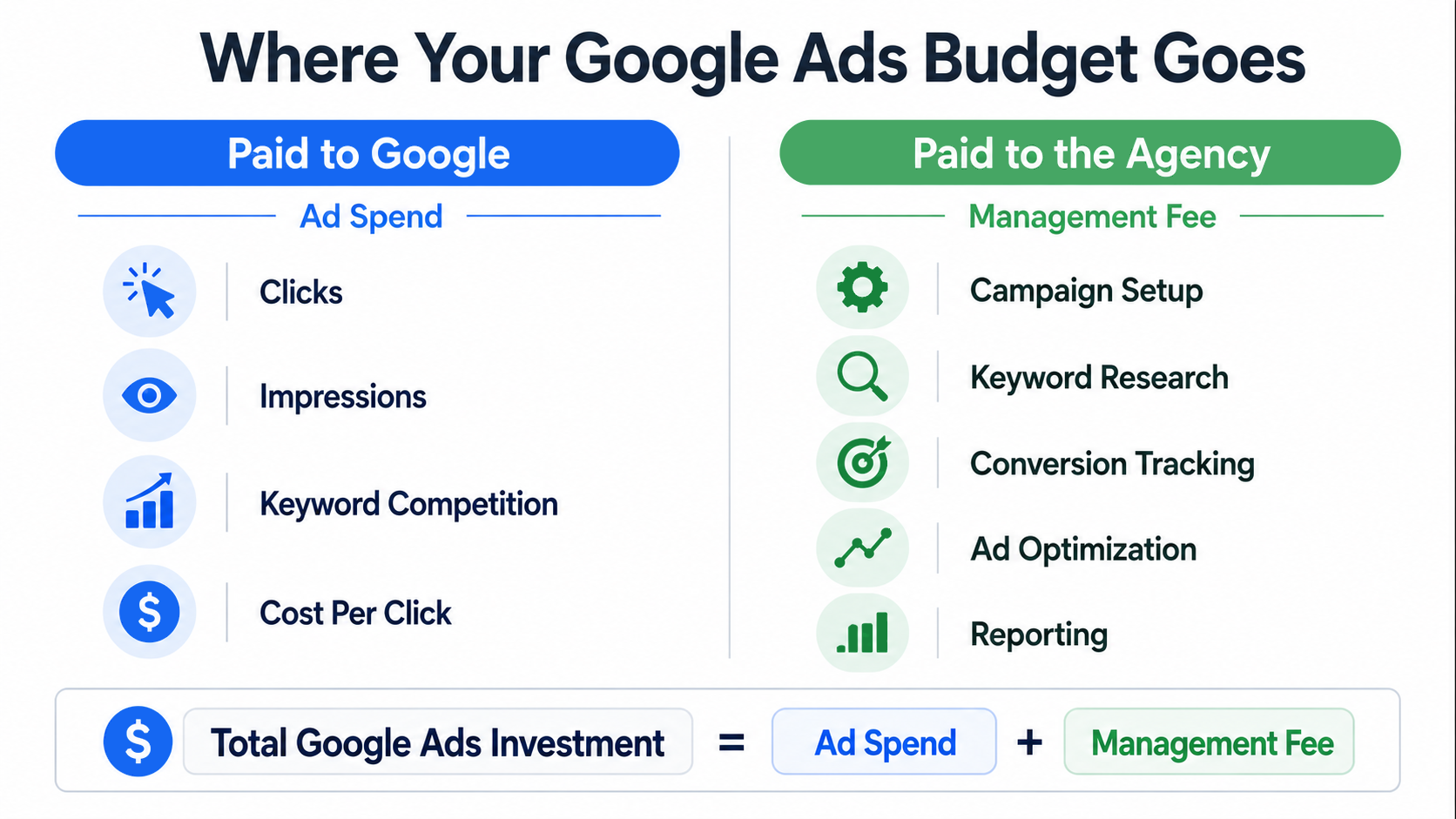
| Cost | What It Covers |
|---|---|
| Ad Spend | Your budget paid directly to Google for clicks and impressions generated by your advertisements. |
| Management Fee | Professional campaign setup, keyword research, ad creation, conversion tracking, optimization, reporting, and ongoing campaign management. |
The amount you spend on advertising depends on several factors, including:
- Your industry
- The competitiveness of your keywords
- Your geographic targeting
- Your campaign goals
- Your daily or monthly budget
For example, highly competitive industries such as legal services, insurance, and certain home services often have higher cost-per-click (CPC) because multiple businesses are competing for the same searches. Other industries may have significantly lower advertising costs while still generating excellent results.
The important thing to remember is that a larger budget doesn't automatically guarantee better performance. A well-managed campaign that targets the right audience, uses relevant keywords, and directs visitors to a high-quality landing page can often produce stronger results than a campaign with a much larger budget but poor strategy.
At The Business Theory, our Google Ads Management Services are priced separately from your advertising budget, giving you complete transparency about where your investment is going. We work with businesses of all sizes to develop campaigns that align with their goals, optimize performance over time, and make the most of every advertising dollar. Our management plans begin at $747.50 per month, plus a one-time $249 setup fee, while your ad spend is paid directly to Google based on the budget you choose.
If you'd like to see our Google Ads management plans, what's included, and which option is right for your business, explore our Google Ads Management Services for complete pricing and plan details.
Is Google Ads Right for Every Business?
Google Ads can be an incredibly effective marketing tool, but that doesn't mean it's the right solution for every business.
The best candidates for Google Ads are businesses whose customers are actively searching for the products or services they offer. When someone searches for phrases like "roof repair near me," "personal injury lawyer," or "website designer," they're often looking for a solution immediately. Google Ads allows businesses to appear at that exact moment.
However, some businesses may benefit more from long-term strategies like Search Engine Optimization (SEO), content marketing, or social media marketing, especially if they have limited advertising budgets or operate in industries where customers spend more time researching before making a decision.
Many successful businesses don't choose between Google Ads and SEO—they use both. Google Ads can generate immediate visibility while SEO helps build long-term organic traffic. Together, they create a balanced digital marketing strategy that supports both short-term and long-term growth.
| Google Ads May Be a Good Fit If... | Another Strategy May Also Be Worth Considering |
|---|---|
| You want leads quickly | You're building long-term organic visibility |
| Customers actively search for your services | You're focused on educating your audience through content |
| You have a monthly advertising budget | Your marketing budget is very limited |
| You're launching a new business or service | You're building brand awareness over time |
| You want measurable advertising performance | You prefer investing primarily in long-term marketing assets |
Rather than asking whether Google Ads is "better" than SEO, it's more helpful to ask which strategy best supports your current business goals. In many cases, the answer isn't one or the other—it's finding the right combination of both.
At The Business Theory, we help businesses develop marketing strategies based on their goals, industry, competition, and budget. Whether that includes Google Ads, Search Engine Optimization (SEO), or a combination of both, the objective is always the same: helping your business attract more qualified customers and grow sustainably.
Common Google Ads Mistakes Small Businesses Make
Google Ads can be one of the fastest ways to generate qualified leads, but it's also easy to waste money if campaigns aren't planned and managed correctly.
Many businesses assume that simply creating an ad is enough to generate results. In reality, successful campaigns require ongoing optimization, testing, and refinement. Even small mistakes can reduce performance and increase advertising costs over time.
Fortunately, most of these mistakes are preventable.
| Common Mistake | Why It Hurts Performance |
|---|---|
| Targeting Too Many Keywords | Broad targeting can attract irrelevant clicks and quickly exhaust your advertising budget. |
| Ignoring Negative Keywords | Without negative keywords, your ads may appear for searches that aren't relevant to your business, resulting in wasted ad spend. |
| Sending Traffic to the Homepage | Visitors often convert better when they're directed to a dedicated landing page instead of a general homepage. |
| Not Tracking Conversions | Without conversion tracking, it's difficult to know which ads are actually generating leads or sales. |
| Setting It and Forgetting It | Google Ads campaigns require ongoing monitoring, testing, and optimization to maintain strong performance. |
| Focusing Only on Clicks | High click volume doesn't always mean success. The real goal is generating qualified leads and measurable business results. |
One of the biggest misconceptions about Google Ads is that once a campaign is live, the work is finished. In reality, the opposite is true. The most successful campaigns are continually refined by reviewing search terms, testing new advertisements, adjusting bids, improving landing pages, and analyzing performance data.
That's why ongoing campaign management is so important. Small improvements made consistently over time can have a significant impact on your cost per lead and overall return on investment.
At The Business Theory, our Google Ads Management Services include ongoing campaign optimization, keyword refinement, audience testing, landing page recommendations, ad copy improvements, conversion tracking audits, and detailed monthly reporting to help businesses continually improve campaign performance.
Frequently Asked Questions About Google Ads
If you're considering Google Ads for your business, you probably have a few questions before getting started. Below are answers to some of the most common questions we hear from small business owners.
Turn Google Searches Into Business Opportunities
Every day, people search Google looking for businesses that can solve a problem, answer a question, or provide a service. Google Ads gives your business the opportunity to appear in front of those potential customers at the exact moment they're ready to take action.
However, running successful Google Ads campaigns involves much more than choosing a few keywords and setting a budget. The best campaigns are built on a thoughtful strategy, compelling advertisements, high-quality landing pages, accurate conversion tracking, and ongoing optimization. When all of these elements work together, Google Ads can become one of the most effective ways to generate qualified leads and grow your business.
Whether you're launching your first campaign or looking to improve an existing one, understanding how Google Ads works is the first step toward making smarter advertising decisions. The more informed you are, the better equipped you'll be to invest your marketing budget where it can have the greatest impact.
At The Business Theory, we help businesses create and manage Google Ads campaigns designed to generate measurable results. From campaign setup and keyword research to conversion tracking, audience targeting, ongoing optimization, and monthly performance reporting, our PPC management services in South Florida are designed to help businesses maximize their advertising investment while focusing on long-term growth.
If you're ready to reach more customers through Google Ads, explore our Google Ads Management Services or Contact The Business Theory to schedule a consultation. We'd be happy to discuss your business goals and help you determine whether Google Ads is the right strategy for your business.