Why Is Your Business Information Different on Google, Apple Maps, and Yelp?
Share this article
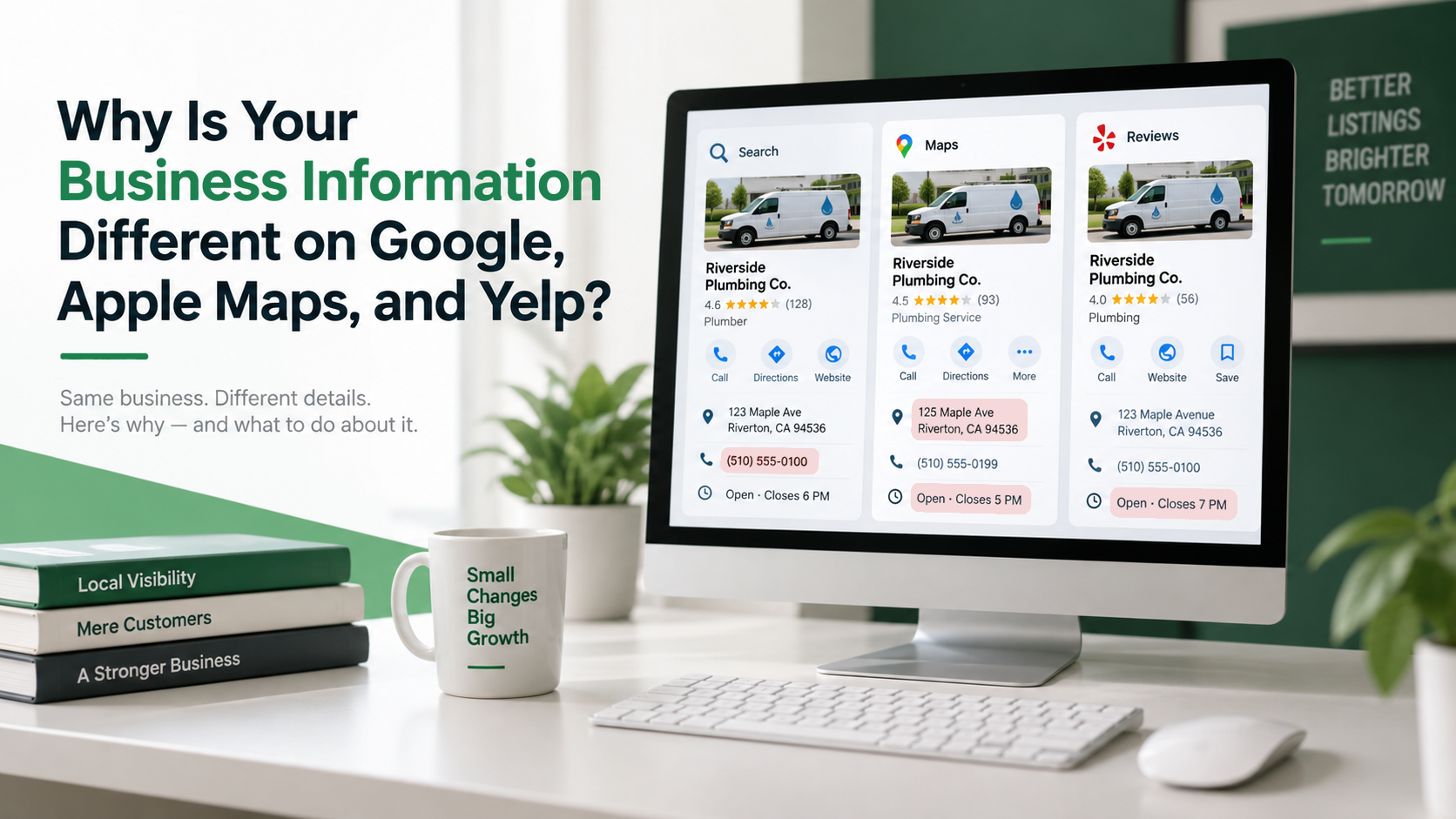
Why Is Your Business Information Different on Google, Apple Maps, and Yelp?
Yes, it is common for business information to differ across Google, Apple Maps, Yelp, Bing, and other directories. Each platform maintains separate records and may receive updates from business owners, websites, users, licensed data, partners, and older listings.
Quick answer:
Your business information can differ online because Google, Apple Maps, Yelp, Bing, and other directories maintain separate records and update them from different sources. Fixing one listing does not automatically correct every other platform, so businesses should keep a master record, update their website, claim major profiles, and monitor important listings.\
Common conflicts include old addresses, different hours, former phone numbers, incorrect website links, conflicting categories, duplicate profiles, or a business marked closed on one platform but open on another. If online listings are new to you, start with our complete guide to business directory listings for local SEO.
Most listing problems can be approached systematically. Focus on which differences matter, where the wrong information originates, and which platform needs a direct correction.
Why Is My Business Information Different Across the Internet?
There is no single button that controls every online listing. Major platforms maintain separate databases, update on different schedules, and apply their own verification and category rules.
- Independent platform databases and separate update schedules.
- Different verification requirements and platform policies.
- Publicly available and licensed data.
- User-submitted corrections and customer reports.
- Old business records and previously published listings.
- Data-distribution partners and directory networks.
- Claimed versus unclaimed listings.
That is why changing your phone number on Google Business Profile does not necessarily change it on Yelp, and updating your website does not guarantee that every directory will immediately replace its older record.
Where Do Google, Apple Maps, and Yelp Get Business Information?
Each major platform has its own process for collecting and reviewing business information. The sources overlap, but they are not identical, which is one reason conflicting details can remain online at the same time.
How Google Gets Business Information
Google says Business Profile information can be compiled from multiple sources, including information supplied by the business, publicly available web content, licensed data, users, and Google’s own interactions with businesses. Google may also update profile information when other sources indicate that details are outdated. See Google’s official guidance on how it sources business information.
For certain suggested edits, Google may notify the owner before publishing a change. When an edit requires review, Google currently gives the owner four days to accept or reject it. If there is no response, a supported change may publish. Some policy-related edits may be applied without advance review.
How Apple Maps Gets Business Information
Apple manages business place cards through Apple Business. Those place cards can appear across Apple experiences such as Maps, Siri, Calendar, Messages, and other products. Apple says place-card content can include information provided through the Apple ecosystem and related partners.
Apple Maps users can report incorrect or incomplete information, and Apple may edit a place card after review. Businesses with Apple Business access can review location data and respond to certain Apple-made changes through its location-accuracy process.
How Yelp Gets Business Information
A Yelp Business Page may already exist before the owner claims it. Yelp instructs businesses to search for the existing page first, then claim it and complete verification rather than immediately creating a duplicate.
After verification, owners can manage available business details, hours, specialties, photos, and review responses. Yelp may review submitted changes, so updates are not guaranteed to appear immediately.
What About Bing and Other Directories?
Other directories may receive information from businesses, public records, data providers, partners, listing networks, or older databases. Because the sources differ, correcting one major listing may not remove old information everywhere else.
Which Business-Listing Differences Are Normal?
Not every difference is an error. Platforms have different category systems, field limits, features, review totals, and formatting rules, so some variation is expected.
- “Street” versus “St.”
- Different phone-number formatting.
- Platform-specific category names.
- Different description lengths.
- Different photograph selections.
- Different review counts.
- Slight differences in how service areas are displayed.
- Different platform-specific attributes or features.
These variations differ from factual conflicts. Prioritize information that can send customers to the wrong place, prevent contact, misstate hours, or misrepresent the business.
Which Inconsistencies Should You Fix?
Prioritize errors that affect customer access, trust, or the basic identity of the business. Minor formatting differences usually deserve less attention than a wrong phone number, address, website, or operating status.
| Listing difference | Priority | Why it matters |
|---|---|---|
| Old phone number | High | Customers may call the wrong number. |
| Previous address | High | Customers may travel to the wrong location. |
| Incorrect business hours | High | Customers may arrive when the business is closed. |
| Wrong website URL | High | Leads may be sent to an outdated or broken page. |
| Business marked closed | Urgent | Customers may believe the company no longer operates. |
| Duplicate listing | High | Can confuse customers and divide profile activity. |
| Different primary category | Review carefully | May change how the business is understood. |
| “Street” versus “St.” | Usually minor | Normally a formatting difference. |
| Different description length | Usually minor | Platforms use different limits and fields. |
If inaccurate information is already creating customer confusion, read
Why Accurate Business Listings Matter More Than You Think
for a deeper explanation of the customer-impact side of listing accuracy.
Why Is My Old Address or Phone Number Still Appearing?
Old information usually remains online because it still exists somewhere in the data chain. The visible directory listing may only be one copy of the record.
- The business moved or changed phone numbers.
- A call-tracking number was used in the past.
- A former website or landing page still exists.
- A previous owner, employee, or agency created a listing.
- Old listings were never closed or corrected.
- A data provider still holds the old information.
- Duplicate profiles exist.
- The official website still contains outdated information in the footer, contact page, schema markup, social links, or downloadable files.
Correcting one visible listing may not solve the source. If old details remain on your website, another directory, or a duplicate profile, other systems can keep finding them.
Can Customers Change My Business Information?
Customers generally cannot take unrestricted control of a claimed business profile, but some platforms allow users to suggest edits or report incorrect information. The platform then decides whether to accept, reject, verify, or publish the suggestion.
Owners should monitor notifications, keep account access under company control, respond to incorrect changes, and retain supporting documentation. The website should also remain accurate because platforms may compare public sources.
Does Inconsistent Business Information Hurt Local SEO?
Meaningful conflicts can create customer friction and make your online presence less clear, but not every formatting difference affects rankings. Accurate listings help customers and platforms understand who you are, where you operate, how to contact you, and what you offer.
Directory accuracy is only one part of local search. Rankings can also depend on relevance, proximity, categories, website quality, reviews, authority, competition, and other signals. Our local SEO checklist for service businesses shows how listings fit into the larger picture.
For businesses that want a broader organic strategy, The Business Theory also provides SEO services that combine technical, on-page, local, and content-focused work.
Why Should You Correct Your Website First?
Your website should act as the clearest public source for current business information. Before chasing dozens of directory corrections, make sure the information on your own site is accurate.
- Official and public-facing business name.
- Current phone number.
- Correct address or service area.
- Accurate regular and holiday hours.
- Current domain and contact links.
- Services and location information.
Review the header, footer, contact and location pages, schema markup, appointment links, and old files. Outdated website information can continue feeding conflicts into the wider web.
If the site itself is outdated or difficult to maintain, review our website design services before treating directory listings as the only problem.
How Do You Fix Different Business Information Across Platforms?
Use one consistent process instead of making isolated edits whenever you spot an error. This reduces the chance of correcting one profile while leaving the source data wrong somewhere else.
Step 1: Create a Master Business-Information Record
Document the legal and public-facing name, address, service area, phone, website, hours, categories, services, description, appointment link, and social profiles. Use this record for future updates.
Step 2: Correct the Official Website
Update visible website information and structured data before or alongside directory corrections. Remove obsolete contact details from old pages, footers, forms, and files.
Step 3: Secure Account Access
Identify who controls the major profiles and directories. Use company-owned email addresses where possible and document administrators.
Step 4: Update Google Business Profile
Review the profile, check for Google updates, correct important fields, add special hours, and monitor edit-status notices. Do not assume every update will publish immediately.
Step 5: Update Apple Maps Through Apple Business
Access the location, review the place card, confirm the name, address, coordinates, phone, website, hours, and categories, then review Apple-generated updates or notifications.
Step 6: Claim and Update the Yelp Business Page
Locate the existing page, claim it, complete verification, and correct available information, hours, categories, services, website details, and photos. Avoid creating an unnecessary duplicate.
Step 7: Check Bing and Major Directories
Prioritize directories that matter most for your industry, market, and customers. Not every business needs to treat every directory equally.
Step 8: Identify Duplicate and Outdated Profiles
Review duplicates carefully before removal, closure, suppression, or merging. Do not delete a profile impulsively if it represents a legitimate former location or valid review history.
Step 9: Monitor the Corrections
Track the submission date, platform, corrected field, documentation, status, and follow-up date because each platform processes changes independently.
Not Sure Where Your Incorrect Business Information Is Coming From?
Old addresses, duplicate profiles, incorrect phone numbers, and conflicting hours can remain active across multiple platforms even after one listing has been corrected. The Business Theory can help review your online business information, identify inconsistencies, and manage accurate details across supported directories and data networks.
What If Your Business Does Not Have a Public Storefront?
Storefront, service-area, and hybrid businesses may need to display location information differently. A home address should not automatically be published simply because the business operates from home.
Follow each platform’s eligibility and address-display rules. Do not use fake offices, virtual offices, rented mailboxes, or inaccurate locations to influence rankings. Service-area businesses should use legitimate business details and accurate service areas.
What Should Multi-Location Businesses Do?
Each legitimate location should have its own accurate address, hours, categories, services, account ownership, and internal location identifier. A local phone number and dedicated location page may also be appropriate depending on how the company operates.
Avoid merging distinct locations or creating multiple profiles for the same location. Keep a location-level master record so staff and agencies know which information belongs to each branch.
How Often Should You Review Your Business Listings?
There is no universal review schedule required by every platform, but important listings should be checked whenever business information changes and periodically during normal operations.
- After moving or opening or closing a location.
- After changing a phone number or website domain.
- After rebranding.
- After changing regular or holiday hours.
- After changing services.
- After changing agencies or employees with account access.
- Whenever a platform sends an update notification.
Regular reviews are especially useful for multi-location businesses, seasonal hours, frequent staffing changes, or recurring duplicate profiles.
Can Directory Listing Services Fix Every Platform Automatically?
No. Listing-management services can distribute, synchronize, monitor, and update information across supported networks, but they do not control every directory on the internet.
- Not every directory participates in every listing network.
- Some platforms require direct ownership or verification.
- Some corrections require manual review.
- Approval timelines vary by platform.
- Duplicate listings can require separate handling.
- Reviews and user-generated content are not automatically transferred.
- Listing management cannot guarantee local rankings.
The Business Theory’s
directory listing services are designed to help businesses distribute and maintain accurate information across supported platforms while setting realistic expectations about what individual directories control.
When Should You Hire a Professional to Manage Your Listings?
Professional management can help when problems span multiple records or the owner does not have time to trace and monitor them.
- The business has moved and old listings remain online.
- Different phone numbers appear across directories.
- Duplicate profiles exist.
- The business has multiple locations.
- The owner cannot identify who controls the accounts.
- Hours and services change frequently.
- The company recently rebranded.
- Inaccurate information is causing missed calls, appointments, or visits.
For a deeper look at why repeated consistency matters, see Why Consistent Business Directory Listings Matter for Local Rankings.
Key Takeaways
Business-listing discrepancies are usually a data-management problem, not evidence that every platform is doing something wrong. The goal is to create one accurate source of truth, correct the most important records, and monitor the platforms customers actually use.
- Google, Apple Maps, Yelp, and other platforms maintain separate business records.
- Each platform may receive information from different sources.
- Updating one listing does not automatically update every other platform.
- Meaningful errors such as wrong addresses, phone numbers, hours, and website links should be prioritized.
- Minor formatting differences are not always important.
- The company website should contain accurate source information.
- Important listings should be claimed and monitored.
- The Business Theory can help maintain consistent directory information across supported platforms.
Frequently Asked Questions
Below are answers to common questions business owners ask about incorrect directory information, Google Business Profile updates, Apple Maps, Yelp, NAP consistency, duplicate listings, and local SEO.
Keep Your Business Information Accurate Wherever Customers Search
Customers may find your business through Google, Apple Maps, Yelp, Bing, navigation systems, or another directory before they visit your website. Accurate information helps them call, visit, book, or learn more without unnecessary confusion.
How The Business Theory Can Help With Directory Listing Management
The Business Theory provides directory listing management for service-based businesses throughout South Florida. We help distribute and maintain accurate information across supported platforms, identify inconsistencies, and strengthen your local online presence. Explore our directory listing services to learn more.
If old addresses, duplicate profiles, conflicting phone numbers, or recurring errors are creating problems, schedule a free consultation to discuss which listings should be addressed first.
About The Business Theory
The Business Theory is an award-winning website design and digital marketing agency helping service-based businesses build stronger online presences and attract more qualified customers. We specialize in custom website design, Search Engine Optimization (SEO), directory listings, Google Ads, Meta Ads, social media posting, content marketing, and link building, with strategies tailored to each business rather than a one-size-fits-all approach. Whether you need a new website, stronger search visibility, or a more coordinated digital marketing strategy, explore our services or schedule a free consultation to learn how The Business Theory can support your business goals.