Do You Still Need a Blog When Google Gives AI Answers?
Share this article
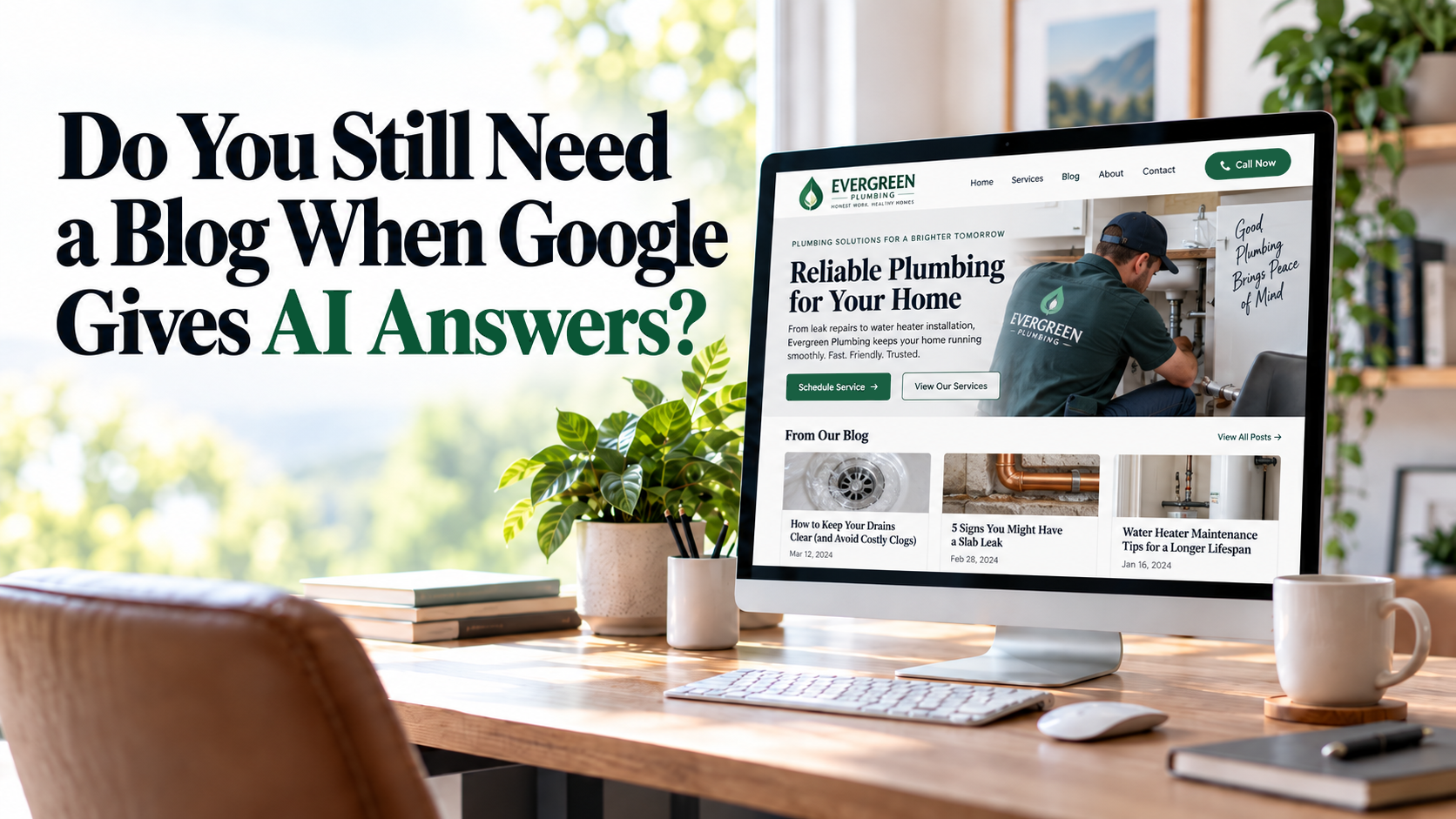
Do You Still Need a Blog When Google Gives AI Answers?
Yes. Businesses can still benefit from blogging even when Google and other AI platforms answer questions directly. The role of a business blog is changing, though. Generic articles created mainly to capture broad keyword traffic are less useful than content that answers real customer questions, shows firsthand expertise, supports service pages, and helps people make decisions. Strategic
content marketing and professional blogging can still support both SEO and AEO.
Quick answer: A business blog is still worth having when it gives customers and search systems information worth finding. The strongest articles answer specific questions, add original expertise or local context, connect naturally to a relevant service, and help qualified prospects understand what to do next.
Google can answer some informational questions directly through AI Overviews and AI Mode, so certain searches may generate fewer website clicks. That does not make blogging useless. It means businesses should focus less on traffic volume and more on qualified visibility, customer education, service-page support, and conversions.
Do Businesses Still Need a Blog in the Age of AI?
Yes, when the blog has a clear purpose. A company does not need to publish every week simply because someone believes every website needs constant new content. A worthwhile article should help a customer, strengthen a relevant topic, or support a service the business actually wants to sell.
- Answer an important customer question.
- Support a profitable service.
- Build topical or local authority.
- Demonstrate firsthand expertise.
- Help customers compare options or understand a process.
- Address objections that delay a purchase decision.
- Guide the reader toward an appropriate next step.
Blogging works best as part of a broader
SEO strategy, not as an isolated publishing calendar.
How Has Google AI Changed Business Blogging?
AI search changes how some people receive information, especially for simple questions. It also makes conversational, detailed queries more common and raises the value of content that goes beyond a generic summary.
AI Can Answer Basic Questions Without a Website Click
For some searches, a user can get enough of an explanation directly in Google and may not click a traditional result. That can reduce traffic to broad informational posts, but websites still matter for deeper research and decisions.
For more detail on the search feature itself, see Google AI Overviews SEO: What Small Businesses Should Do.
Searches Are Becoming More Conversational
People increasingly ask complete questions such as “How much does mold testing cost after water damage?”, “What type of pest control does a Weston home need?”, “Is residential window film worth it in South Florida?”, or “How do I choose an SEO company for a local business?” Good blog content can answer the decision behind the question instead of merely repeating a keyword phrase.
The Remaining Website Visits May Carry Stronger Intent
A person who already received a basic AI explanation may click to compare providers, verify credentials, understand pricing or process, see local experience, or contact a company. A smaller number of qualified visitors can matter more than a large volume of casual traffic.
That is part of the broader shift explained in Is SEO Dead in the Age of AI? No, but the Rules Have Changed.
Where Does Google Get Information for AI Answers?
Google says its generative AI features use core Search systems and indexed web content. Google can also show links to source websites. Publishing an article never guarantees that Google will use or cite it.
Useful source information can come from blog articles, service pages, accurate business details, Google Business Profiles, reviews, original images, structured data that matches the visible page, trustworthy third-party sources, and consistent local information.
For local businesses, How Google AI Is Changing Local Search for Service Businesses explains how those signals can work together.
What Can a Blog Do That a Generic AI Answer Cannot?
A generic answer can summarize common information. A strong business article can add details that come from the business’s own experience.
Share Firsthand Experience
Use real customer questions, recurring project observations, lessons learned, and professional judgment. This adds something beyond a recycled summary of existing search results.
Provide Local Knowledge
South Florida businesses can explain climate, seasonal conditions, service areas, or regional terminology when those details affect the service. Local context should help the customer, not simply insert city names.
Explain the Company’s Actual Services
A blog can accurately explain what the company offers, what it does not offer, where it works, and what customers should expect. That can reduce poor-fit inquiries and make the business easier to understand.
Demonstrate Trust and Expertise
Author information, credentials, original photography, case studies, reviews, transparent limitations, and accurate sourcing can help readers evaluate the business’s expertise.
Guide Readers Toward a Business Decision
A useful article can answer the question thoroughly and then connect the reader to the relevant professional service without turning every paragraph into an advertisement.
What Types of Blog Posts Still Create Value?
The strongest topics usually sit close to a real customer decision. For service businesses, these categories are often more useful than broad traffic topics.
Cost and Pricing Articles
Explain what affects price, what may be included, and why estimates vary. Examples include mold inspection cost, professional SEO cost, or commercial window tinting cost. Avoid inventing universal prices.
Comparison Articles
Help customers choose between options, such as mold inspection versus mold testing, SEO versus Google Ads, extermination versus ongoing pest control, or a service page versus a blog post.
Problem-and-Solution Articles
Start with a problem the customer already recognizes, such as a musty smell with no visible mold, website traffic with no leads, or an unexpected ranking change. Explain likely causes, what to check, and when professional help makes sense.
Process and Expectation Articles
Reduce uncertainty by explaining what happens during a service, what a client should prepare, or how the process typically works.
Local, Seasonal, and Original Insight
South Florida conditions, project examples, case studies, and professional observations can be valuable when they genuinely connect to the company’s services.
For the relationship between educational articles and commercial pages, see Service Pages vs. Blog Posts: Which One Helps Local Businesses Get More Leads?.
Which Blogging Practices Are Losing Value?
Low-value publishing adds little beyond what search results or an AI summary already provide. A stronger approach is to publish fewer pieces with a clearer customer and business purpose.
| Outdated blogging approach | Stronger AI-era approach |
|---|---|
| Writing broad topics for traffic | Answering specific customer questions |
| Repeating existing search results | Adding firsthand expertise and examples |
| Publishing without a service connection | Supporting relevant service pages |
| Targeting keywords without intent | Matching content to customer needs |
| Mass-producing generic AI articles | Using AI with human review and original input |
| Measuring only pageviews | Measuring leads, assisted conversions, and visibility |
| Publishing on an arbitrary schedule | Publishing when there is a meaningful content opportunity |
Other weak patterns include keyword-stuffed headings, rewritten competitor content, unrelated trend-chasing, overlapping posts, and articles that attract people who will never need the company’s services. AI assistance is not the problem. Content that lacks usefulness, accuracy, originality, or purpose is.
Can AI Write Your Business’s Blog Content?
Yes, AI can assist with blogging. Google’s current guidance does not say content is automatically unacceptable because AI was used. It focuses on quality, purpose, accuracy, usefulness, and compliance with spam policies.
AI can help with brainstorming, outlines, drafts, FAQs, metadata, editing, and repurposing. Human review should add accurate service information, firsthand expertise, local relevance, original examples, source verification, appropriate legal or safety review, internal links, and a relevant call to action.
For a broader look at that balance, see Can AI Manage Your Small-Business Marketing, or Do You Still Need an Expert?.
How Do Blog Posts Support Service Pages?
Service pages target people looking for a service. Blog posts answer questions people ask before choosing it. The two work best when they support each other instead of competing for the same intent.
Customer Question → Helpful Blog Answer → Relevant Service Page → Call, Form or Consultation
For example, a mold article about musty odors can lead to a mold inspection page, while a ranking-change article can lead to an SEO audit. Internal links should make the reader’s next step easier, not exist merely to manipulate rankings.
How Should You Optimize Blog Content for AEO?
AEO is most useful when it makes content easier for people and answer systems to understand. No formatting trick guarantees an AI citation, so focus on clarity, originality, and solid SEO.
- Answer the main question early with a concise response.
- Use descriptive question-based headings when they reflect real customer questions.
- Organize content with readable paragraphs, bullets, tables, and FAQs where useful.
- Add firsthand experience, local context, project examples, and original images when available.
- Identify authorship and cite trustworthy sources for important claims.
- Connect commercial articles to the service that solves the reader’s problem.
- Keep the page crawlable, indexable, mobile-friendly, reasonably fast, and properly structured.
- Use descriptive titles, proper headings, internal links, image alt text, and structured data when appropriate.
Technical optimization cannot compensate for weak content. To review the site foundation, use the Free SEO Audit and How Healthy Is Your Website’s SEO? 12 Things to Check.
Do Fewer Blog Clicks Mean the Content Is Failing?
Not necessarily. AI answers can reduce some informational clicks while a useful article still supports search impressions, source visibility, branded searches, service-page discovery, customer education, assisted conversions, and trust. Google also now provides Search Console reporting for generative AI visibility.
Significant traffic declines should still be investigated. The point is to evaluate the full customer journey instead of assuming that every lower click count means the content has failed.
How Should a Business Measure Blogging Results Now?
Measure whether content helps the right people discover and engage with the business. Useful metrics include impressions, clicks, click-through rate, query visibility, generative AI visibility when available, service-page performance, internal-link clicks, engaged sessions, calls, forms, bookings, qualified leads, assisted conversions, branded searches, and revenue when tracking permits.
A smaller audience of people who genuinely need the service can be more valuable than a much larger audience that never becomes a realistic customer.
How Often Should a Small Business Publish Blog Content?
There is no universal frequency that guarantees results. The right schedule depends on expertise, quality, competition, customer questions, search opportunities, budget, and the ability to maintain content. Consistency helps, but fewer strong articles are better than weak posts created only to meet a schedule.
When Should a Business Strengthen Other Pages Before Blogging More?
More articles may not be the immediate priority when important services lack dedicated pages, service pages are outdated, the site has technical or indexing problems, mobile usability is poor, calls to action are unclear, conversion tracking is missing, existing articles overlap, or the website has substantial content but very few qualified inquiries.
If the website foundation itself needs work, review The Business Theory’s website design services before assuming the answer is simply to publish more.
How Can a Small Business Build an AI-Ready Blog Strategy?
Start with the services the business wants to grow, then build content around customer questions. This keeps the blog connected to real business goals instead of an arbitrary quota.
- Identify the services the business most wants to promote.
- Confirm each important service has a strong dedicated page.
- Collect questions customers ask before hiring.
- Review Search Console for existing query opportunities.
- Group related questions into topics instead of creating overlapping posts.
- Prioritize cost, comparison, process, problem, and decision-making topics.
- Add firsthand expertise, local knowledge, and original examples.
- Link each article to the appropriate service page.
- Include a useful next step for the reader.
- Monitor visibility, leads, and service-page performance.
- Update valuable articles when information materially changes.
- Consolidate unnecessary overlapping content when appropriate.
Not Sure What Your Business Should Be Blogging About?
The strongest blog topics come from your services, customer questions, search opportunities, and the decisions people make before contacting you. The Business Theory creates SEO- and AEO-focused content that answers those questions, supports service pages, and strengthens visibility across traditional and AI-powered search.
Key Takeaways
Blogging still has a role in modern search, but its value depends on purpose and quality. The strongest content supports both customer decisions and the website.
- Businesses can still benefit from blogging.
- Generic content created only for traffic is becoming less valuable.
- AI search still relies on reliable web content and indexed sources.
- Blogs should support services, authority, and customer decisions.
- Firsthand expertise and local relevance help content stand out.
- Businesses should measure qualified visibility and leads, not traffic alone.
- The Business Theory can develop SEO- and AEO-focused blog content.
Frequently Asked Questions
Below are answers to common questions small-business owners have about blogging, SEO, AEO, AI search, and how content can support visibility and lead generation.
Build a Blog Strategy That Supports Search, AI and Real Business Goals
AI is changing how people search, but it has not eliminated the need for useful, trustworthy content. A strong blog strategy can still help your business answer customer questions, support important service pages, demonstrate real expertise, and stay visible throughout the research and decision-making process. The key is to focus less on publishing for traffic alone and more on creating content that has a clear purpose for your customers and your business.
How The Business Theory Can Help With SEO- and AEO-Focused Content
The Business Theory helps service-based businesses create content that supports traditional SEO, AI-powered search, and real customer decisions. Our content marketing services include professionally researched blog writing, SEO- and AEO-focused content strategy, internal linking, service-page support, local relevance, and human review so each article has a clear purpose within your broader marketing strategy.
If you are not sure what your business should be blogging about, which topics are worth prioritizing, or how your existing content could better support your services, schedule a free consultation to see how The Business Theory can help you build a more focused content strategy.
About The Business Theory
The Business Theory is an award-winning website design and digital marketing agency helping service-based businesses build stronger online presences and attract more qualified customers. We specialize in custom website design, Search Engine Optimization (SEO), directory listings, Google Ads, Meta Ads, social media posting, content marketing, and link building, with strategies tailored to each business rather than a one-size-fits-all approach. Whether you need a new website, stronger search visibility, or a more coordinated digital marketing strategy, explore our services or schedule a free consultation to learn how The Business Theory can support your business goals.