Business Directory Listings for Local SEO: A Complete Guide
Share this article
When potential customers search for a local business, they may encounter information about that company across Google, Bing, Apple Maps, Yelp, social platforms, industry directories, navigation services, and other websites before they ever visit the company's website. Keeping that information accurate and consistent is an important part of maintaining a trustworthy local online presence.
Business directory listings are online profiles that contain information about a business, such as its name, address, phone number, website, hours, services, and other details. These listings can help customers discover and verify a business while also giving search engines additional information about the company and where it operates.
For local businesses, directory management isn't simply about appearing on as many websites as possible. The goal is to maintain accurate, consistent, and useful business information across relevant platforms, correct outdated or duplicate listings, and make it easier for customers and search engines to understand the business.
In this complete guide, we'll explain how business directory listings work, how they relate to local SEO, what NAP consistency means, which directories matter, how data aggregators and listing networks distribute information, how inaccurate listings can create problems, and whether professional directory listing management is worth it for your business.
If you'd rather have your business information distributed, monitored, and managed across supported directories, explore our business directory listing services for South Florida businesses.
What Are Business Directory Listings?
Business directory listings are online profiles that display essential information about a business across search engines, maps, directories, apps, and other digital platforms. They help customers find and verify details about a company while creating consistent references to the business across the web.
For local businesses, these listings can appear in many places beyond Google, which makes keeping the information accurate and up to date especially important.
What Information Is Included in a Business Listing?
The exact information available varies by platform, but a business listing may include:
- Business name
- Physical address or service area
- Phone number
- Website URL
- Business hours
- Business category
- Services or products
- Business description
- Photos
- Social media profiles
- Customer reviews
- Accessibility or amenity information
- Other business attributes
The most important details should accurately reflect how customers can find, contact, and interact with the business.
Where Do Business Directory Listings Appear?
Business information can appear across many types of platforms, including:
- Search engines
- Mapping and navigation services
- General business directories
- Local directories
- Industry-specific directories
- Review platforms
- Social networks
- Voice assistants and connected services
- Apps that use third-party business data
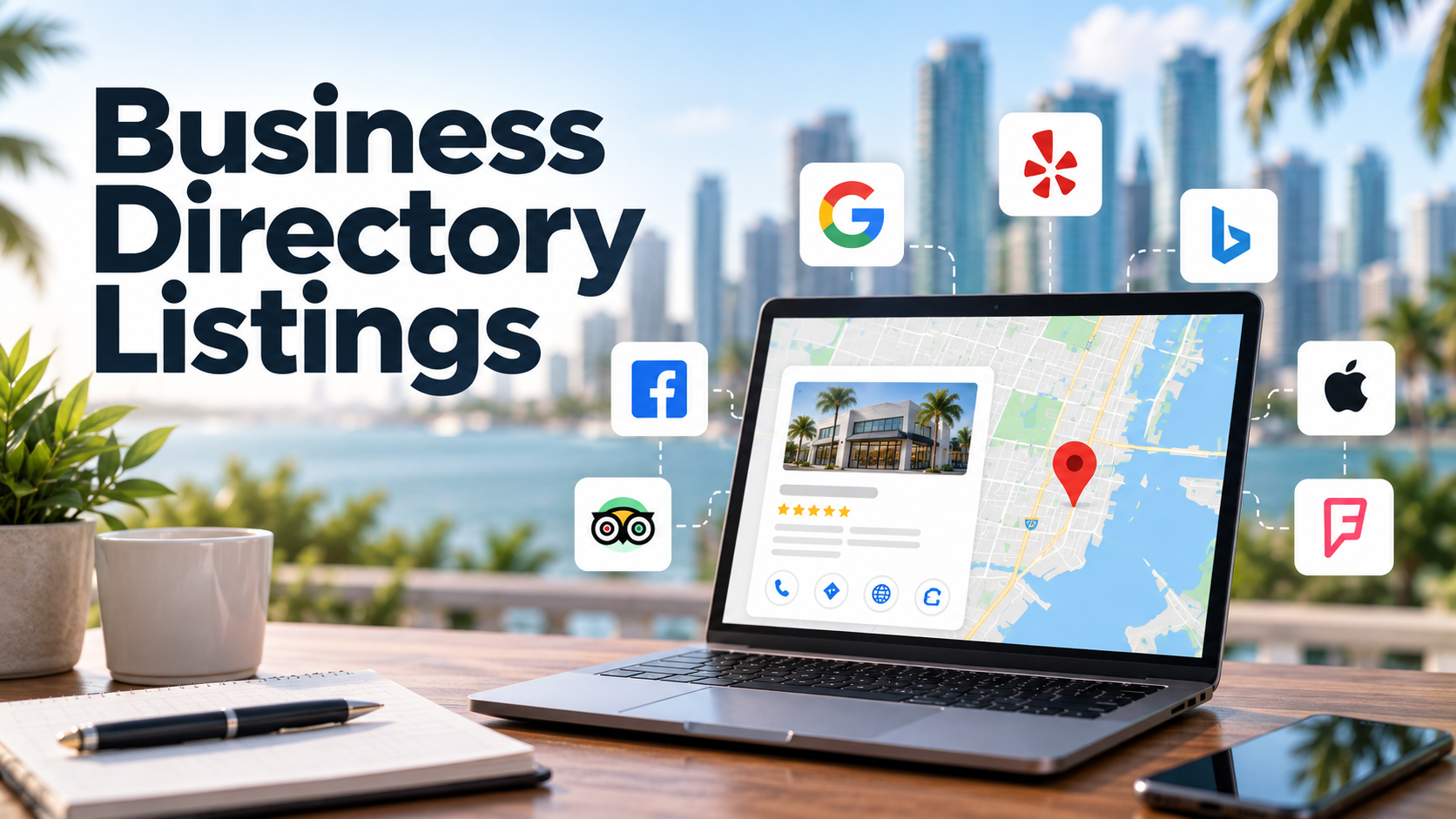
Examples can include Google Business Profile, Bing Places, Apple Business Connect, Yelp, and other relevant platforms depending on the business and industry.
Not every directory has equal value. Businesses should prioritize accurate listings on reputable platforms that customers actually use rather than trying to appear on every directory available.
Are Business Listings the Same as Local Citations?
The terms are closely related, but they aren't always used in exactly the same way.
A business listing is generally a profile or directory entry containing information about a company. A local citation is an online mention of a local business—often including its name, address, and phone number—even when that mention isn't a complete business profile.
This means a directory listing can function as a local citation, but local citations can also appear in other places across the web.
Why Do Business Directory Listings Matter?
Business listings help create a consistent digital footprint for your company. When customers encounter your business on different platforms, accurate information makes it easier for them to verify your location, visit your website, call your business, check your hours, or get directions.
For local SEO, directory listings are one component of a broader strategy that can also include your website, Google Business Profile, reviews, locally relevant content, internal linking, and other local search signals.
The objective isn't to collect the largest possible number of listings. It's to make sure the listings that represent your business are accurate, consistent, relevant, and maintained over time.
Do Business Directory Listings Help Local SEO?
Business directory listings can support local SEO by reinforcing accurate information about a business across relevant online platforms. They are not a shortcut to higher rankings, but they can contribute to a broader local search strategy by helping search engines and customers encounter consistent information about your company.
The value comes primarily from accuracy, consistency, relevance, and visibility across trusted platforms—not simply from creating as many listings or backlinks as possible.
How Do Directory Listings Support Local Search?
Directory listings can support your local online presence in several ways:
- Reinforce business information: Consistent details across reputable platforms provide additional references to your business.
- Improve customer discovery: Potential customers may find your company through directories, maps, review platforms, and navigation services—not only Google Search.
- Reduce conflicting information: Correcting old addresses, phone numbers, websites, or hours helps prevent customers from encountering outdated details.
- Create relevant local citations: Listings can provide online mentions connecting your business with its location and services.
- Send referral traffic: Some directories can send visitors directly to your website or business profile.
- Support a broader local SEO strategy: Listings work alongside your website, Google Business Profile, reviews, content, and other local signals.
Do More Directory Listings Mean Better Rankings?
No. Having more directory listings does not automatically mean your business will rank higher in local search. A large number of low-quality, irrelevant, or outdated listings is not necessarily more valuable than maintaining accurate information across reputable platforms that matter to your customers and industry.
Instead of focusing on listing quantity, prioritize:
- Reputable platforms
- Accurate business information
- Relevant industry directories
- Important local directories
- Duplicate-listing cleanup
- Ongoing updates when business information changes
This is one reason businesses should be cautious of services promising hundreds or thousands of directory submissions as a guaranteed way to improve rankings.
Are Directory Backlinks Good for SEO?
Some business directories provide a link to your website, but the backlink should not be the only reason you create or maintain a listing. Directory links vary considerably in quality and relevance, and having a link from a directory does not guarantee improved rankings.
A useful directory listing should primarily provide accurate business information and a legitimate way for customers to discover or verify your company. Any referral traffic or backlink value should be viewed as an additional benefit rather than the sole purpose of the listing.
Are Directory Listings Enough for Local SEO?
No. Directory listings are only one part of local SEO.
A broader local SEO strategy may also include:
- An optimized Google Business Profile
- Relevant service and location pages
- Helpful website content
- Customer reviews
- Strong on-page SEO
- Internal linking
- Local relevance and authority
- Accurate business information across the web
If your goal extends beyond managing listings and includes improving your broader organic and local search presence, our local SEO and search engine optimization services address these areas as part of a more comprehensive strategy.
Directory listings are therefore best viewed as supporting infrastructure for your local presence, rather than a standalone ranking tactic. When the information is accurate and maintained consistently, listings complement the other signals customers and search engines use to understand your business.
What Is NAP Consistency and Why Does It Matter?
NAP stands for Name, Address, and Phone Number, and NAP consistency refers to keeping those core business details accurate across your online presence. When a business changes its phone number, address, name, or other important information, outdated listings can remain online unless they are actively corrected.
For local businesses, consistent information helps customers confidently identify and contact the correct company while reducing conflicting information across directories and platforms.
Which Business Information Should Stay Consistent?
NAP is the traditional starting point, but businesses should maintain more than just three pieces of information. Important details can include:
- Business name
- Street address, when applicable
- Service area, for businesses that travel to customers
- Primary phone number
- Website URL
- Business hours
- Primary business category
- Services offered
- Business description
- Appointment or booking links
- Holiday or special hours
The information does not always need to be formatted identically on every platform. For example, one directory may abbreviate “Street” as “St.” What matters most is that the information is factually accurate and clearly refers to the same business.
What Causes Inconsistent Business Listings?
Listing inconsistencies often develop naturally as businesses change over time.
Common causes include:
- Moving to a new location
- Changing phone numbers
- Rebranding or changing the business name
- Updating the website domain
- Changing business hours
- Opening or closing locations
- Creating duplicate profiles
- Old employees or vendors creating listings
- Third-party platforms using outdated business data
- Different departments entering business information differently
A company that has operated for many years may have outdated information spread across platforms without realizing it.
Can Incorrect Business Listings Hurt Your Business?
Yes. Incorrect listings can create problems even before considering SEO.
A potential customer may:
- Call an outdated phone number
- Visit an old address
- See incorrect operating hours
- Reach the wrong website
- Find duplicate profiles with conflicting information
- Question whether the business is still operating
That creates unnecessary friction at exactly the moment someone is trying to contact or visit the company.
From a local search perspective, maintaining accurate information also helps create a clearer and more consistent representation of the business across the web.
Does NAP Information Have to Match Exactly Everywhere?
Not necessarily character for character. Accuracy matters more than superficial formatting differences.
For example:
123 Main Street
and
123 Main St.
clearly describe the same address.
Businesses should focus on correcting meaningful discrepancies such as different phone numbers, outdated addresses, incorrect websites, wrong hours, duplicate listings, or old business names rather than worrying about harmless formatting variations.
The goal of NAP consistency is ultimately simple: wherever a customer encounters your business online, they should receive accurate information about who you are, where you're located or serve, and how to contact you.
Which Business Directories Matter Most for Local Businesses?
The most valuable business directories are generally the platforms that customers actually use, search engines recognize, or your industry and local market rely on. Businesses do not need to appear on every directory available; they should prioritize reputable platforms that are relevant to how customers discover and verify their company.
The right directory mix can vary by industry and location, but most local businesses should begin with major search, mapping, navigation, review, and business-data platforms before considering more specialized directories.
Which Major Business Listing Platforms Should You Prioritize?
Depending on your business, important platforms may include:
- Google Business Profile — Helps businesses manage information that can appear across Google Search and Google Maps.
- Apple Business Connect — Allows businesses to manage how their information appears across Apple services such as Maps.
- Bing Places for Business — Helps businesses manage information associated with Bing search and mapping experiences.
- Yelp — A widely used business discovery and review platform across many local-service categories.
- Facebook — Business pages can provide customers with contact details, hours, location information, and other company information.
- Industry-specific directories — Platforms focused specifically on your profession or industry may be particularly relevant to potential customers.
- Local and regional directories — Reputable chambers, associations, community organizations, and local business resources may also provide useful business references.
Not every platform will be equally important for every company. A restaurant, attorney, contractor, healthcare provider, and marketing agency may each benefit from a different mix of industry-specific listings.
Are Niche and Industry Directories Worth It?
Yes, when the directory is legitimate, relevant to your industry, and genuinely useful to potential customers.
For example, a professional-services company may benefit from industry associations or specialized directories where customers actively research providers. These listings can provide additional opportunities for discovery while reinforcing what the business does.
Before creating a listing, consider:
- Is the directory relevant to your industry?
- Does it appear to have a real audience?
- Are legitimate businesses listed there?
- Does the platform maintain useful business information?
- Could a potential customer realistically use it to find or evaluate your company?
A relevant niche directory can be more useful than dozens of unrelated general directories.
Should You Submit Your Business to Hundreds of Directories?
Usually, no. Directory quantity should not be the primary goal.
Mass-submitting a business to hundreds of low-quality directories can create unnecessary listings that become difficult to maintain and may provide little meaningful value to customers.
A stronger approach is to build and maintain a high-quality directory presence across major platforms, relevant industry resources, and appropriate local directories.
How Do You Decide Which Directories Are Worth Managing?
Prioritize directories based on:
- Customer usage
- Platform reputation
- Industry relevance
- Local relevance
- Accuracy of the information displayed
- Potential referral traffic
- Whether the listing can be maintained over time
Your directory strategy should reflect where your customers are likely to encounter your business—not simply how many websites will accept a submission.
Professional listing management can also simplify this process by distributing and maintaining business information across supported platforms. Our directory listing management services are designed to help businesses maintain accurate information across their online presence.
The goal is not to be listed everywhere. It is to make sure your business is accurately represented in the places that matter.
How Do Business Listing Networks and Data Aggregators Work?
Business information does not always move from your company directly to every directory where it appears. Some platforms receive business data from third-party providers, listing networks, data aggregators, or other sources that collect and distribute information across multiple services.
This helps explain why incorrect business information can sometimes appear on platforms you never personally created a listing on—and why correcting one profile does not necessarily correct every version of your business information across the web.
What Is a Business Data Aggregator?
A business data aggregator collects information about companies and distributes that data to other platforms that use business information.
Depending on the provider and network, this information may include:
- Business name
- Address
- Phone number
- Website
- Business category
- Hours
- Location information
- Other business attributes
Directories, mapping services, apps, navigation tools, and other platforms may obtain or verify business information through various data sources.
Why Does Business Information Appear on Sites You Never Submitted To?
Business information can originate from multiple sources, including:
- Data providers and listing networks
- Public records
- Existing online directories
- Mapping databases
- Business websites
- User-submitted information
- Previous business owners or employees
- Marketing companies or vendors
- Older versions of business data
As information is shared and republished, outdated details can sometimes continue circulating even after your business has made a change.
For example, moving offices or changing a phone number may leave older information visible across platforms unless those listings and data sources are updated.
Does Updating One Business Listing Update Every Directory?
No. Updating one listing does not guarantee that every other platform will automatically update.
Some platforms manage their information independently, while others may receive updates through outside data sources or listing-management networks. Changes can also take different amounts of time to appear across platforms.
That is why businesses should periodically review important listings after changes such as:
- Moving locations
- Changing phone numbers
- Updating business hours
- Rebranding
- Changing website domains
- Opening or closing locations
- Expanding or changing services
What Is the Benefit of a Listing Management Service?
Listing-management services can make it easier to distribute, update, and maintain business information across supported platforms from a more centralized process.
This can be particularly useful for businesses that:
- Appear across many directories
- Have outdated or conflicting information
- Recently moved or rebranded
- Manage multiple locations
- Do not have time to update platforms individually
- Want a more consistent process for maintaining listings
However, the exact directories and capabilities depend on the listing-management provider being used. Businesses should understand which platforms are supported, what information can be managed, and what happens to listings if the service is discontinued.
Business listing networks help explain why directory management is not always a one-time project. Business information can change, platforms can update their data, and new inconsistencies can develop over time, making periodic monitoring an important part of maintaining an accurate online presence.
Can Business Directory Listings Help You Appear in Google Maps?
Business directory listings can support a broader local search strategy, but directory listings alone do not determine whether a business appears prominently in Google Maps or the local results. Google considers multiple signals when determining local visibility, including the business’s Google Business Profile, relevance to the search, location, prominence, reviews, website signals, and other information available about the business online.
Accurate directory information can complement these signals by helping maintain a consistent representation of your business across the web.
What Factors Influence Google Maps Visibility?
There is no single action that guarantees higher Google Maps rankings. Important areas for local businesses can include:
- Google Business Profile completeness and accuracy
- Appropriate primary and secondary business categories
- Accurate business name, address, phone number, and hours
- Relevant services and business information
- Customer reviews and review activity
- Proximity or location relative to the searcher
- Relevance to the customer’s search
- Website content and local relevance
- Overall business prominence
- Accurate information across other online sources
These signals work together, which is why directory listings should be viewed as one component of local search rather than a standalone Maps-ranking strategy.
How Do Directory Listings Support Your Google Business Profile?
Your Google Business Profile and your other business listings serve different purposes, but the information associated with them should accurately describe the same company.
For example, if your Google Business Profile shows one phone number while several prominent directories display an outdated number, customers may encounter conflicting information depending on where they discover your business.
Maintaining accurate listings can help create a more consistent online presence across:
Google → Maps → directories → review platforms → navigation services → your website
That consistency is valuable even beyond rankings because it reduces confusion for potential customers.
Will Fixing Directory Listings Automatically Improve Google Maps Rankings?
No. Correcting inaccurate directory listings does not guarantee a specific Google Maps ranking improvement.
A business can have perfectly consistent directory information and still face strong competition from businesses with greater proximity, relevance, reviews, prominence, website authority, or other advantages.
Directory cleanup should therefore be approached as foundational local-search maintenance, not as a guaranteed ranking hack.
What Should You Do If Your Goal Is Better Local Search Visibility?
If improving Google Search and Maps visibility is the larger objective, directory management should work alongside a broader local SEO strategy.
That may include:
- Optimizing your Google Business Profile
- Strengthening service and location pages
- Publishing locally relevant content
- Earning and responding to customer reviews
- Improving internal linking
- Maintaining accurate directory listings
- Monitoring organic and local search performance
For a deeper explanation of how these pieces work together, read our complete guide to local SEO for Miami businesses.
Directory listings can support the foundation, but strong local visibility comes from the combined strength of your business information, website, Google Business Profile, reputation, relevance, and authority.
What Happens When Business Directory Listings Are Incorrect?
Incorrect business directory listings can create problems for both customers and the business itself. Outdated phone numbers, addresses, hours, website links, or duplicate profiles can make it harder for potential customers to confidently find, contact, or verify a company.
These problems often accumulate over time, especially when a business moves, changes phone numbers, rebrands, updates its website, or has listings created by multiple people or platforms.
What Are the Most Common Business Listing Errors?
Common directory-listing problems include:
- Incorrect business name
- Old or disconnected phone numbers
- Previous business addresses
- Incorrect business hours
- Outdated website URLs
- Wrong business categories
- Duplicate listings
- Incomplete profiles
- Inconsistent service information
- Listings for locations that have closed
- Old branding after a company rebrand
Even established businesses can have inaccurate listings they do not know exist.
How Can Incorrect Listings Affect Customers?
Imagine a potential customer finds your business in a directory and decides to call, but the number is disconnected. Another customer drives to an address you left two years ago. Someone else sees that your listing says you're closed when you're actually open.
Each situation creates friction at a moment when someone may have been ready to contact your business.
Incorrect information can lead to:
- Missed phone calls
- Lost website visits
- Customers visiting the wrong location
- Confusion about business hours
- Reduced trust
- Frustration before the customer ever contacts you
The issue is therefore bigger than SEO. Listing accuracy is part of the customer experience.
Can Duplicate Business Listings Cause Problems?
Yes. Duplicate listings can create multiple versions of the same business across a platform, sometimes with different addresses, phone numbers, reviews, or other information.
This can make it difficult for customers to determine which profile is correct.
When duplicate listings are discovered, businesses should determine whether they can be claimed, corrected, merged, suppressed, or removed, depending on the options available through that particular platform.
How Often Should You Check Your Business Listings?
There is no universal schedule that every business must follow, but listings should be reviewed whenever important business information changes.
You should consider reviewing your listings after:
- Moving to a new address
- Changing your phone number
- Updating business hours
- Changing your website domain
- Rebranding
- Opening or closing a location
- Changing important services
- Discovering duplicate or inaccurate profiles
Periodic reviews can also help identify discrepancies that developed without an obvious change from the business.
What Should You Do If You Find Incorrect Business Information?
Start with the platforms most important to your customers and local presence. Claim or verify listings where appropriate, correct inaccurate information, address duplicates, and make sure your website and primary business profiles contain the current details.
If incorrect information appears across many platforms, managing each listing individually can become time-consuming. Businesses dealing with widespread inconsistencies can use business directory listing management to help distribute and maintain accurate information across supported directories.
The objective isn't simply to fix an error once. It's to establish a reliable source of business information and maintain it as your company changes over time.
How Often Should You Update Your Business Directory Listings?
Business directory listings should be updated whenever important business information changes and reviewed periodically to catch outdated, incomplete, or conflicting information. Directory management is not necessarily a one-time task because businesses change and platforms can continue displaying information from different sources.
The frequency of review depends on how often your business information changes, how many locations you operate, and how widely your information appears online.
When Should Business Listings Be Updated Immediately?
Update important listings as soon as possible when your business changes:
- Business name
- Address or location
- Phone number
- Website URL
- Regular business hours
- Holiday or special hours
- Primary services
- Business categories
- Appointment or booking information
- Location status, such as an opening or closure
These changes directly affect a customer's ability to find, contact, or visit your business.
Should You Review Listings Even If Nothing Has Changed?
Yes. Periodic reviews can uncover issues that were not intentionally created by your business.
For example, you may discover:
- Duplicate listings
- Missing information
- Incorrect hours
- Old phone numbers
- Outdated website links
- Inconsistent categories
- Listings you did not create
- Changes suggested or submitted by third parties
Businesses with multiple locations or a long operating history may need more frequent monitoring because there are more profiles and data points to maintain.
What Should You Check During a Directory Listing Audit?
A directory listing audit should focus first on whether customers are receiving accurate information.
Review:
- Business name
- Address or service area
- Phone number
- Website
- Hours
- Business categories
- Services
- Business description
- Photos where applicable
- Duplicate profiles
- Closed or outdated locations
You should also identify which platforms actually matter to your business rather than spending time correcting obscure directories that provide little customer value.
Is Directory Listing Management a One-Time Service?
It can be, but ongoing management may be useful when business information changes frequently or when a company wants its listings monitored and maintained across supported platforms.
A one-time cleanup can correct existing problems, while ongoing management focuses on keeping important business information accurate as your company and the platforms displaying it change.
The right approach depends on the number of listings, number of business locations, existing inaccuracies, and how often your information changes.
Regular maintenance helps prevent a directory presence that was accurate today from becoming outdated months or years later.
Can You Manage Business Directory Listings Yourself?
Yes. A business can manage its own directory listings, especially if it has one location, relatively few listings, and someone available to monitor business information across important platforms. The challenge is usually not creating a listing—it is finding inaccurate profiles, correcting duplicates, updating multiple platforms, and maintaining the information over time.
Whether you manage listings yourself or use a professional service depends largely on the size and complexity of your online presence.
What Does DIY Directory Listing Management Involve?
Managing listings yourself may require:
- Identifying the directories where your business already appears
- Claiming or verifying profiles when required
- Correcting inaccurate business information
- Updating names, addresses, phone numbers, websites, and hours
- Selecting appropriate business categories
- Adding services and business descriptions
- Finding duplicate listings
- Requesting corrections or removals
- Monitoring listings after business information changes
- Keeping important platforms updated over time
For a small business with only a handful of important listings, this may be completely manageable.
When Does Directory Management Become Difficult?
Managing listings manually becomes more complicated when a business:
- Has been operating for many years
- Has changed addresses or phone numbers
- Has undergone a rebrand
- Operates multiple locations
- Has numerous duplicate listings
- Appears across many platforms
- Frequently changes hours or services
- Has inconsistent information already circulating online
The more locations and listings involved, the more time it can take to identify and maintain accurate information.
What Are the Benefits of Professional Directory Listing Management?
Professional listing management can reduce the amount of manual work required to distribute and maintain business information across supported platforms.
Depending on the provider, services may include:
- Business information distribution
- Listing updates
- Duplicate suppression or management
- Monitoring for inconsistencies
- Access to a network of supported directories
- Centralized updates
- Ongoing listing maintenance
However, businesses should understand exactly what the service includes, which directories are supported, and whether ongoing service is required to maintain certain listing-management features.
How Much Does Directory Listing Management Cost?
Pricing varies by provider, the number of locations, the platforms included, and whether the service is a one-time cleanup or ongoing management.
At The Business Theory, Directory Listings are $85 as a standalone service or $59 when added to any of our SEO plans.
Businesses that want help maintaining accurate information across supported platforms can review our business directory listing service and pricing.
For businesses with only a few listings and plenty of time to maintain them, DIY management may be sufficient. For businesses dealing with widespread inconsistencies or that simply prefer not to manage multiple platforms manually, a listing-management service can make the process more efficient.
Frequently Asked Questions About Business Directory Listings
Business directory listings can affect how customers find, verify, and contact a local business across the web. These answers cover common questions about listing accuracy, local SEO, NAP consistency, directories, updates, and professional listing management.
Key Takeaways About Business Directory Listings and Local SEO
Business directory listings are an important part of maintaining an accurate and consistent local online presence, but they should not be treated as a shortcut to higher search rankings. Their value comes from helping customers and search engines encounter reliable information about your business across relevant platforms.
For local businesses, the strongest approach focuses on accuracy, relevance, consistency, and ongoing maintenance rather than simply creating the largest possible number of listings.
- Business listings help customers find and verify your company. They can display your name, address, phone number, website, hours, services, categories, and other important information.
- Directory listings can support local SEO. Accurate listings complement your website, Google Business Profile, reviews, local content, and other local-search signals.
- NAP consistency means keeping your core business information accurate. Your name, address, and phone number should correctly represent your business wherever customers encounter it.
- Accuracy matters more than identical formatting. Minor differences such as “Street” versus “St.” are less important than conflicting phone numbers, addresses, websites, or business names.
- More directory listings do not automatically mean better rankings. Prioritize reputable platforms that are relevant to your customers, industry, and market.
- Directory backlinks should not be the primary objective. Some listings may include website links, but the primary value of a listing is accurate business information and customer discovery.
- Incorrect listings can create real customer problems. Outdated addresses, phone numbers, hours, and duplicate profiles can lead to missed calls, lost visits, and confusion.
- Directory listings alone do not determine Google Maps rankings. They should work alongside your Google Business Profile, website, reviews, local relevance, and broader SEO strategy.
- Listings should be maintained as your business changes. Updates are especially important after moving, changing phone numbers, updating hours, rebranding, or opening and closing locations.
- Businesses can manage listings themselves or use professional management. The right approach depends on the number of listings, locations, existing inaccuracies, and time available for ongoing maintenance.
Keep Your Business Information Accurate Across the Web
Business directory listings help customers find, verify, and contact your business across search engines, maps, directories, review platforms, navigation services, and other digital channels. Maintaining accurate information across those platforms can reduce customer confusion while supporting a broader local search strategy.
The goal isn't to submit your business to every directory available. A stronger approach focuses on reputable and relevant platforms, accurate business information, duplicate management, and ongoing updates as your company changes.
Manage Your Business Directory Listings With The Business Theory
The Business Theory provides business directory listing management for service-based businesses throughout South Florida, including Miami-Dade, Broward, and Palm Beach County. We help businesses distribute and maintain accurate information across supported directory platforms without requiring owners to manage every listing individually.
Directory Listings are available for $85 as a standalone service or $59 when added to any of our SEO plans. If your business has outdated information, inconsistent listings, or you simply want a more efficient way to maintain your directory presence, explore our business directory listing services in South Florida.
About The Business Theory
The Business Theory is an award-winning website design and digital marketing agency helping service-based businesses build stronger online presences and attract more qualified customers. We specialize in custom website design, Search Engine Optimization (SEO), directory listings, Google Ads, Meta Ads, social media posting, content marketing, and link building, with strategies tailored to each business rather than a one-size-fits-all approach. Whether you need a new website, stronger search visibility, or a more coordinated digital marketing strategy, explore our services or schedule a free consultation to learn how The Business Theory can support your business goals.