7 Signs It’s Time to Improve Your Business’s Online Presence
Share this article
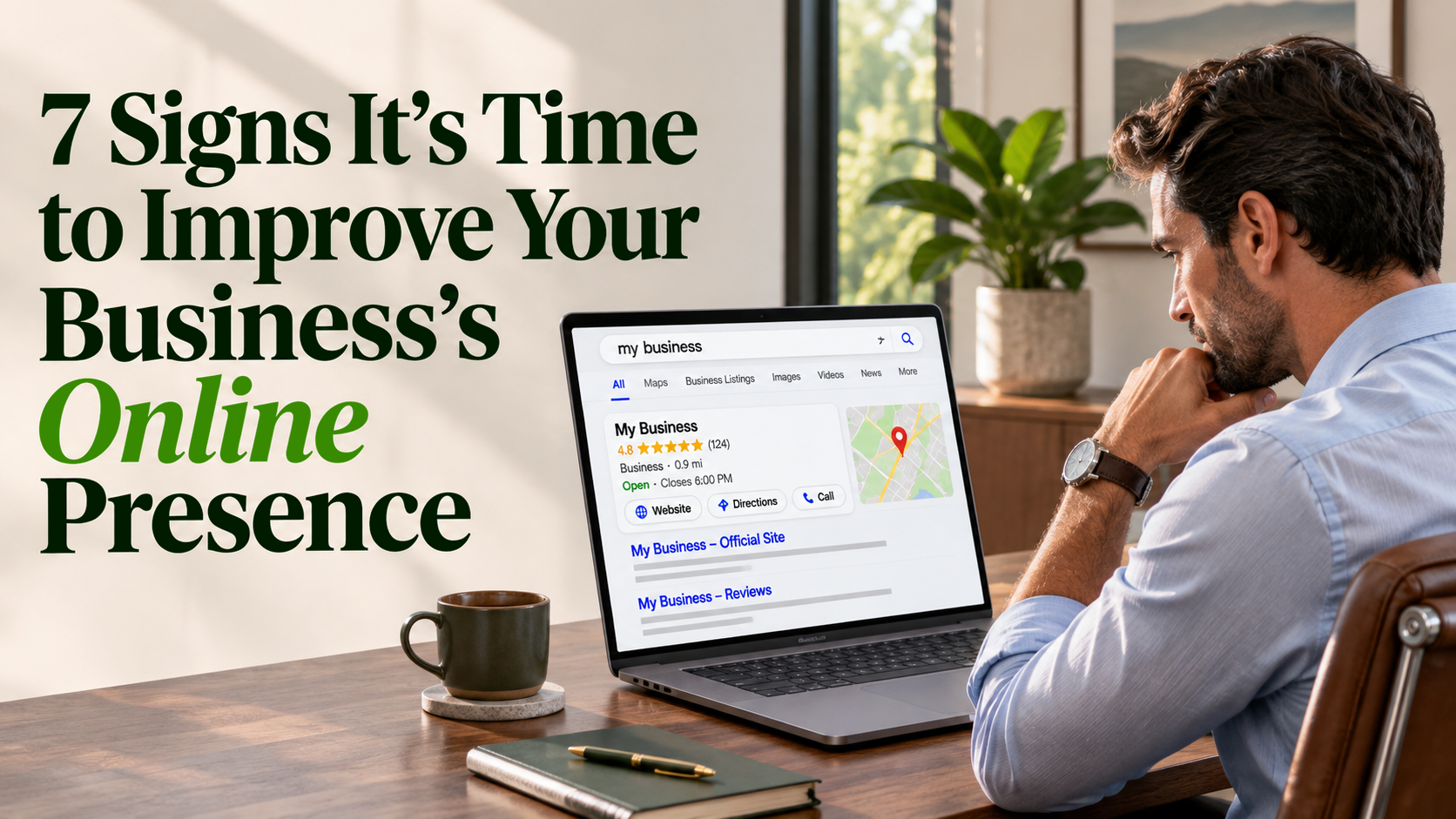
An online presence is the collection of places where customers discover, research, and contact your business—including your website, search results, business profiles, and relevant social channels. If people cannot confirm what you offer, where you work, or how to reach you, it may be time to improve it. You do not need to use every platform; you need accurate information and an easy path from discovery to inquiry
The following seven signs can help you decide whether your next step should be a new website, a stronger local search foundation, refreshed content, or a better way to measure customer inquiries.
What Does a Strong Online Presence Look Like in 2026?
A strong online presence helps the right people find your business, understand its services, verify that it is credible, and contact you without unnecessary effort. Your website is the central place you control. Search listings and social profiles can introduce customers to the business, but they should reinforce—not contradict—your website.
Search now includes traditional results alongside AI-powered experiences. Google says its established SEO guidance still applies to AI features; there is no special markup that guarantees an appearance. Useful, accurate answers and pages people can navigate remain a sensible foundation. See Google’s guidance on AI features and websites for the current framework.
Sign 1: Customers Know Your Business, but You Still Do Not Have a Website
Referrals, repeat customers, and social media recommendations can keep a business busy. But a potential customer who hears about you may still search your name to check services, examples of your work, business hours, and how to get started. If your only digital destination is a social profile, visitors may have to scroll through posts to answer basic questions.
When Is a Dedicated Website Worth the Investment?
A website becomes especially useful when customers need to compare multiple services, review a process, request an estimate, or check whether you serve their location. For example, a hypothetical home-service company could explain residential and commercial work on separate pages instead of relying on a single social media biography.
Start with the essentials: who you help, what you offer, proof of your work, accurate contact details, and an obvious next step. The Business Theory’s custom website design services are built around those business requirements, rather than the idea that every company needs a large site.
Sign 2: People Search for Your Services but Struggle to Find Accurate Information
If customers cannot find your business for relevant services or see inconsistent hours, phone numbers, or locations, your online presence may be creating confusion. Search visibility is not one universal ranking: results vary by query, competition, location, and other factors. Checking a keyword once on your own phone does not establish how your site performs everywhere.
What Should You Check Before Paying for More Traffic?
Search your business name and your main services, then review what a prospective customer actually sees. A local business should confirm its website and major profiles describe the same real operation. Google’s Business Profile guidelines require accurate representation of a business, including eligible address and service-area information.
- Verify your business name, phone number, website, hours, and actual service area.
- Check whether your most important services have clear pages on your website.
- Review Google Search Console for searches that already show your pages, while remembering impressions are not customers.
If listings disagree, our guide to why business information differs on Google, Apple Maps, and Yelp explains the issue. For broader improvement, explore local SEO services or directory listing management, depending on what is missing.
Sign 3: Your Website No Longer Reflects the Business You Operate Today
Businesses change. You may add services, adjust your service area, update your brand, or stop offering work that still appears on the website. An outdated page can attract inquiries you cannot fulfill—or make potential customers question whether the information is current. The concern is not whether the website follows the latest design trend; it is whether it represents your business accurately.
How Can You Tell Whether to Refresh or Rebuild?
If the layout works well and the structure supports your services, updated photos, copy, and contact information may be enough. Consider a new build when the navigation is confusing, the existing site cannot support your current service categories, or the customer journey is difficult to improve without starting over.
Before making major changes, document the pages that already receive relevant search traffic. Our article on redesigning a website without overlooking SEO explains why you should review URLs, redirects, and important content during a rebuild. A redesign should solve a defined business problem, not simply give the homepage a new color.
Sign 4: Customers Have to Work Too Hard to Contact You on Their Phones
Your website might look attractive on a desktop yet be frustrating on a phone. Warning signs include unreadable text, menus that cover content, buttons too close together, a form that refuses to submit, or a contact option that is difficult to find. These obstacles can interrupt an inquiry regardless of how someone discovered the site.
Test One Real Customer Journey
Pretend you are a new customer who knows nothing about your business. Open the page on a phone, choose a service, check whether you cover your location, and try the contact process. Test the confirmation message and verify that the inquiry reaches the correct inbox. If you cannot comfortably complete those steps, make mobile usability a priority.
Google’s Core Web Vitals guidance describes loading, responsiveness, and visual stability metrics. These are useful diagnostic signals, not a promise that improving a score automatically creates rankings or leads. The goal is a usable site that lets interested customers take action.
Sign 5: Your Social Profiles and Business Listings Tell Different Stories
A business does not have to post daily or maintain an account on every social network. It does need its active channels to represent the same company. Conflicting service descriptions, expired offers, old logos, or an abandoned profile that still directs customers to a dead link can damage the experience before someone reaches your website.
Choose the channels that your customers actually use. A restaurant might update hours and menus frequently; a professional service firm might rely more on a strong website and occasional educational posts. Avoid treating follower counts as proof that your marketing is working.
What Should Stay Consistent Across Platforms?
Use your website as the reference point for core facts: services, service areas, contact information, active offers, and brand identity. Update the platforms that matter most to your customers, then periodically check links and contact buttons. If the administrative work has become difficult to manage,
professional directory listing services can help keep public business details organized.
Sign 6: Customers Keep Asking Questions Your Website Should Already Answer
Repeated questions about prices, service areas, timelines, requirements, or what happens after contacting you are useful feedback. If prospects have to call just to learn whether you offer the service they need, your website may not be helping them make informed decisions. You do not necessarily need a blog; sometimes the right solution is a clearer service page or FAQ.
When Does Educational Content Make Sense?
Create an article when a question deserves a fuller explanation than a service page can reasonably provide, and when it connects to a service you actually sell. For instance, an article explaining different service-pricing models can support a pricing page without replacing it. Our guide to service pages versus blog posts explains which page type best fits each intent.
For search and answer engines, write a direct answer first, add relevant conditions, and use descriptive headings. Google recommends helpful, people-first content, not writing solely to chase search traffic. If your team needs help maintaining useful explanations, The Business Theory also provides content writing and blogging services.
Sign 7: You Cannot Tell Whether Your Online Presence Produces Useful Inquiries
A business may receive visits, likes, and profile views without knowing whether those activities lead to suitable prospects. That makes it difficult to decide what needs improvement. You do not need a complicated dashboard to start; you need a consistent definition of a qualified inquiry and a way to record what happens afterward.
Which Results Should You Measure?
Measure the steps that matter to your sales process. Search Console can report clicks and impressions from Google Search; website analytics can show certain on-site actions. Neither automatically proves that a lead became a customer. Compare those signals with your actual call records, appointment requests, and completed projects.
- Track inquiries by service requested and location, so you can identify good-fit prospects.
- Check that call links, forms, and appointment requests work and reach the right person.
- Review qualified inquiries and booked work before deciding which channel deserves more spending.
The website features that help generate qualified leads article explores how information and forms support that process. Use your measurements to find the biggest obstacle, then improve that part of the experience first.
Frequently Asked Questions About Improving Your Online Presence
If you are deciding whether to invest in a website or update what you already have, these answers cover the most common decisions business owners face before taking the next step.
Ready to Build an Online Presence That Reflects Your Business Today?
The clearest sign that your online presence needs attention is a gap between what your business offers and what customers can find, understand, or do online. Start with the basics: accurate information, a professional and usable website, relevant search visibility, answers to real questions, and a reliable way to measure inquiries. You do not need to tackle every channel at once.
The Business Theory builds custom Duda websites for service-based businesses throughout South Florida, with clear service information, responsive design, and search-friendly foundations. Explore our website design services to see how a new site can support your goals. If visibility rather than the website itself is the main challenge, our SEO services may be a better next step.
Ready to discuss what your business needs? Schedule a free consultation with The Business Theory and tell us what customers are struggling to find or do online. We will help you identify a sensible next step.
About The Business Theory
The Business Theory is an award-winning website design and digital marketing agency helping service-based businesses build stronger online presences and attract more qualified customers. We specialize in custom website design, Search Engine Optimization (SEO), directory listings, Google Ads, Meta Ads, social media posting, content marketing, and link building, with strategies tailored to each business rather than a one-size-fits-all approach. Whether you need a new website, stronger search visibility, or a more coordinated digital marketing strategy, explore our services or schedule a free consultation to learn how The Business Theory can support your business goals.