How Google AI Is Changing Local Search for Service Businesses
Share this article
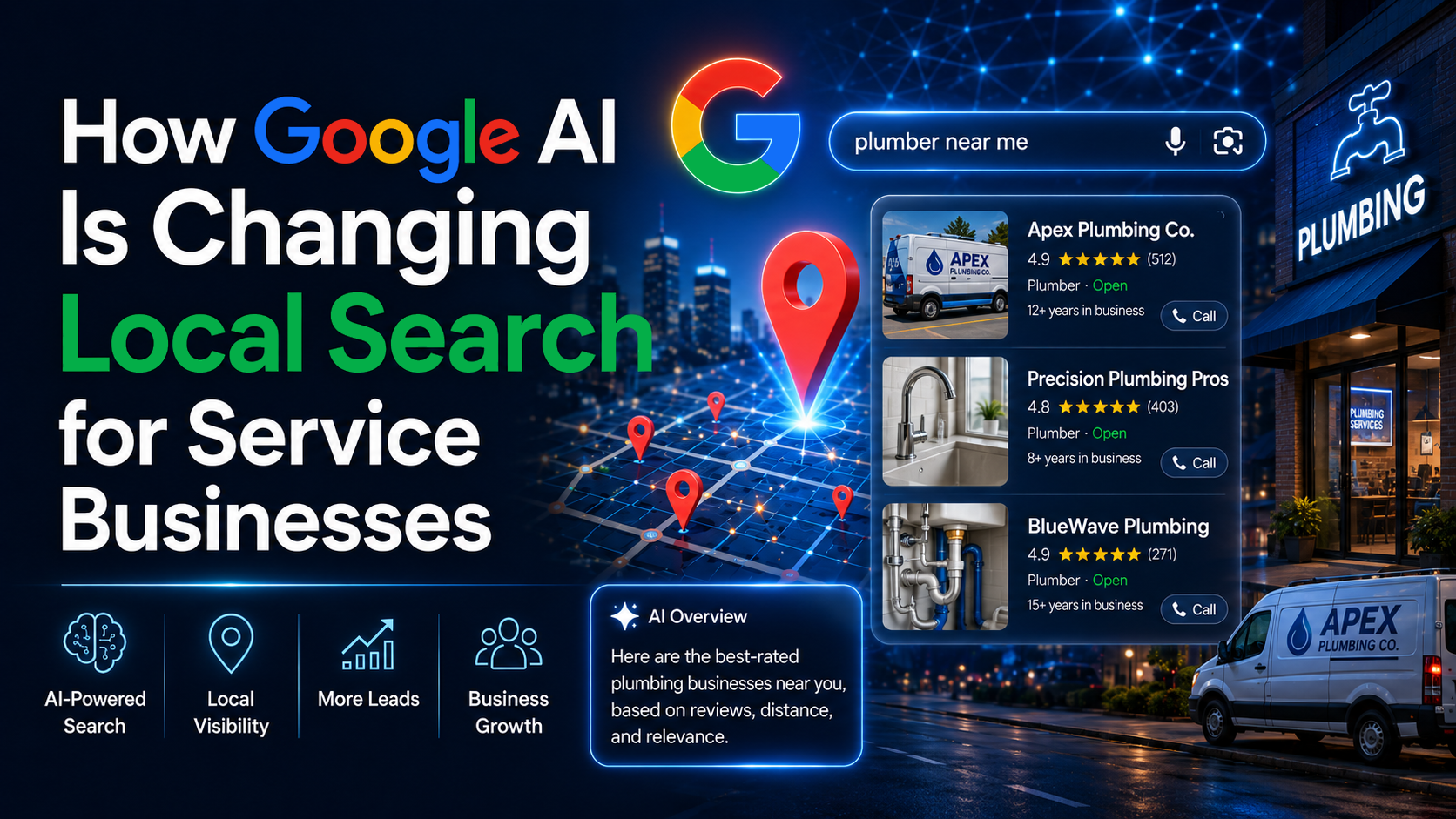
Local search is changing.
For years, service businesses focused heavily on keywords, proximity, reviews, and traditional Google rankings. Those factors still matter, but Google’s search experience is becoming increasingly AI-driven, which means the information surrounding your business now matters just as much as the keywords on a single page.
When someone asks Google a conversational question such as, “Who is the best mold inspection company near me?” or “Which plumber in my area handles emergency leaks?”, Google has to understand far more than a business name. It needs clear, consistent information about what the company does, where it operates, what customers say about it, and whether the information found across its website, Google Business Profile, and other trusted sources supports the recommendation.
For service-based businesses, that makes accuracy, consistency, and credibility more important than ever. In this guide, we’ll look at how AI is changing local search, why your Google Business Profile and website work together, how reviews and structured information help search engines understand your business, and the practical steps you can take to strengthen your visibility as search continues to evolve.
How Google’s AI-Driven Local Search Works
Google Search is becoming less about matching a few exact keywords and more about understanding what a person is actually trying to accomplish. Instead of simply looking at a search like “plumber near me” as a group of keywords, Google’s AI-powered systems are increasingly built to interpret the full meaning behind conversational searches such as:
- “Who can repair a leaking pipe near me tonight?”
- “Which mold inspection company serves Broward County?”
- “What local company has experience treating termites in older homes?”
- “Who offers same-day HVAC repair in my area?”
That changes the game for service businesses. Google is not only trying to identify businesses that are nearby. It is also trying to understand which businesses appear most relevant, credible, active, and trustworthy for that specific request.
From Keywords to Business Entities
One useful way to think about modern local search is that Google is trying to understand your business as an entity.
That entity includes much more than your website.
Google may encounter information about your company through your:
- Google Business Profile
- Website content
- Service pages
- Business directories
- Customer reviews
- Photos
- Structured data
- Social profiles
- Other trusted websites that mention your business
When those sources consistently tell the same story, it becomes easier for search systems to understand who you are, what you offer, and where you operate.
For example, imagine a restoration company whose website says it provides emergency water damage services in Fort Lauderdale. Its Google Business Profile lists the same service, its reviews mention emergency water removal, its directory listings show the same phone number and location, and its website includes detailed service information. That creates a much clearer picture than a business whose website says one thing, directory listings show outdated information, and Google Business Profile barely includes any service details.
Why Consistency Matters More in AI Search
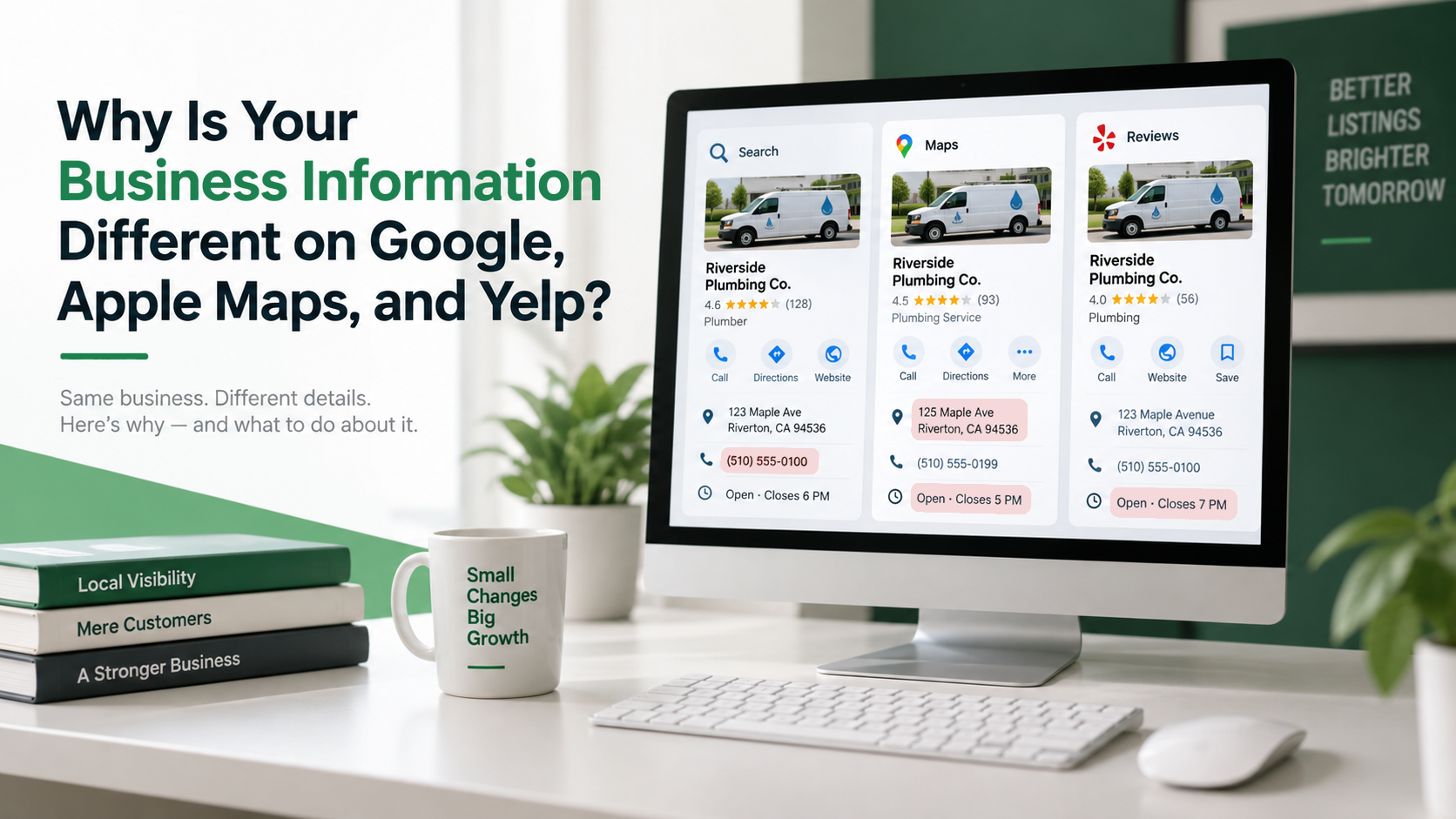
AI-powered search systems need reliable information to generate useful answers. If your business details are incomplete, outdated, or inconsistent across the web, Google has less confidence in the information it has available. On the other hand, when your website, Google Business Profile, reviews, and listings reinforce one another, you provide a stronger collection of signals that help search engines understand your business.
This is why local SEO is becoming less about repeating the same keyword over and over and more about providing clear, consistent proof of:
- What your business does
- Where you provide services
- Who you serve
- How customers describe their experience
- Whether your information is current
- Whether your business appears active and legitimate
The Rise of Zero-Click Search
Another major shift is that users do not always need to click a traditional website result to get an answer. Google can increasingly surface summaries, business information, photos, reviews, map results, and other details directly within the search experience. That means your business may be evaluated before someone ever reaches your website.
This does not make your website less important. It makes the quality and consistency of your entire online presence more important because Google may use information from multiple sources to understand whether your business is relevant to a search.
For service businesses, the takeaway is simple:
Your website, Google Business Profile, reviews, and business listings should all reinforce the same clear message about who you are and what you do.
Where Does Google’s AI Get Its Information?
Google’s AI-powered search experience does not rely on a single source when deciding what information to show. Instead, it pulls together signals from across the web to better understand a business, its services, its location, and whether the information appears consistent and trustworthy.
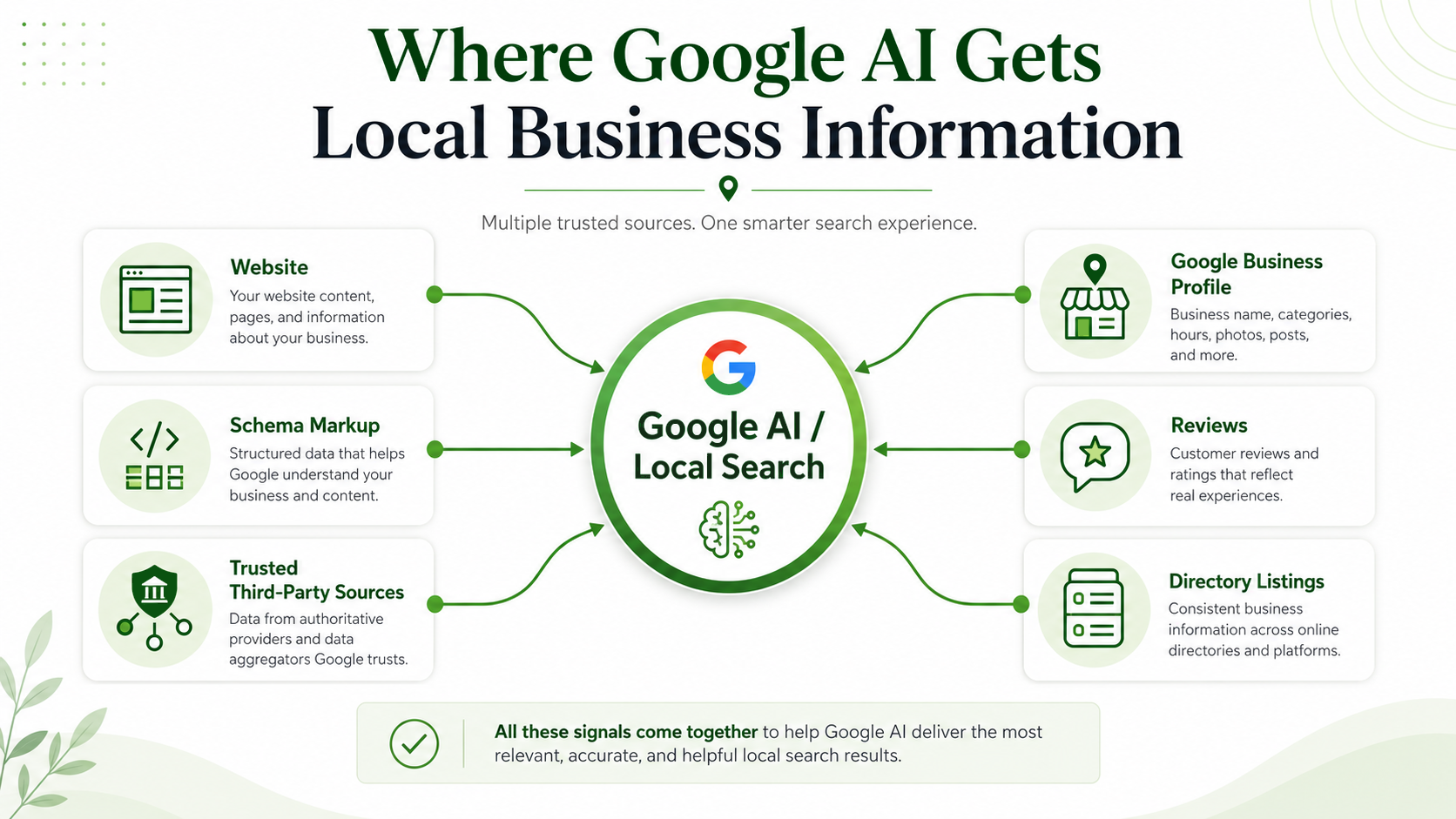
Some of the most important sources include:
- Your Google Business Profile. This gives Google direct information about your business name, categories, services, hours, service areas, photos, and other local details.
- Your website. Service pages, FAQs, location information, structured content, and technical SEO all help search systems understand what your business actually does.
- Customer reviews. Reviews provide real-world language about the services customers received, the areas served, and their overall experience.
- Business directories and citations. Consistent information across directories reinforces your business identity and local presence.
- Structured data. Schema markup helps search engines interpret important details such as your organization, services, location, and other business information.
- Trusted third-party sources. Mentions from chambers of commerce, industry directories, local organizations, and other reputable websites can help reinforce your business information.
The important thing is not simply being present in one of these places. It is making sure the information across them tells the same story.
If your website says you provide emergency plumbing in Fort Lauderdale, your Google Business Profile should reflect that service, your directory listings should display the correct business information, and your reviews may naturally reinforce that customers have actually used that service. That consistency helps create a clearer digital footprint.
Why Your Website Still Matters
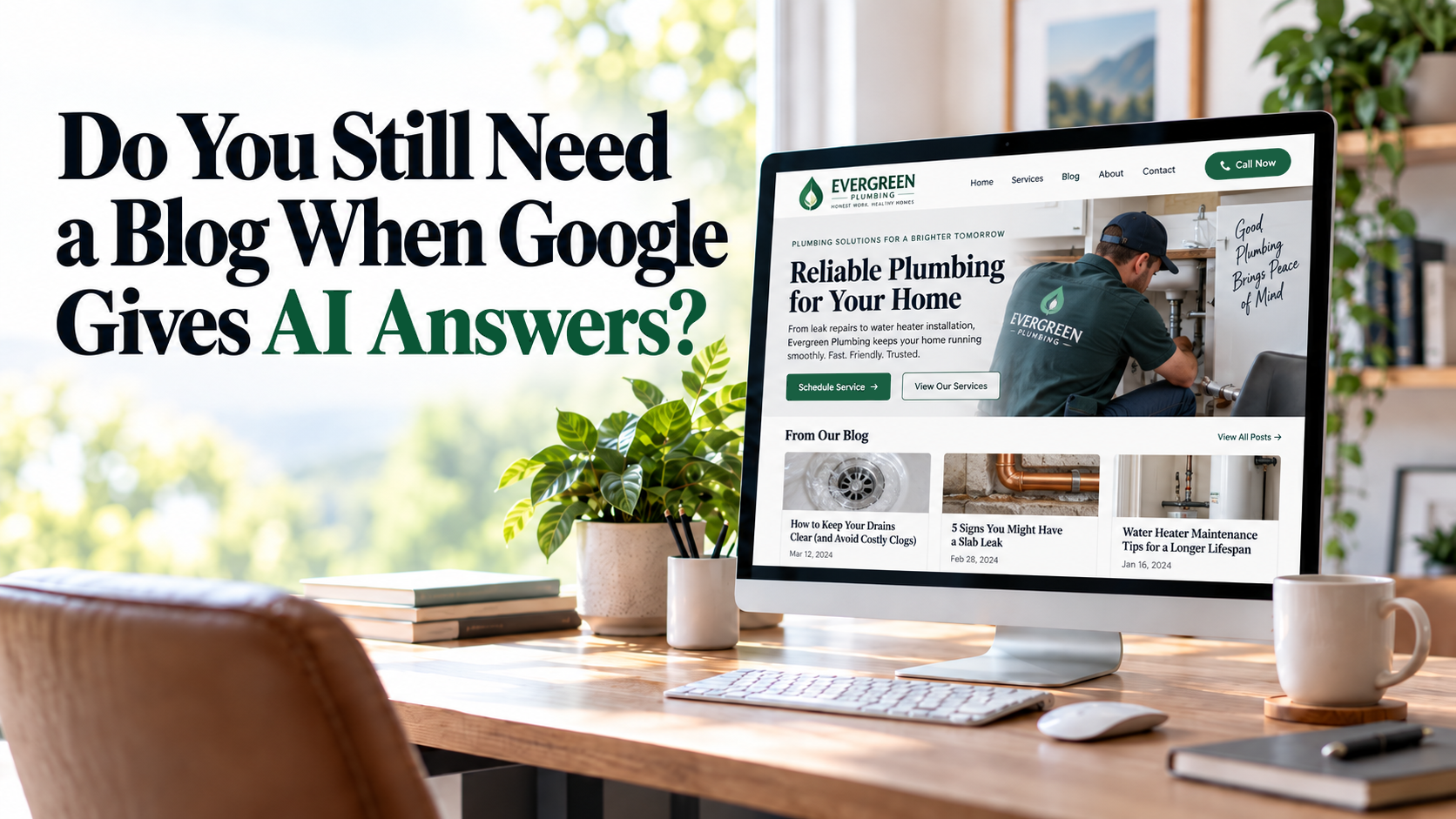
Even as Google displays more information directly in search results, your website remains one of the most important sources of detailed information about your business. A well-structured website gives search engines more context about your services, locations, expertise, and customer questions. This is where detailed service pages, FAQs, internal links, and structured data become especially valuable.
If your website is outdated, thin on content, or difficult for search engines to understand, our Website Design Services can help create a stronger foundation for both users and search visibility. And if you already have a solid website but want to improve how search engines understand and rank your content, our Search Engine Optimization (SEO) Services can help strengthen the technical, on-page, and content signals across your site.
Business Listings Reinforce the Same Story
Your website is only one part of your online presence. Accurate directory listings help reinforce your business name, address, phone number, website, categories, and other important details across the wider web. That consistency becomes increasingly important as AI-powered systems compare information from multiple sources.
Our Directory Listings Services help businesses maintain more consistent information across directories, mapping platforms, voice-search systems, and other business data networks. The stronger the agreement between your website, listings, reviews, and Google Business Profile, the easier it is for search systems to understand exactly who your business is and what you offer.
Why Your Website Needs to Answer Questions, Not Just Target Keywords
Natural Language Matters More
People do not always search with perfectly structured keywords anymore. They ask questions. They use voice search. They type long, conversational phrases.
And AI-powered search systems are designed to interpret those more natural requests.
That is why detailed service pages, educational articles, FAQs, and clearly written answers are becoming increasingly valuable. They give Google more information it can use to understand when your business may be relevant to a specific question.
This is also where Search Engine Optimization (SEO) Services go beyond inserting keywords into a page. A strong SEO strategy looks at search intent, content depth, website structure, technical health, and how clearly each page answers the questions potential customers are asking.
Structured Content Makes Your Website Easier to Understand
How your information is organized matters too. Clear headings, short sections, FAQs, service details, internal links, and structured data can make it easier for search engines to interpret the meaning of a page.
Instead of one giant block of text, your website should clearly communicate:
- The service being offered
- Who the service is for
- Where it is available
- Common customer questions
- What happens during the process
- What action visitors should take next
If you are not sure whether your current website has a strong SEO foundation, our Free SEO Audit Tool can help identify technical and on-page issues that may deserve a closer look.
And if your website itself is outdated, difficult to navigate, or lacking the content structure needed to support your marketing efforts, our Website Design Services can help create a stronger foundation for future growth.
The goal is no longer to write for an algorithm. It is to create clear, useful information for people in a format that search engines can easily understand.
Why Your Google Business Profile Matters More in AI-Driven Local Search
Your website gives Google depth, but your Google Business Profile gives it some of the most important local context about your business.
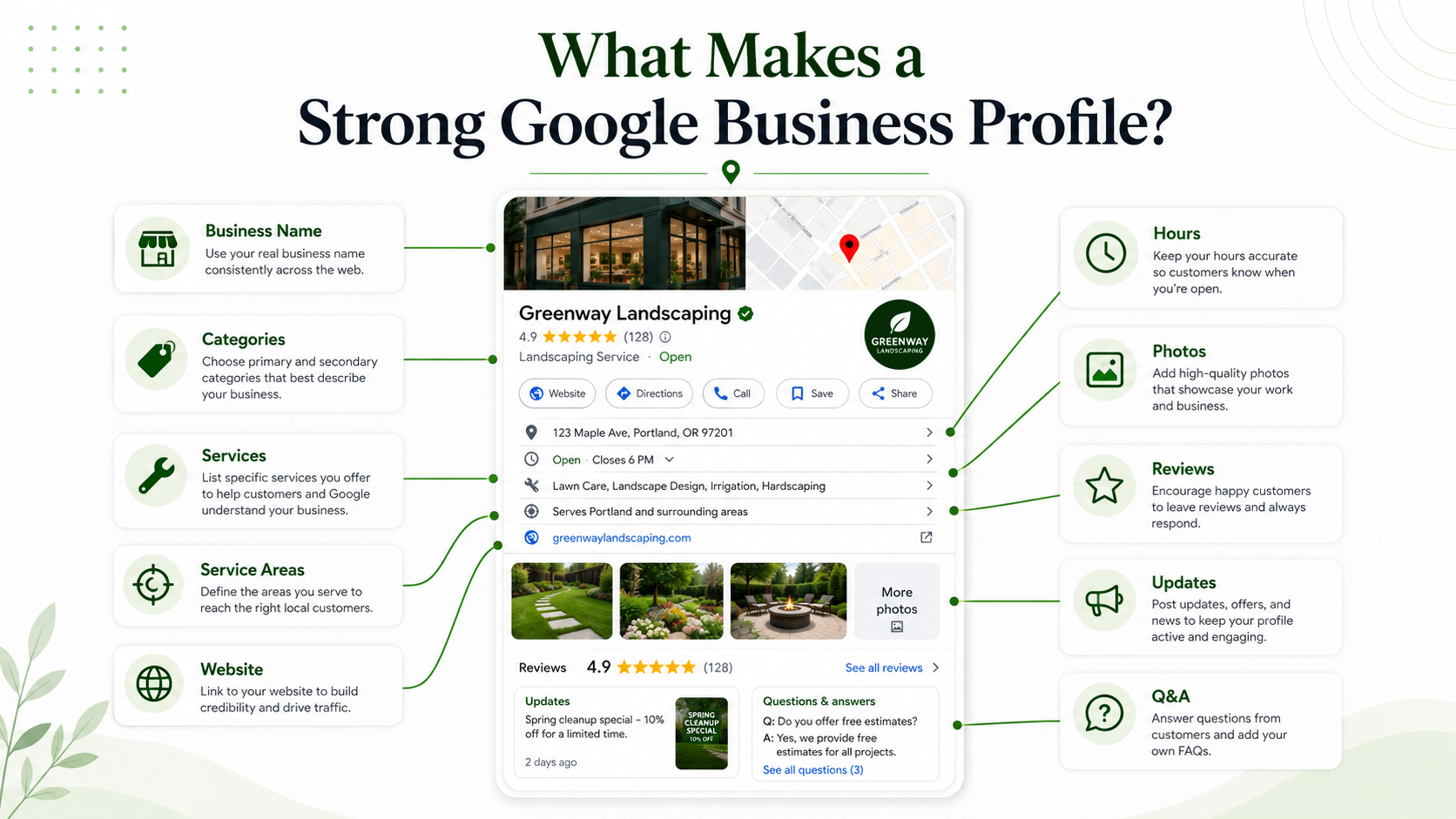
For service-based companies, this profile can help Google understand details such as your business category, service areas, hours, phone number, website, services, photos, and customer reviews. When that information is complete and consistent with the rest of your online presence, it creates a stronger picture of who you are and what you offer.
Complete Profiles Give Google More Context
A sparse profile leaves important questions unanswered.
Whenever possible, service businesses should keep key details current, including:
- Business name
- Primary and secondary categories
- Phone number
- Website
- Hours of operation
- Service areas
- Individual services
- Business description
- Photos
- Other available profile attributes
The goal is not to fill fields for the sake of filling them. It is to give customers and search systems accurate information they can rely on.
Fresh Information Shows That Your Business Is Active
Local business information changes. Hours get updated. Services expand. Photos become outdated. Businesses move or enter new service areas. Keeping your Google Business Profile current helps ensure that customers are seeing information that reflects the business as it operates today.
Regularly adding relevant photos, publishing useful updates when appropriate, answering questions, and reviewing your business information can help keep the profile from becoming stale.
However, updates should always be accurate and consistent with Google's policies. More activity is not automatically better if the information being added is misleading, repetitive, or unrelated to the business.
Your Profile and Website Should Tell the Same Story
This is where consistency becomes especially important.
If your Google Business Profile says you provide one set of services while your website says something completely different, search systems have to reconcile conflicting information.
A stronger setup looks like this:
- Your Google Business Profile lists your core services.
- Your website has detailed pages explaining those services.
- Your service areas are consistent across both.
- Your business name, phone number, and other key details match.
- Your Directory Listings reinforce the same information across other platforms.
When these pieces align, you create a clearer and more trustworthy digital footprint.
Our Directory Listings Services can help maintain consistent business information across directories, mapping systems, voice platforms, and other data networks, while our Search Engine Optimization (SEO) Services can help strengthen the website content and technical signals supporting your local visibility.
For AI-driven local search, your Google Business Profile should not exist in isolation. It should work together with your website, reviews, listings, and other online signals to provide a consistent picture of your business.
Why Reviews Matter More Than Just Your Star Rating
A strong star rating still matters, but reviews contain far more information than a simple number. AI-driven search systems can interpret the language people use in reviews, which means the details customers mention may help provide additional context about the services a business actually performs, the locations it serves, and the experiences people have had.
For example, a five-star review that simply says “Great company!” is positive, but it provides very little context. A review that says:
“They responded quickly to our emergency water damage issue in Fort Lauderdale and explained the entire mold testing process.” provides much more information about the service, location, customer experience, and type of problem the business handled.
Detailed Reviews Provide Useful Context
For service businesses, authentic customer reviews may naturally mention:
- Specific services performed
- Cities or neighborhoods served
- Responsiveness
- Communication
- Professionalism
- Customer service
- Results or outcomes
- The type of problem the customer needed solved
That language can help reinforce the same information appearing on your website and Google Business Profile. The goal is not to tell customers what keywords to include in their reviews. Reviews should always reflect the customer's genuine experience. Instead, focus on consistently providing excellent service and making it easy for satisfied customers to leave honest, detailed feedback.
Recent Reviews Show an Active Customer Experience
Review activity also gives potential customers a sense of whether a business is currently serving people. A company with reviews arriving consistently over time may appear more active than a business whose most recent feedback is several years old.
That does not mean an older business with hundreds of reviews suddenly becomes irrelevant. It simply means that ongoing customer feedback creates a more current picture of the business.
Encouraging reviews should therefore be an ongoing process rather than something businesses focus on once and then forget.
Responding to Reviews Builds Another Layer of Trust
Business owners should also respond to reviews when possible. A thoughtful response shows customers that the company is paying attention and gives the business an opportunity to reinforce useful context naturally.
For example, instead of responding with:
“Thanks!”
a business might say:
“Thank you for trusting our team with your mold inspection in Weston. We appreciate you taking the time to share your experience.”
The response is still written for the customer first, but it also provides clearer context about the service and location.
Reviews should work together with the rest of your online presence. When your customer feedback, Google Business Profile, website content, and Directory Listings consistently reinforce what your business does and where it operates, search systems have a clearer picture of the company behind the listing.
Our Search Engine Optimization (SEO) Services can help businesses strengthen the broader local search signals surrounding their website while keeping the focus on useful content, consistency, and long-term visibility.
Why Schema Markup and Technical SEO Matter for AI Search
A website can contain excellent information and still make that information difficult for search engines to interpret if the technical foundation is weak.
This is where technical SEO and structured data become important. Google’s systems need to crawl, understand, and organize the information on your website before that information can be used effectively in search. A technically healthy website makes that process easier.
Schema Markup Gives Search Engines More Context
Schema markup is structured code added to a website that helps search engines better understand what different pieces of information represent.
For a local service business, structured data may help clarify details such as:
- Business name
- Business type
- Address or service area
- Phone number
- Website
- Services
- Hours of operation
- Reviews or ratings, when eligible
- Frequently asked questions, where appropriate
Think of schema as an extra layer of labeling.
Your customers may see:
“We provide mold inspections throughout Broward County.”
Structured data can help search engines more clearly understand that the page is discussing a specific business, service, and location rather than simply reading those words without additional context. Schema does not guarantee rankings or inclusion in an AI-generated result. What it can do is make important information easier for search engines to interpret accurately.
Your Website Still Needs to Be Crawlable
Structured content is not very useful if search engines cannot properly access the website.
Technical problems can make it harder for Google to crawl or index important pages, including:
- Pages accidentally blocked from crawling
- Incorrect canonical tags
- Broken internal links
- Missing or confusing heading structures
- Poor mobile configuration
- Slow-loading pages
- Duplicate content
- Incorrect redirects
- Pages that are difficult to discover through the site’s navigation
This is one reason technical SEO should not be treated as something separate from content. The content may explain your services beautifully, but the technical foundation needs to make that information accessible.
If you are not sure whether your website has some of these issues, our Free SEO Audit Tool can check several important technical and on-page signals and give you a starting point for identifying areas that may need attention.
Speed and Mobile Experience Still Matter
AI may be changing how search results are presented, but the person clicking through to your website still expects a fast, easy experience. A website that loads slowly, breaks on mobile devices, or makes information difficult to find can create problems regardless of how sophisticated the search technology becomes.
Your website should be:
- Fast enough to use comfortably
- Responsive across phones, tablets, and desktops
- Easy to navigate
- Secure with HTTPS
- Structured logically
- Accessible to search engines
- Built around clear service information
If the technical foundation of your current site is holding you back, our Website Design Services can help create a modern, responsive website built with SEO best practices in mind.
For businesses that already have a solid website but need deeper optimization, our Search Engine Optimization (SEO) Services can help improve technical structure, on-page content, internal linking, and other signals that support long-term visibility.
AI search may feel new, but the underlying principle is familiar:
Google can only understand and recommend the information it can reliably access, interpret, and trust.
Takeaway Action Plan: What Service Businesses Should Do Now
AI-driven search is not about finding a new trick to “beat” Google. It is about giving Google more clear, consistent, trustworthy information about your business across every place that matters.
If you want to strengthen your visibility as local search becomes more AI-driven, start with these five priorities:
1. Keep Your Google Business Profile Accurate
Review your business name, phone number, website, hours, categories, services, service areas, photos, and other available details. If something changes in your business, update the profile so customers and search systems are not relying on outdated information.
2. Strengthen Your Website Content
Make sure your website clearly explains:
- What services you provide
- Where you provide them
- Who you help
- Common customer questions
- What makes each service different
- How someone can contact you
Your website should provide enough useful information for both people and search engines to understand your business without guessing. If your current website does not provide that foundation, our Website Design Services can help you build a more complete and user-friendly online presence.
3. Make Sure Your Business Information Matches Across the Web
Your name, address, phone number, website, and other important business details should remain consistent across directories, mapping platforms, and other data sources. Our Directory Listings Services can help distribute and maintain that information across a broader network of directories, voice platforms, mapping systems, and business data sources.
4. Build an Ongoing Review Strategy
Do not treat customer reviews as a one-time project. Continue providing strong service, make it easy for customers to leave honest feedback, and respond thoughtfully when reviews come in. The goal is to build a steady stream of authentic customer experiences that reflect what your business is actually doing today.
5. Keep Your SEO Foundation Healthy
Review technical issues, structured content, internal links, page organization, mobile usability, and other elements that help search engines access and understand your website.
If you want a quick starting point, our Free SEO Audit Tool can check several important on-page and technical SEO signals and highlight areas that may need attention. For businesses that need a more complete strategy, our Search Engine Optimization (SEO) Services can help strengthen your website content, technical foundation, local signals, and long-term search visibility.
The Bigger Picture
The businesses most prepared for AI-driven search will not necessarily be the ones repeating the most keywords.
They will be the businesses giving search engines the clearest evidence of:
- Who they are
- What they do
- Where they operate
- Whether their information is accurate
- Whether customers trust them
- Whether their website provides useful answers
- Whether their online presence is current and consistent
That is the real shift.
Local search is becoming less about telling Google you are relevant and more about giving Google enough reliable information to understand why you are relevant.
Frequently Asked Questions About Google AI and Local Search
As Google continues adding AI-driven features to Search and Maps, local businesses naturally have questions about what these changes mean for their visibility online.
Build the Kind of Online Presence Google Can Understand and Trust
AI may be changing the way search results are presented, but the fundamentals still come back to the same thing: clarity, consistency, and trust.
For service-based businesses, that means keeping your Google Business Profile accurate, maintaining a technically healthy website, publishing useful content, earning authentic reviews, and making sure your business information matches across the web. When those pieces reinforce one another, search systems have a much clearer picture of who you are, what you do, and where you operate.
The businesses that adapt best to AI-driven search will not be the ones chasing every new tactic. They will be the ones building a strong digital presence that gives Google reliable information to work with while also creating a better experience for real customers.
Ready to Strengthen Your Visibility in an AI-Driven Search World?
At The Business Theory, we help businesses strengthen the different pieces of their online presence so they work together instead of operating separately.
Our Search Engine Optimization (SEO) Services help improve website structure, content, technical health, and search visibility. Our Directory Listings Services help maintain more consistent business information across directories, mapping systems, voice platforms, and other data networks. And if your website itself needs a stronger foundation, our Website Design Services can help you build a modern, responsive site designed around both users and search engines.
Not sure where your website currently stands? Start with our Free SEO Audit Tool for a quick look at several important on-page and technical SEO signals.
If you are ready to build a stronger, more consistent online presence, Contact The Business Theory to discuss which digital marketing services make the most sense for your business.
About The Business Theory
The Business Theory is an award-winning website design and digital marketing agency helping service-based businesses build stronger online presences and attract more qualified customers. We specialize in custom website design, Search Engine Optimization (SEO), directory listings, Google Ads, Meta Ads, social media posting, content marketing, and link building, with strategies tailored to each business rather than a one-size-fits-all approach. Whether you need a new website, stronger search visibility, or a more coordinated digital marketing strategy, explore our services or schedule a free consultation to learn how The Business Theory can support your business goals.