How Much Should a Small Business Spend on Google Ads?
Share this article
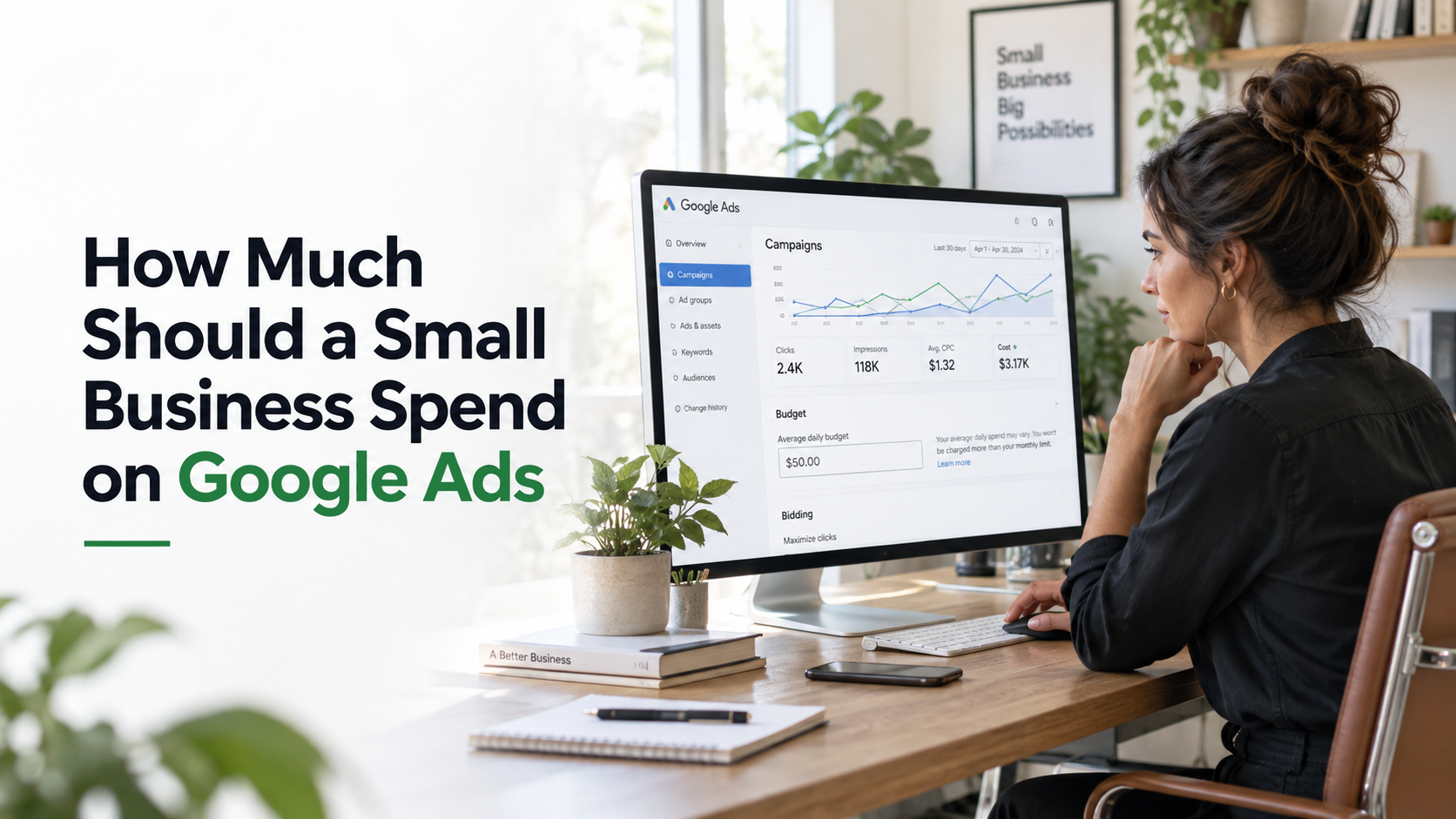
How much should a small business spend on Google Ads? That question sounds simple, but the real answer depends on more than picking a monthly number. A practical budget has to account for the money paid directly to Google, professional management costs when an agency is involved, campaign setup, conversion tracking, landing-page readiness, competition, and the value of a new customer.
Direct answer:
There is no universal Google Ads budget for every small business. The appropriate amount depends on the business's market, cost per click, geographic targeting, competition, lead goals, conversion rate, and customer value. A useful budget must generate enough relevant activity to evaluate performance without exceeding what the business can reasonably afford to acquire a customer.
A focused local campaign may work with a smaller budget, while competitive South Florida service markets may need more room to collect meaningful data. Spending more still cannot fix poor targeting, broken tracking, or a weak landing page.
This article focuses specifically on budgeting and the complete investment behind a Google Ads campaign. If you want a broader overview of paid search, see The Business Theory's Google Ads Management Services.
How Much Should a Small Business Spend on Google Ads?
A small business should spend enough to reach a meaningful number of relevant searches and evaluate qualified lead performance, but not so much that the advertising cost becomes financially uncomfortable. The right amount depends on the service being promoted, the size of the market, competition, estimated click costs, expected conversion behavior, and the value of a customer.
A realistic starting budget should be built around factors such as:
- The specific services being advertised.
- The geographic service area and how many locations are being targeted.
- Competition from other advertisers.
- Estimated cost per click for relevant searches.
- The number of qualified leads the business hopes to generate.
- The website or landing page conversion rate.
- The percentage of qualified leads that become customers.
- Average customer value and potential repeat business.
- Profit margin and service-delivery costs.
- How much time the business can reasonably allow for testing and optimization.
Smaller budgets may work for narrowly targeted campaigns but can collect data more slowly. Larger budgets can create more testing opportunities, but they do not fix poor targeting, weak offers, tracking problems, or ineffective landing pages.
What Costs Are Included in a Google Ads Campaign?
The total Google Ads investment can include more than the amount charged by Google. Business owners should separate advertising spend from management fees, one-time setup costs, and any website or landing-page improvements needed to turn ad traffic into qualified inquiries.
Advertising Spend Paid to Google
Advertising spend is the budget used to deliver the ads. This money is paid directly to Google and is separate from any agency management fee. Depending on campaign type and bidding strategy, the budget may fund clicks, conversions, or other campaign activity.
- The advertising budget is paid directly to Google.
- Campaign budgets help control how much the account is intended to spend.
- Google uses average daily budgets for most campaigns.
- For most campaigns, Google may spend up to twice the average daily budget on a high-opportunity day, while the monthly spending limit is generally 30.4 times the average daily budget.
- Average daily budgets can be changed as the business learns more about campaign performance.
This means a campaign does not necessarily spend the exact same amount every day. Google can shift more spend toward days with greater traffic or conversion opportunity while staying within applicable spending limits.
Google Ads Management Fee
A management fee pays for the professional work involved in creating, monitoring, and improving the campaign. It is separate from the advertising money Google uses to deliver the ads.
- Campaign strategy and keyword research.
- Campaign creation and targeting.
- Ad copy development.
- Search-term monitoring and negative keywords.
- Budget management.
- Conversion tracking.
- Testing and ongoing optimization.
- Performance reviews and reporting.
For business owners comparing agencies, the advertising spend and management fee should always be shown separately.
Initial Campaign Setup
A new campaign may also require a one-time setup fee because the account needs to be configured before meaningful optimization can begin. Setup can include account structure, keyword research, location targeting, conversion tracking, audience configuration, ad creation, budget recommendations, and retargeting preparation when appropriate.
Website and Landing-Page Costs
Some businesses need website work before or alongside the advertising campaign. Paying for clicks does not guarantee that a visitor will call, book, or submit a form. If the page is slow, confusing, weak on mobile, or missing trust signals, the campaign may bring traffic without producing enough qualified leads.
- Landing-page improvements.
- New service pages.
- Stronger calls to action.
- Mobile usability improvements.
- Page-speed improvements.
- Call tracking and form tracking.
- Trust-building content, reviews, credentials, or service details.
If the website itself is the weak point, our custom website design services can address the conversion experience separately from the ad campaign.
What Determines the Cost of Google Ads?
Google Ads costs vary because the advertising auction changes by search, location, competition, intent, campaign settings, and the quality of the experience surrounding the ad. There is no universal cost per click that applies to every small business, even within the same industry.
- Industry and advertiser competition.
- Geographic market and service radius.
- Customer search intent.
- Keyword specificity.
- Campaign type and bidding approach.
- Device targeting and user behavior.
- Time of day and ad scheduling.
- Landing-page relevance and experience.
- Conversion tracking quality.
- Competitor activity and search demand.
- The specific services being advertised.
A narrowly targeted local service can face a very different auction from a company advertising across all of South Florida, even within the same industry.
How Can You Calculate a Starting Google Ads Budget?
A useful starting budget can be planned by working backward from qualified lead goals instead of choosing a random number. Start with the number of leads the business would like to generate, estimate an acceptable cost per qualified lead, and then use actual campaign data to refine the plan.
Start With Your Lead Goal
Decide how many qualified inquiries the business can realistically handle each month. A lead goal should reflect staffing, scheduling capacity, average close rate, and the number of new customers the business actually wants.
Estimate an Acceptable Cost Per Lead
An acceptable cost per lead is not the same for every business. A company selling a high-value recurring service may be able to pay more for a qualified opportunity than a business with a small one-time transaction.
- Average customer value.
- Profit margin.
- Lead-to-customer close rate.
- Repeat business.
- Customer lifetime value.
- Service-delivery costs.
Connect the Budget to the Goal
Planning formula: Estimated Monthly Advertising Budget = Desired Qualified Leads × Acceptable Cost Per Lead
This formula is a planning estimate, not a prediction. It connects budget planning to business outcomes rather than competitor spending.
Hypothetical example: A service business wants 20 qualified leads per month and can reasonably afford to spend $100 per qualified lead. Its estimated advertising budget would be approximately $2,000 per month. Actual performance could be higher or lower, so early campaign data should be used to refine the estimate.
Can a Small Business Start Google Ads With $500 Per Month?
Yes, $500 per month can work in some very focused situations, but it may be too limited for competitive service industries or broad geographic targeting. The real question is whether that amount can buy enough relevant traffic to produce useful conversion data without spreading the campaign too thin.
- The campaign may receive only a small number of clicks.
- Keyword coverage may need to be extremely narrow.
- Geographic reach may be limited.
- Data collection may take longer.
- Testing multiple ads or landing pages may be difficult.
- A few expensive clicks can consume a meaningful share of the budget.
A $500 budget may be reasonable for one service in a lower-cost, tightly defined market. It may be too restrictive for several services across multiple South Florida counties.
What Is a Realistic Google Ads Budget for a Local Service Business?
A realistic budget depends on the market, but the ranges below can help business owners think about campaign scope. These are planning examples, not promises about clicks, leads, or performance.
| Approximate Monthly Ad Spend | Possible Campaign Scope | Main Limitation or Consideration |
|---|---|---|
| Under $1,000 | Very focused service, keyword set, or geography | May collect data slowly and leave little room for testing. |
| $1,000 to $2,500 | Focused local campaign with more keyword and service coverage | Still requires careful prioritization in competitive markets. |
| $2,500 to $5,000 | Multiple services, broader geography, or more testing capacity | Budget must still be tied to lead quality and conversion tracking. |
| More than $5,000 | Competitive markets, multiple campaigns, locations, or higher search volume | Larger spend magnifies both strong strategy and campaign mistakes. |
Smaller budgets usually require tighter targeting. Larger budgets may support more services, locations, or testing, but every campaign still needs accurate tracking and ongoing optimization.
How Much Does Google Ads Management Cost?
Google Ads management pricing varies by agency. Common models include fixed monthly fees, percentages of advertising spend, performance-based arrangements, or tiered pricing tied to the size of the ad budget. Transparent fixed pricing can make monthly expenses easier to forecast because the business knows the management cost separately from the Google advertising spend.
When comparing management fees, review what is included. A lower fee may omit tracking, search-term reviews, testing, landing-page recommendations, or reporting.
The Business Theory's Google Ads Management Pricing
The Business Theory uses tiered monthly management pricing based on the amount of Google Ads spend being managed. Pricing below is current as of October 2026 and was confirmed on the live Google Ads service page before publication.
| Plan | Monthly Google Ads Spend Managed | Monthly Management Fee |
|---|---|---|
| Pro | Up to $2,500 | $747.50 |
| Plus | $2,500 to $5,000 | $997.50 |
| Platinum | $5,000 or more | $1,247.50 |
- One-time Google Ads setup fee: $249.
- The advertising budget is paid directly to Google.
- The monthly management fee is paid to The Business Theory.
- The setup fee covers initial campaign preparation and configuration.
You can review the current inclusions and pricing on our Google Ads management plans.
What Would the Total Monthly Google Ads Investment Look Like?
The easiest way to understand the total investment is to separate Google ad spend, management, and the one-time setup fee. The examples below are hypothetical illustrations using The Business Theory's current management pricing.
| Example | Google Ad Spend | Management Fee | One-Time Setup | First-Month Total | Ongoing Monthly Total |
|---|---|---|---|---|---|
| Focused Pro campaign | $1,500 | $747.50 | $249 | $2,496.50 | $2,247.50 |
| Full Pro budget | $2,500 | $747.50 | $249 | $3,496.50 | $3,247.50 |
| Midrange Plus campaign | $4,000 | $997.50 | $249 | $5,246.50 | $4,997.50 |
| Growing Platinum campaign | $6,000 | $1,247.50 | $249 | $7,496.50 | $7,247.50 |
These examples are not recommended budgets for every business. The advertising amount should be based on the company's market, services, competition, lead goals, and financial capacity. Additional website or landing-page work would be quoted separately if needed.
How Do You Know Whether Your Google Ads Budget Is Working?
A working budget should be judged by qualified business outcomes, not simply by how many clicks or impressions the campaign receives. Clicks and impressions are useful diagnostic data, but they do not prove profitability.
- Qualified leads.
- Cost per qualified lead.
- Booked appointments, consultations, or estimates.
- New customers.
- Customer acquisition cost.
- Lead quality.
- Conversion rate.
- Search-term relevance.
- Revenue connected to advertising when tracking allows.
- Missed calls and lead follow-up performance.
For the deeper measurement process, read our guide on how to measure Google Ads ROI.
What Common Problems Waste a Google Ads Budget?
A Google Ads budget is often wasted by setup, targeting, tracking, or follow-up problems rather than by the budget amount itself. Increasing spend before fixing these issues can make the inefficiency more expensive.
- Running ads without conversion tracking.
- Targeting locations outside the actual service area.
- Using broad or irrelevant keywords.
- Failing to review search terms.
- Sending every click to the homepage.
- Using an offer that does not match the advertisement.
- Ignoring mobile users.
- Counting every recorded conversion as a qualified lead.
- Missing phone calls.
- Responding too slowly to inquiries.
- Spreading a small budget across too many services.
- Increasing the budget before fixing campaign problems.
- Making constant changes before enough data is available.
Professional management cannot fix every sales or follow-up problem inside a business, but good campaign management can help identify whether the issue appears to be the campaign, the landing experience, lead tracking, or the way inquiries are handled after they arrive.
Should You Manage Google Ads Yourself or Hire an Agency?
Self-management can make sense for a knowledgeable business owner with enough time and a relatively simple campaign. Professional management may make more sense when the account is more competitive, tracking is unreliable, multiple services or locations are involved, or the owner cannot consistently monitor search terms, budgets, and conversions.
| Consideration | Self-Management | Professional Management |
|---|---|---|
| Time commitment | Owner handles setup, reviews, testing, and adjustments. | Agency performs ongoing monitoring and optimization. |
| Learning curve | Requires learning Google Ads terminology and account structure. | Strategy and account management are handled by specialists. |
| Keyword research | Owner selects and maintains keywords. | Agency researches keywords and monitors search terms. |
| Conversion tracking | Owner must configure and verify tracking. | Agency can help configure and audit conversion tracking. |
| Ongoing optimization | Depends on owner's available time and skill. | Built into the management process. |
| Search-term monitoring | Must be reviewed manually and consistently. | Reviewed as part of campaign management. |
| Accountability | Owner evaluates all campaign decisions. | Agency provides an outside strategy and review process. |
| Management cost | No agency management fee. | Monthly professional management fee applies. |
| Risk of wasted spending | Higher if setup or monitoring is weak. | Management can reduce avoidable waste, but cannot guarantee results. |
| Reporting | Owner builds or interprets reports. | Agency provides reporting and performance context. |
Professional management may be especially useful when spend is substantial, competition is high, tracking is unreliable, multiple locations are involved, or past campaigns produced unclear results.
Is Professional Google Ads Management Worth the Cost?
Professional management can be worth the cost when better strategy, tracking, search-term control, testing, and optimization help a business make better use of its advertising budget. The fee should be evaluated against the quality of management and the value of reducing avoidable waste, not treated as a guarantee of performance.
Campaign success still depends on the market, services, competition, website, offer, budget, demand, and lead follow-up. Professional management cannot guarantee that every click becomes a customer.
If you are comparing providers, our guide on how to choose a Google Ads agency in South Florida explains what to evaluate before hiring.
Frequently Asked Questions About Google Ads Budgets
Google Ads budgeting questions usually come down to how much traffic a business can afford to test, what a qualified lead is worth, and how the ad spend fits with management and conversion costs. These short answers address the most common questions small-business owners ask before launching or expanding a campaign.
Build Your Google Ads Budget Around Qualified Leads
The right Google Ads budget is not simply the largest amount a business can afford to spend. It should be connected to customer value, qualified lead goals, competition, targeting, conversion tracking, and the company's ability to turn inquiries into customers.
A professionally managed campaign should connect advertising spend to measurable business outcomes rather than focusing only on clicks. The budget, targeting, landing experience, and follow-up process all need to work together so the business can make informed decisions about whether to scale, refine, or reduce spending.
Ready to Build a Google Ads Strategy Around Your Budget?
The Business Theory can review your services, target locations, goals, website, competition, and available advertising budget to help determine which Google Ads Management Services option may be the best fit for your business. Our goal is to build a campaign structure around qualified opportunities and measurable performance rather than recommending a larger budget simply for the sake of spending more.
If you are considering Google Ads or want a professional review of an existing campaign, schedule a free consultation to discuss your budget, campaign needs, and which digital marketing services may make the most sense for your goals.
About The Business Theory
The Business Theory is an award-winning website design and digital marketing agency helping service-based businesses build stronger online presences and attract more qualified customers. We specialize in custom website design, Search Engine Optimization (SEO), directory listings, Google Ads, Meta Ads, social media posting, content marketing, and link building, with strategies tailored to each business rather than a one-size-fits-all approach. Whether you need a new website, stronger search visibility, or a more coordinated digital marketing strategy, explore our services or schedule a free consultation to learn how The Business Theory can support your business goals.