Local SEO vs. Directory Listings: Where Should You Start?
Share this article
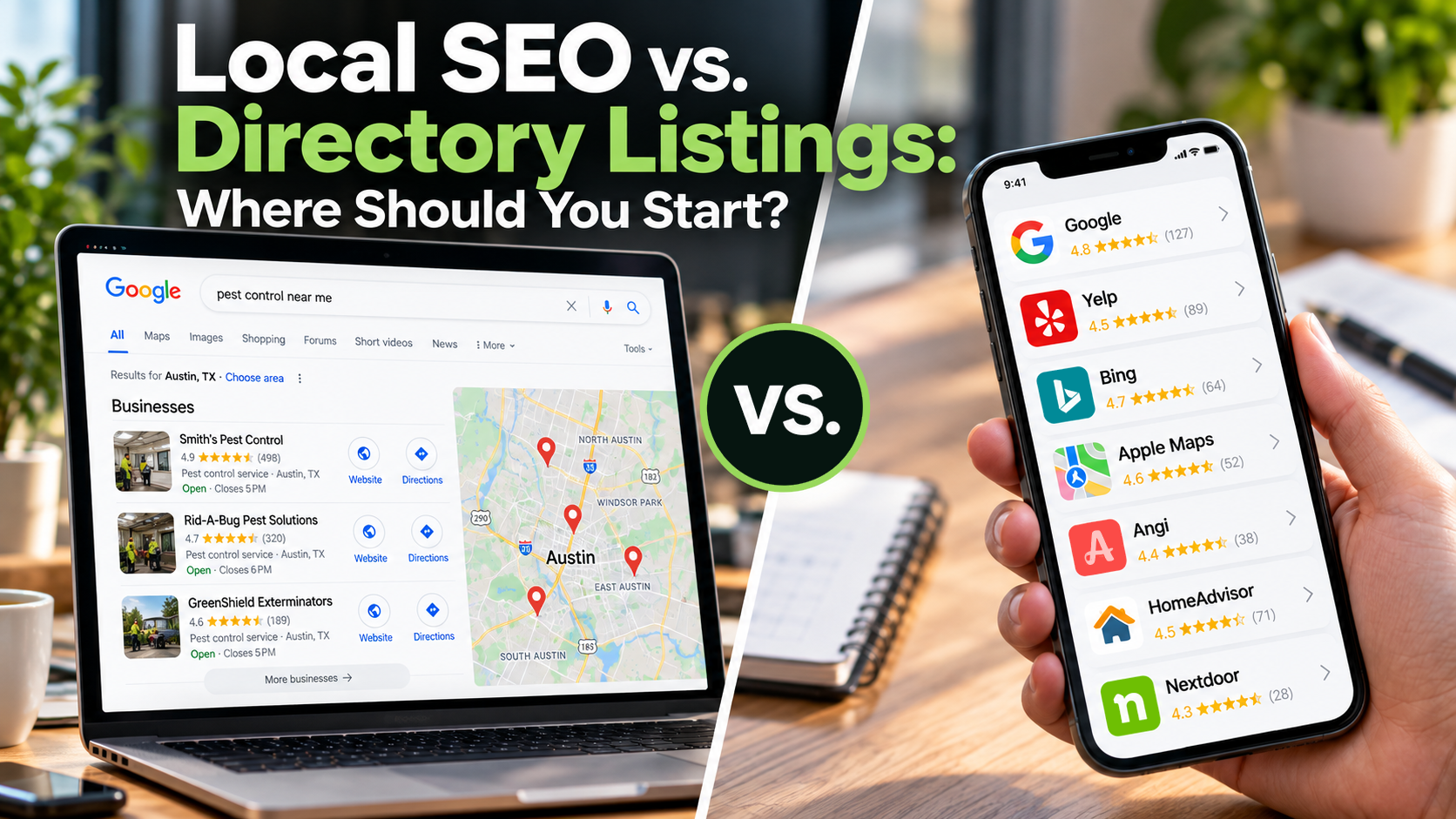
Should you start with local SEO or directory listings?
Start with directory listings when customers are finding incorrect phone numbers, outdated addresses, conflicting hours, or duplicate business profiles. Start with broader local SEO when your information is accurate but your website does not clearly explain your services or attract relevant local searches. Many businesses need both, but the first investment should address the problem that most directly prevents qualified customers from finding or contacting you.
The distinction matters because visibility and accuracy solve different problems. Directory management helps customers verify and reach a business. Local SEO also addresses service pages, local relevance, site structure, content, and the path from search to inquiry. Neither guarantees rankings or leads.
What is the difference between local SEO and directory listings?
Local SEO is the broader process of improving how a business appears for searches related to its services and geographic market. Directory listings are public records on third-party platforms that display a business name, phone, website, hours, address, or service area. Listings can support local search, but are not a complete SEO strategy.
What does local SEO include?
A local SEO plan can improve service pages, internal links, geographic clarity, technical foundations, and content that answers buyer questions. The work should be prioritized around actual customer needs and search opportunities. Our local SEO services describe the broader offering.
- Service pages that explain what is included and who qualifies.
- Accurate coverage details for locations actually served.
- Useful navigation, internal links, and clear contact options.
- Monitoring relevant search queries and priority landing pages.
A contractor whose website only says “quality solutions” may need clearer service descriptions before additional citations would make a meaningful difference.
What does directory listing management include?
Listing management focuses on finding, claiming, correcting, and maintaining business records on supported platforms. It is particularly relevant after a relocation, phone change, rebrand, or acquisition. Directory listing services can reduce the work of correcting information in multiple places.
Confirm the official business name and contact details.
Identify high-priority inaccurate or duplicate records.
Submit corrections to supported platforms.
Maintain consistency when business information changes.
Google recommends claiming a Business Profile and verifying the official website in Search Console. Its Google guidance on business details explains how businesses can make key information available in Search and Maps.
When should directory listings come first?
Prioritize listings when an error could cause a missed call, wasted trip, or mistaken belief that your business is closed. Those are immediate customer-experience problems even if the website receives search traffic. Correcting a broken contact path is often more urgent than creating another article.
Which accuracy problems deserve attention?
Search your business name, phone number, and any former address. Review the profiles a customer is likely to encounter and compare them with your official website. Not every punctuation difference matters equally; focus on mistakes that change whether a customer can reach you.
- A disconnected or outdated phone number.
- A former location presented as current.
- Incorrect opening hours.
- Conflicting duplicate profiles.
- An address displayed contrary to service-area business rules.
For a deeper explanation, see our article on business information differences across Google, Apple Maps, and Yelp. Updating a master business-information record first can help avoid repeated contradictions.
Hypothetical example: a plumbing company changes numbers
Imagine a Broward County plumbing company that changes its main phone number. Its website is correct, but several directories still display the old line. Correcting the most visible records is the logical first step. New location pages would not solve missed calls. Once customers can reliably reach the company, broader SEO can be evaluated.
When should broader local SEO come first?
Choose broader SEO when business information is dependable but your website does not answer the questions behind important searches. A company might have accurate profiles yet offer only a generic homepage with no clear description of its highest-value services. Visitors need enough information to decide whether to contact the business.
Does your website match customer search intent?
A person searching for commercial air-conditioning maintenance in Fort Lauderdale wants to confirm the provider handles commercial systems in that area. A general promise of reliable service may not answer the question. A useful service page can explain the work, the customers served, common concerns, and how to request a quote.
- Give important services distinct, useful explanations.
- State geographic coverage accurately.
- Answer practical questions about the process and suitability.
- Make calls and inquiry forms easy to find on mobile.
Location references should add real value. Publishing dozens of near-identical city pages solely to increase page count is not a substitute for clear, helpful content.
Hypothetical example: a mold-testing business has accurate profiles
Suppose a mold-testing company has correct directory records but a website that never explains the difference between inspection and remediation or what an appointment involves. Additional citations would not answer those questions. Improving its actual service descriptions and supporting educational content is the more relevant next step.
How do you diagnose the right problem before spending?
Separate business-information accuracy, search visibility, and lead quality. These are related, but they are not the same. Search impressions show exposure; they do not prove that someone contacted the company or purchased a service. A simple audit helps determine where the customer journey breaks down.
Run a three-part assessment
First, inspect your most visible public profiles. Second, review whether your website has useful pages for your most important services and locations. Third, test the inquiry process on a mobile phone. Record obstacles and rank them by their likely effect on a qualified customer.
- Accuracy: Can customers find the right contact details?
- Relevance: Does the website explain what you offer and where?
- Conversion: Can a suitable visitor easily request service?
Search Console can show which queries and pages generate impressions and clicks. Compare that information with actual calls, forms, and qualified inquiries rather than assuming traffic equals revenue.
What if both listings and website pages need improvement?
Correct errors that prevent immediate contact while improving one or two high-priority service pages. The business does not need to wait until every directory is updated before improving its website. A phased approach can be more practical than purchasing every marketing service at once.
What should the first 30 days look like?
The first month should establish a baseline and remove obvious obstacles, not promise first-page rankings. Directory changes may take time to propagate, and organic search results can fluctuate. Prioritize the work that has the clearest connection to customers.
Week one: confirm the official business record
Document the name, phone, website, hours, public address or service area, and primary services. Check the website first, then compare important public profiles. Service-area businesses should follow platform rules about whether an address may be shown.
Weeks two and three: fix the highest-impact gaps
Correct the most consequential listing errors. Improve one or two service pages that are directly relevant to qualified inquiries. Add useful details, realistic coverage, and clear contact options. Our local SEO checklist offers additional practical steps.
Week four: verify the work and plan the next cycle
Check whether corrections are visible, test forms and calls, and review early search and inquiry data. Record what changed and when. Decide whether the next month should focus on unresolved accuracy issues, service-page improvements, or supporting content.
How much should you budget for either service?
There is no universal price. A single-location company with a few incorrect records has a different scope from a multi-location business with many duplicate profiles and an underdeveloped website. Request a proposal that separates initial cleanup from ongoing management and explains deliverables.
What should you ask before hiring a provider?
For listings, ask which platforms are supported and how duplicates or future changes are handled. For SEO, ask which pages and search intents are prioritized, whether content and technical work are included, and how results will be reported.
- What happens in the first month?
- Which tasks are one-time and which recur?
- Who controls the website and business profiles?
- How are completed changes documented?
- What is excluded or billed separately?
Avoid promises of guaranteed Maps positions or a fixed number of leads. Outcomes depend on the market, website, business fit, and customer demand.
How should you measure results?
Measure outcomes tied to the original problem. For listings, verify that important records display accurate information and that calls reach the right business. For SEO, track relevant search visibility, useful landing-page traffic, and suitable inquiries. More impressions alone do not establish commercial success.
Create a simple monthly scorecard
Before making changes, record the current state. Track corrected profiles and remaining conflicts, relevant search queries and pages, contact actions, and the quality of inquiries. A small set of meaningful measures is more useful than a long report of disconnected numbers.
- Accuracy: Are essential public details correct?
- Visibility: Are relevant service pages being discovered?
- Contact: Do forms and phone numbers work?
- Lead quality: Are inquiries from customers you can serve?
- Business outcome: Do those inquiries become real opportunities?
Hypothetical example: an increase from 100 to 200 impressions indicates more exposure, not 100 new customers. Likewise, twenty forms are not twenty qualified leads if many request services the company does not offer.
Can local SEO and directory listings work together?
Yes. Accurate listings reduce confusion, while useful website pages explain why someone should contact the business. A customer might verify the company on a directory and then read a service page before requesting an estimate. These approaches complement each other but serve different functions.
Think of listings as part of the information foundation and SEO as the broader strategy for relevance and discoverability. Our directory listing guide discusses citations in more detail. Neither approach replaces a clear website, reliable service, or straightforward communication.
Frequently asked questions about local SEO and listings
These questions help business owners distinguish between the two services and make a sensible first investment. The right sequence depends on the condition of the website, public profiles, and actual customer inquiries.
Where should your business start?
If customers cannot reliably reach you, correct the information they encounter. If details are accurate but the website does not communicate your services or attract relevant searches, consider broader SEO. If both need work, begin with the most urgent accuracy corrections and the pages most likely to attract qualified inquiries.
The Business Theory provides directory listing services and local SEO services for service businesses. To discuss the most practical next step for your website and local presence, contact The Business Theory to request a free consultation.
About The Business Theory
The Business Theory is an award-winning website design and digital marketing agency helping service-based businesses build stronger online presences and attract more qualified customers. We specialize in custom website design, Search Engine Optimization (SEO), directory listings, Google Ads, Meta Ads, social media posting, content marketing, and link building, with strategies tailored to each business rather than a one-size-fits-all approach. Whether you need a new website, stronger search visibility, or a more coordinated digital marketing strategy, explore our services or schedule a free consultation to learn how The Business Theory can support your business goals.