Can AI Build a Website That Actually Ranks on Google and Generates Leads?
Share this article
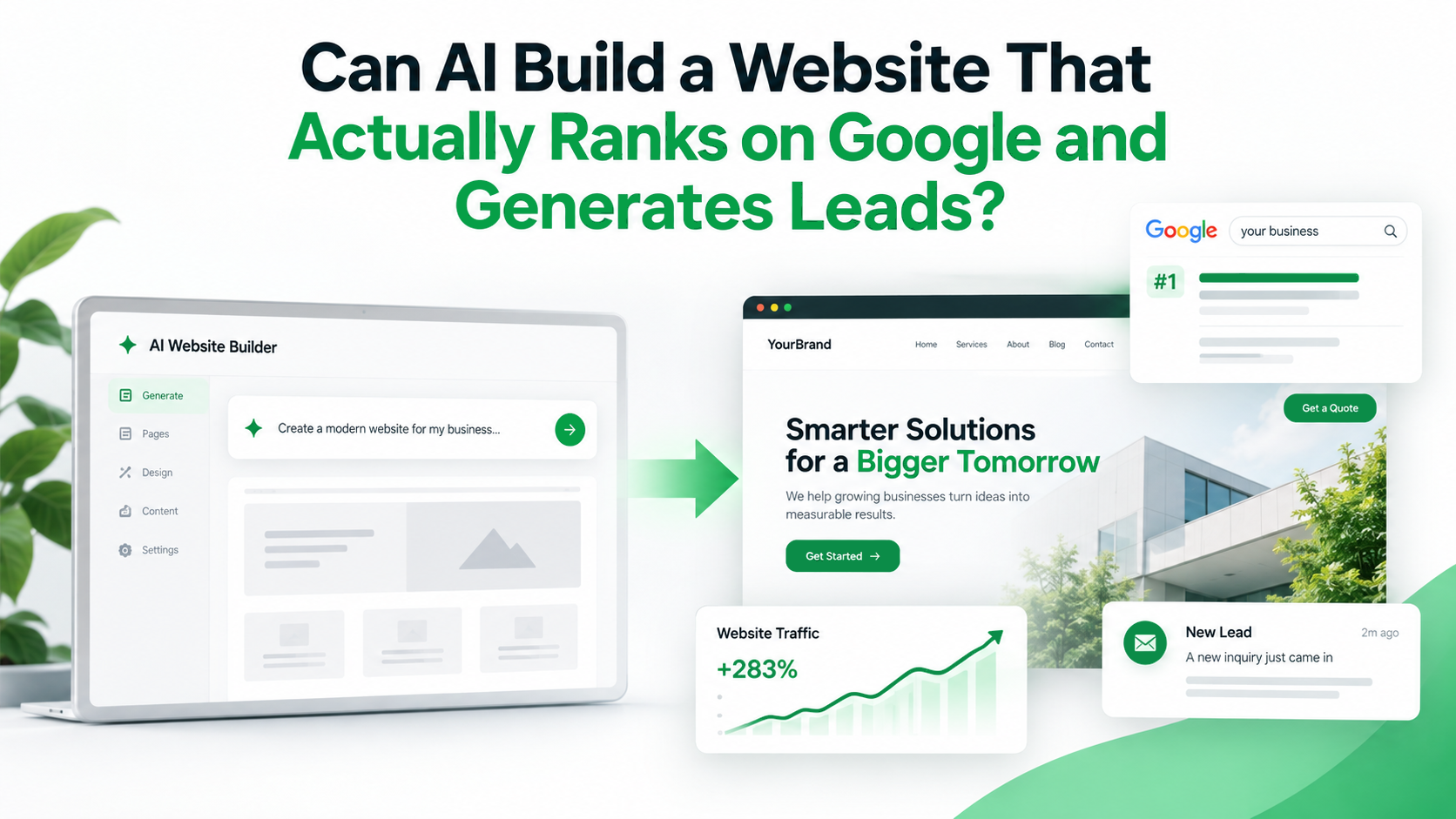
Building a business website has changed dramatically. A business owner can now enter a company name, industry, and a few prompts into an AI website builder and receive a functional site with layouts, images, navigation, and basic copy in a remarkably short amount of time.
For a service business, however, the important question is not simply whether AI can create pages. It is whether customers can find the website, trust the business, understand the services, and take the next step. A website that looks complete can still struggle if it lacks the right page structure, search strategy, local relevance, conversion planning, or useful content.
This guide looks at the performance question behind AI website building: can an AI-built website rank on Google, generate leads, and support long-term growth? We will cover where AI website builders work well, where businesses commonly run into limitations, and when professional strategy becomes valuable. If you are still deciding between the two approaches, start with our AI Website Builder vs. Professional Web Designer guide for the full comparison.
Can AI Actually Build a Business Website?
Yes. AI website builders can generate functional business websites, including layouts, navigation, basic copy, images, calls to action, and common page sections. For a business that mainly needs a simple online presence, that speed and convenience can be genuinely useful.
The important distinction is that creating a website and creating a website that performs for a business are not the same goal. AI can assemble the pieces quickly, but the business still needs to decide what those pieces should accomplish.
What AI Website Builders Do Well
- Launch a basic website quickly
- Lower the initial cost of getting online
- Create starter layouts and common page sections
- Draft first-pass website copy
- Suggest images, colors, and design directions
- Handle simple websites with limited service or content needs
Where the Real Question Begins
Once the website exists, performance becomes the real test. Can the right customers discover it? Does it explain the business clearly? Does it create trust? Does it give visitors a reason to call, book, or request a quote? Those questions require more than a generated layout.
Can an AI-Built Website Rank on Google?
Yes, an AI-built website can rank on Google. Google does not rank a site simply based on whether AI or a human created it; what matters is whether the website is crawlable, useful, relevant to the search, and strong enough to compete with the other pages available.
The limitation is that an AI website builder does not automatically know the search strategy behind your business. It can generate a page you request, but it may not know whether that page is the one you actually need.
What an AI Builder Does Not Automatically Know
- Which services deserve dedicated pages
- Which keywords have meaningful search intent
- Which geographic markets are worth targeting
- What competitors already rank for
- How service pages and supporting articles should link together
- Which pages Google is discovering or ignoring
- Where Google Search Console shows existing opportunities
- How the website should expand as the business grows
AI can help execute SEO tasks, but strategy determines what should be optimized in the first place. For a deeper look at how search is changing, read
Is SEO Dead in the Age of AI? No, but the Rules Have Changed.
Can an AI Website Generate Leads?
It can, but contact forms and buttons alone do not make a website conversion-focused. Lead generation depends on understanding what a prospective customer needs to see before they feel comfortable contacting the business and then removing unnecessary friction from that path.
For service businesses, the website should make the next step obvious while giving visitors enough information and trust to act.
Clear Calls to Action
Visitors should not have to guess what to do next. Calls such as Request a Quote, Schedule a Consultation, Book an Appointment, or Call Now should appear naturally where a visitor is most likely to be ready to act.
Trust Signals
- Customer reviews and testimonials
- Years of experience or credentials
- Portfolio or completed-work examples
- Clear business and contact information
- Service areas
- Professional branding and consistent messaging
Clear Service Information and Mobile Experience
A visitor should be able to understand what the business does, whether the service fits their need, and how to contact the company without digging through the site. Because many local searches happen on phones, the same journey should work smoothly on mobile.
Reduce Friction
Forms should not ask for unnecessary information, navigation should remain simple, and important phone numbers or calls to action should not be buried. Every extra obstacle increases the chance that a qualified visitor leaves before converting.
If you want to see the core elements that help a business website build trust, improve usability, and guide visitors toward taking action, read 6 Things Every Great Business Website Has in Common.
Does AI Know What Pages Your Business Actually Needs?
Not automatically. AI can build the pages you request, but strategy determines which pages you should request in the first place. That distinction becomes important when the website needs to rank for multiple services or markets.
For example, a plumber may ask an AI builder to create a Home, About, Services, and Contact page. A search and content strategy might determine that the business also needs dedicated pages for Water Heater Repair, Drain Cleaning, Emergency Plumbing, Leak Detection, Repiping, and other high-value services because customers search for those services separately.
The same applies to legitimate location content. A business serving multiple markets may need location-specific information, but each page should have a genuine purpose and meaningful local value rather than simply changing the city name.
AI can build the pages you request. Strategy determines which pages you should request in the first place.
Can AI Understand Your Local Market?
AI can help research a market, but a generic AI-generated website does not automatically create a thoughtful local-search strategy. Competition, customer expectations, and search behavior can vary significantly between markets such as Miami, Fort Lauderdale, Weston, Boca Raton, and West Palm Beach.
A strong local website strategy considers how services, locations, and supporting information connect across the site and the broader local-search ecosystem.
- Service areas and geographic priorities
- Local search intent
- Competitors already ranking in each market
- Unique location pages when there is a real reason for them to exist
- Google Business Profile information
- Local keywords and customer questions
- Internal links between service and location content
- Accurate directory and citation information
AI can help gather ideas, but the business still needs to decide which markets matter, how much local content is justified, and what information makes each location genuinely useful to customers.
What About AEO and AI Search?
A business website is no longer competing only for traditional blue-link rankings. Customers increasingly encounter information through AI Overviews, conversational search, voice search, and other answer-focused experiences, so websites need content that can be understood quickly and used to answer real questions.
This is where answer engine optimization, or AEO, overlaps with strong SEO. The goal is not to write for a robot; it is to organize useful information clearly enough that both people and search systems can understand it.
Content That Supports AEO
- FAQs based on real customer questions
- Direct answers near the beginning of relevant sections
- Clear descriptive headings
- Detailed service explanations
- Comparison content
- Cost and process questions when appropriate
- Original expertise and firsthand information
- Helpful supporting blog content connected to service pages
Ironically, the rise of AI makes useful human-informed business content more important, not less. Generic information is easy to generate; specific experience, local knowledge, accurate service details, and genuine proof are harder to replace.
AI Can Write Your Website Copy. But Should You Publish It As-Is?
Usually not without reviewing and improving it. AI is excellent for first drafts, outlines, ideas, and rewriting, but generated copy can sound convincing while still being generic, repetitive, inaccurate, or disconnected from how the business actually operates.
Before publishing AI-generated website copy, review it as carefully as you would content written by any outside writer.
Common Problems With Unedited AI Website Copy
- Generic language that could describe almost any competitor
- Claims that are not specific to the real business
- Repetitive wording across multiple pages
- Little or no local expertise
- Weak differentiation
- Missing customer questions or objections
- Incorrect assumptions about services, pricing, or process
- Content created without keyword or search-intent research
AI works best as an assistant. Businesses still need accurate information, strategy, human judgment, and a clear understanding of the customer. If you’re deciding how to structure content around real search intent, read
Service Pages vs. Blog Posts: Which One Helps Local Businesses Get More Leads? for a practical look at how different types of content support visibility and conversions.
AI Website Builder vs. Professional Website Designer: Where Is the Line?
The line usually comes down to how important the website is to the business. An AI builder can be enough when the goal is simply to get a clean, basic presence online; professional design becomes more valuable when the website is expected to support search visibility, paid advertising, credibility, and lead generation.
This does not make one option universally better. It means the right choice depends on the job the website needs to perform.
An AI Website Builder May Be Enough If:
- You primarily need a basic online presence
- Your budget is extremely limited
- The website is simple
- Organic search is not currently an important acquisition strategy
- You do not need complex service or location architecture
- You are comfortable managing SEO, content, and updates yourself
Professional Website Design May Make More Sense If:
- Your website needs to generate leads
- Search visibility matters to your growth plan
- You compete in a crowded local market
- You offer multiple services
- You target multiple legitimate service areas
- Your website supports Google Ads or Meta Ads
- Credibility strongly influences customer decisions
- You need a long-term SEO and content foundation
For the detailed side-by-side comparison, read AI Website Builder vs. Professional Web Designer: Which Is Better for Your Business?.
What Should a Business Website Include If You Want It to Perform?
A high-performing business website needs more than attractive pages. It should clearly explain the business, support search visibility, create trust, and give visitors a simple path toward becoming a lead.
The exact structure varies by business, but these elements create a strong foundation for most service-based companies.
- Clear value proposition
- Logical site architecture
- Dedicated service pages where appropriate
- Responsive mobile experience
- Fast, reliable performance
- Clear calls to action
- Lead-generation forms
- Reviews, testimonials, and other trust signals
- SEO-friendly heading structure
- Meta titles and descriptions
- Image alt text
- Relevant internal links
- Accurate local information
- Google Analytics setup
- Google Search Console setup
- XML sitemap submission
- Useful ongoing content
The Business Theory’s Website Design Services include custom responsive design, lead-focused calls to action, initial on-page SEO, analytics and Search Console setup, and the structural elements needed for a professional launch.
You can also view our Website Design Portfolio to see how those principles are applied to real service-based businesses.
Can AI Replace a Website Designer?
AI can automate many website-building tasks, but it does not eliminate the need for strategy. Businesses that simply need a basic online presence may be able to use an AI website builder successfully, while businesses that depend on search visibility, credibility, paid advertising, and lead generation may benefit from professional website design and marketing strategy.
The question is no longer whether AI can build a website. It can. The more useful question is whether the finished website can accomplish what the business needs it to accomplish.
Frequently Asked Questions About AI Website Builders
AI website builders are making website creation faster and more accessible, but business owners still need to decide whether the result will support their long-term marketing goals. These answers address the most common questions about AI-built websites, SEO, cost, lead generation, and professional design.
Build a Website Designed to Do More Than Exist
AI has made website creation faster and more accessible, but the strongest business websites are still built around clear goals. Whether the site is created with AI, professional design tools, or a combination of both, it needs to help the right customers find the business, understand the services, trust the brand, and take the next step.
The Business Theory creates custom websites for service-based businesses based on their services, customers, geographic markets, and long-term goals. Our website design process includes responsive development, lead-generation strategy, initial on-page SEO, content structure, internal linking, Google Analytics, and Google Search Console setup so the website launches with a stronger marketing foundation.
Ready to Build a Website Around Your Business Goals?
Explore our Website Design Services or schedule a free consultation to discuss whether a custom website is the right next step for your business.
About The Business Theory
The Business Theory is an award-winning website design and digital marketing agency helping service-based businesses build stronger online presences and attract more qualified customers. We specialize in custom website design, Search Engine Optimization (SEO), directory listings, Google Ads, Meta Ads, social media posting, content marketing, and link building, with strategies tailored to each business rather than a one-size-fits-all approach. Whether you need a new website, stronger search visibility, or a more coordinated digital marketing strategy, explore our services or schedule a free consultation to learn how The Business Theory can support your business goals.