Why Did My Google Rankings Change? What the September 2026 Spam Update Means for Local Businesses
Share this article
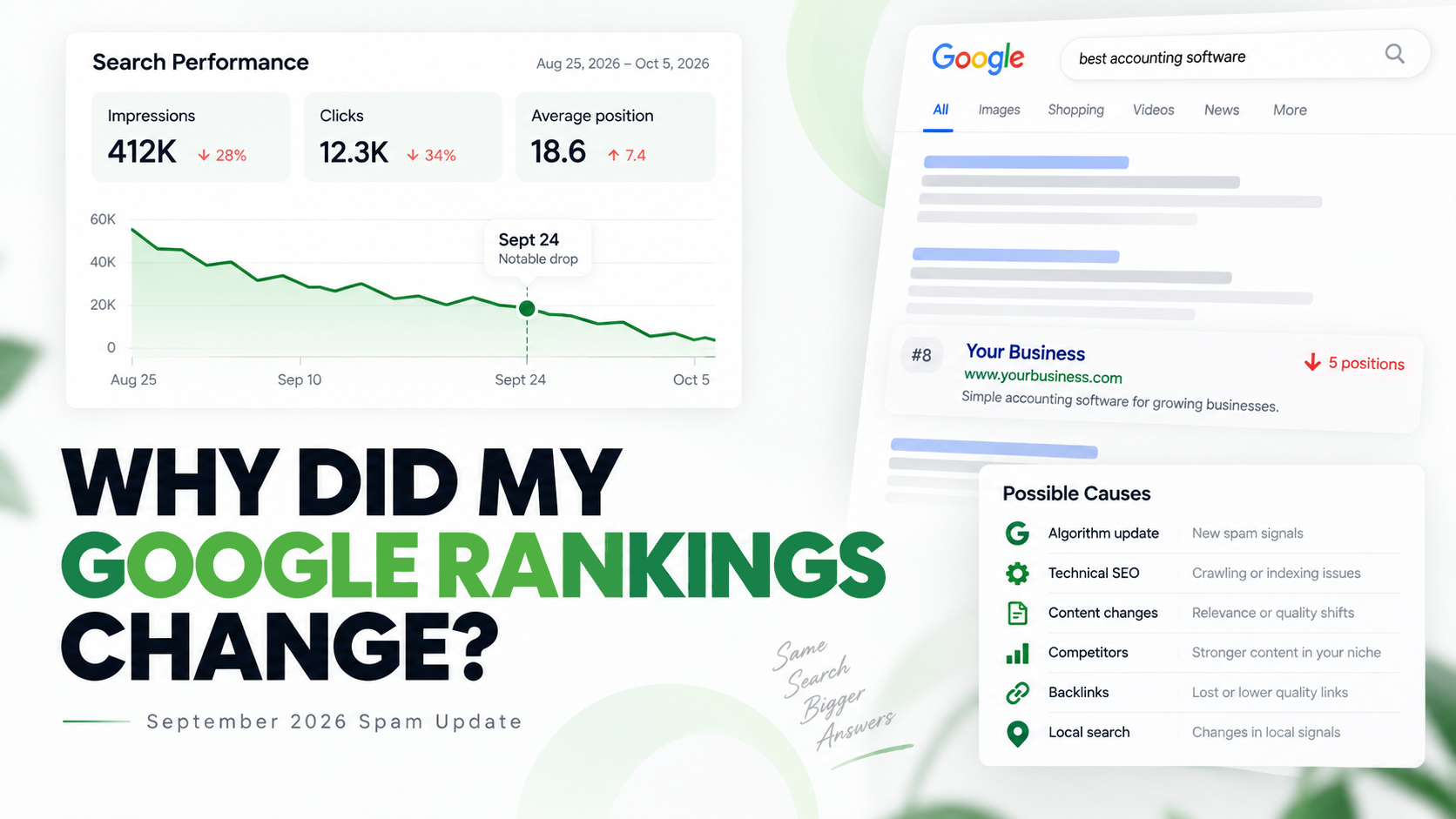
If your Google rankings suddenly moved up or down this week, the September 2026 spam update may be one possible factor, but timing alone does not prove that the update caused the change. Google began rolling out the update on September 24, confirmed that it applies globally and to all languages, and said the rollout may take up to two weeks to complete.
A ranking decline also does not automatically mean your website was penalized. Technical problems, website changes, stronger competitors, backlink changes, indexing issues, local-search inconsistencies, shifting search behavior, and content quality can all affect visibility. Google’s own guidance continues to emphasize creating helpful, reliable, people-first content rather than relying on tactics designed primarily to manipulate rankings.
In this guide, we’ll explain what the September 2026 spam update is, how to tell whether a ranking change may be temporary or requires attention, what to investigate in Google Search Console, and what you should avoid changing while the rollout is still active. The goal is not to react to a few days of movement, but to identify what actually changed before deciding what, if anything, needs to be fixed.
What Is the September 2026 Google Spam Update?
Google’s September 2026 spam update began rolling out on September 24 and is expected to take up to two weeks to complete. The update applies globally and across all languages, which means websites in many industries may experience ranking movement while Google’s systems reassess search results.
A spam update is designed to improve Google’s ability to identify content and practices that violate its spam policies. It does not mean Google is targeting one specific tactic, industry, or type of website, and Google has not said that this update is exclusively about AI content, backlinks, city pages, or any single SEO strategy.
Why Rankings Can Fluctuate During the Rollout
While an update is still rolling out, rankings may move more than usual as Google recalculates which pages should appear for different searches. Some pages may lose visibility temporarily, others may gain positions, and results can continue changing until the rollout is complete.
That is why a few days of movement should not automatically be treated as a final outcome.
Before making major changes, it is better to look at:
- Which pages changed
- Which queries gained or lost visibility
- Whether impressions, clicks, and leads changed together
- Whether technical or indexing problems are present
- Whether recent website edits may have contributed
- Whether competitors improved their content or local presence
A Spam Update Does Not Automatically Mean Your Website Is Spam
A ranking decline during a spam update does not necessarily mean Google has identified your website as spam.
Search visibility can change for many reasons, including content quality, technical SEO, search intent, website changes, backlinks, stronger competitors, and local-search signals. The update may simply create the timing that makes those weaknesses more noticeable.
If your rankings changed and you are not sure whether the issue is technical, content-related, or part of a broader update, our Free SEO Audit Tool can help identify several important on-page and technical signals worth reviewing.
You can also read our guide on How Healthy Is Your Website’s SEO? for a deeper look at the technical and on-page issues that can affect search visibility.
Does a Ranking Drop Mean Google Penalized My Website?
Not necessarily. A sudden ranking decline can happen for several reasons, and a drop during a Google update does not automatically mean your website has been penalized. The first step is to determine whether you
are seeing normal ranking fluctuations, an automated algorithmic reassessment, a technical problem, or an actual manual action.
Understanding the difference matters because each situation requires a completely different response.
Normal Ranking Fluctuations
Google rankings are not permanently fixed. Positions can move as Google reevaluates pages, competitors publish stronger content, search behavior changes, or an algorithm update continues rolling out.
Small movements over a few days may not require any action at all, especially while a major update is still active.
Algorithmic Reassessment
An algorithmic decline happens when Google’s automated systems reevaluate how well your pages deserve to rank compared with other available results.
You typically will not receive a notification saying your website was “algorithmically penalized.” Instead, you may notice changes in impressions, clicks, rankings, or traffic inside Google Search Console.
This is why diagnosis is so important. A decline could reflect weaker content, changing search intent, technical issues, stronger competitors, or other factors rather than one specific violation.
Manual Actions
A manual action is different.
This happens when a human reviewer at Google determines that pages on a website violate Google’s spam policies. If your site receives a manual action, Google Search Console will normally show it in the Manual Actions report.
If rankings suddenly decline, checking this report can quickly tell you whether an actual manual action is involved.
Security or Hacked-Content Problems
Ranking and traffic declines can also happen when a website has been compromised.
Malware, hacked pages, injected spam content, or other security problems can interfere with search performance and damage user trust. Google Search Console includes a Security Issues report that can alert you to some of these problems.
Indexing Problems
Sometimes the problem is much simpler: Google may no longer be indexing an important page correctly.
Accidental [ noindex]
tags, broken redirects, canonical errors, deleted URLs, server problems, or website changes can cause previously visible pages to disappear or lose search visibility.
If you suspect a technical problem, our Free SEO Audit Tool can help identify several important on-page and technical signals worth reviewing before you make major changes.
The Most Common Reasons Google Rankings Change
Google rankings can rise or fall for many different reasons, and sometimes several factors are happening at the same time. That is why a ranking decline should be investigated systematically rather than blamed immediately on an algorithm update, a penalty, or one recent website change.
The most useful approach is to identify when the change started, which pages and searches were affected, and what changed around the same time. From there, you can narrow the problem down to algorithm volatility, technical SEO, content quality, website changes, backlinks, competitors, local-search signals, or changing customer behavior.
A Google Algorithm Update Is Still Rolling Out
When Google releases a major search update, rankings can fluctuate while the rollout is still in progress. Some pages may lose positions temporarily, others may improve, and results can continue changing as Google’s systems reassess which pages best match different searches.
That is especially important during the September 2026 spam update because Google said the rollout may take up to two weeks. A few days of movement during that period are not enough to determine whether a website has experienced a lasting decline.
Before making major changes, compare the timing of the ranking movement with the update and look at whether:
- The decline affected the entire website or only certain pages.
- Specific queries lost visibility while others remained stable.
- Impressions changed before clicks declined.
- Leads and inquiries changed along with rankings.
- Competitors moved into the positions you previously held.
- The movement continues after the update finishes.
If rankings are moving while an update is still active, patience matters. Rewriting large sections of the website, deleting content, or changing important URLs before you understand what happened can make the situation harder to diagnose.
The better strategy is to document the changes, monitor Google Search Console, and wait until the rollout is complete before reaching a final conclusion about whether the movement was temporary or requires action.
Technical SEO or Indexing Problems
A ranking decline can happen even when your content has not changed. Technical issues can prevent Google from crawling, understanding, or indexing important pages correctly, which can reduce visibility without any connection to a spam update.
Because these problems are often invisible to visitors, Google Search Console and a technical review are usually the best places to start.
Common technical issues include:
- Accidental
noindexsettings that tell Google not to include a page in search results. - Broken redirects that send users and search engines to the wrong destination.
- Deleted or changed URLs without proper redirects.
- Canonical problems that cause Google to treat the wrong version of a page as the primary one.
- Sitemap issues that make important pages harder to discover.
- Server errors that prevent Google from accessing pages reliably.
- Mobile usability problems that create a poor experience on smartphones.
- Slow site performance that can affect usability and crawling efficiency.
- Important content blocked from crawling by robots.txt or other technical settings.
If one important service page suddenly loses rankings while the rest of the website remains stable, a technical problem should be investigated before rewriting the content.
A good first step is to check the page in Google Search Console to confirm that it is indexed, review the Page Indexing report, and compare the URL with any recent website changes. You can also check the overall SEO health of your website to identify several common technical and on-page issues before making larger changes.
Website Changes Can Affect Rankings
Major website changes can cause rankings to move even when the changes were made with good intentions. Redesigns, migrations, navigation updates, URL changes, deleted pages, and large content edits can all affect how Google crawls and understands the site.
That does not mean businesses should avoid improving their websites. It means major changes should be planned carefully and reviewed afterward to make sure important SEO signals were not accidentally lost.
Common website changes that can affect visibility include:
- Changing page URLs without setting up proper redirects.
- Removing pages that were already earning traffic or backlinks.
- Rewriting high-performing content without preserving the information users were searching for.
- Changing navigation or internal links in ways that make important pages harder to reach.
- Launching a redesign that changes headings, metadata, page structure, or mobile performance.
- Migrating to a new platform or domain without a clear redirect and indexing plan.
- Combining or splitting pages without considering which keywords and search intent each page was previously serving.
If rankings dropped shortly after a redesign or major website update, compare the affected pages with their previous versions before assuming an algorithm update is responsible.
Look for changes in:
- URLs
- Title tags
- H1 headings
- Internal links
- Page copy
- Canonical tags
- Indexing status
- Mobile usability
- Page speed
- Calls-to-action and page layout
Sometimes the ranking decline is not caused by the redesign itself, but by an important SEO element that was removed or changed during the process.
If your website structure is outdated or difficult to maintain, our Website Design Services can help create a stronger foundation while keeping SEO, user experience, and future growth in mind.
Content No Longer Matches Search Intent
A page can be technically healthy and still lose rankings if it no longer gives searchers the answer, service, or experience they expect. Search intent changes over time, and Google may begin favoring different types of pages if they better match what users are trying to accomplish.
For local service businesses, this often happens when a page is too generic, outdated, or focused on the wrong stage of the customer journey.
Common examples include:
- A service page that reads like a blog article instead of clearly explaining the service and how to hire the business.
- A blog post targeting a transactional keyword when searchers are actually looking for a company to contact.
- Outdated information that no longer reflects current pricing, services, regulations, or customer expectations.
- Pages that answer only part of the question while competitors provide a more complete explanation.
- Content built around keywords instead of customer intent, making the page feel repetitive or unhelpful.
- Local pages with very little local value, where the city name changes but the content remains essentially the same.
A useful way to diagnose this is to search the affected keyword and review the types of pages Google is currently ranking. If the results are mostly service pages and your page is informational, or mostly detailed guides and your page is thin and promotional, the mismatch may be part of the problem.
This is also where understanding the different roles of service pages and blog posts becomes important. Service pages typically target people closer to hiring, while blog content supports informational searches and earlier-stage questions.
If the page no longer matches what searchers want, the goal is not to stuff in more keywords. The better approach is to improve the page so it more clearly satisfies the intent behind the search.
Thin, Repetitive, or Scaled Content
Google may reduce visibility for pages that add very little original value, especially when many pages repeat nearly the same information with only small changes. This can happen with blog articles, service-area pages, or location pages that were created mainly to target search variations rather than genuinely help users.
That does not mean every city page or service-area page is a problem. A legitimate local page can be useful when it gives visitors meaningful information about the specific market, service, and customer needs in that area.
Signs a page may be too thin or repetitive include:
- Only the city name changes while nearly all of the remaining copy stays the same.
- The page adds no meaningful local information, examples, conditions, or customer guidance.
- Multiple pages target nearly identical searches without a clear reason for each one to exist.
- Content is mass-produced without enough human review, original insight, or useful detail.
- Articles repeat information already covered elsewhere instead of providing a distinct answer.
- Pages exist primarily to capture keywords rather than solve a real customer problem.
A stronger location or service page should provide a genuine reason for someone to visit it. That may include:
- Local service details
- Relevant neighborhoods or service areas
- Common questions from customers in that market
- Original photos or examples
- Unique service considerations
- Clear contact information and next steps
For example, a Fort Lauderdale website design article should not simply be a Miami article with the city name replaced. It should reflect the types of businesses, customer expectations, and local context that make Fort Lauderdale different.
If your website has a large amount of thin or repetitive content, the solution is not always to delete everything. Review whether each page serves a clear purpose, improve pages that deserve to exist, and consolidate pages that unnecessarily compete with one another.
If your business needs help creating more useful, search-focused content, our SEO- and AEO-focused content writing can help strengthen articles and service pages with clearer intent, stronger structure, and more original value.
Weak or Outdated Content
A page can lose visibility when the information is no longer as useful, accurate, or complete as the pages competing against it. Even content that once performed well may decline if it becomes outdated, too generic, or less helpful than newer alternatives.
For service businesses, this often happens gradually. A page may still look fine on the surface, but its examples, statistics, service details, FAQs, or recommendations may no longer reflect what customers are actually searching for today.
Common warning signs include:
- Outdated information that no longer reflects current services, pricing, policies, or industry conditions.
- Shallow articles that answer a question only at a surface level.
- Generic AI-generated copy that sounds polished but lacks original experience or useful detail.
- Missing expertise from the people actually working in the business.
- Old statistics or unsupported claims that have not been reviewed recently.
- Competitors publishing stronger content with better examples, clearer answers, or more complete coverage.
- Pages that have not been updated in years even though the topic has changed.
The goal is not to refresh content just for the sake of changing the publication date. Updates should make the page more useful.
That may include adding:
- Firsthand business experience
- Real customer questions
- Updated examples
- Original photos
- Clearer service details
- Better comparisons
- More useful FAQs
- New internal links
- More direct answers to current search intent
If AI tools were used to help create the content, that alone is not automatically a problem. What matters is whether the final page is accurate, original, useful, and reviewed by someone who understands the subject.
If your content library has become outdated or inconsistent, our SEO- and AEO-focused content writing can help strengthen existing pages and create new content around real customer questions and current search intent.
Backlink Changes or Questionable Link Building
Backlinks can influence rankings because they help search engines understand which websites are being referenced and trusted across the web. A decline can happen if your site loses valuable links, gains a large number of low-quality links, or relies on link-building tactics that appear unnatural.
The important thing is to evaluate quality and relevance, not simply the total number of backlinks pointing to your website.
Common backlink-related issues include:
- Losing strong backlinks from reputable websites that previously supported important pages.
- Gaining large numbers of irrelevant links from websites that have little connection to your industry or audience.
- Purchased or automated backlinks created primarily to influence rankings.
- Sudden unnatural link patterns that do not reflect normal business growth or genuine mentions.
- Links pointing to deleted or redirected pages, reducing the value those pages previously received.
- Focusing on quantity over quality, where dozens of weak links are treated as more valuable than a few relevant, authoritative ones.
A backlink from a respected local organization, industry publication, supplier, chamber of commerce, or relevant business resource can carry far more value than hundreds of links from unrelated websites.
Should You Disavow Questionable Backlinks?
Not automatically.
Seeing low-quality or suspicious links in a backlink report does not mean you should immediately disavow them. Google is generally capable of ignoring many links it does not consider useful, and removing or disavowing links without understanding their impact can create unnecessary risk.
A better approach is to review:
- Which links were lost
- Which pages those links supported
- Whether the linking websites are relevant
- Whether the link patterns look natural
- Whether rankings changed around the same time
- Whether the site has a history of aggressive link building
If backlinks appear to be part of the problem, focus on building stronger authority through relevant, legitimate sources rather than chasing raw link volume.
Our strategic link-building services focus on improving authority through relevant backlink opportunities rather than simply increasing the number of links pointing to your website.
Competitors Improved Their Websites
Your rankings can decline even when you did nothing wrong. If competitors improve their service pages, publish more useful content, strengthen their local presence, earn better backlinks, or create a better user experience, Google may decide their pages are a stronger match for the same searches.
This is one of the most overlooked reasons for ranking changes because business owners often focus only on what changed on their own website.
Common competitive improvements include:
- Stronger service pages with clearer explanations, FAQs, trust signals, and calls-to-action.
- More complete local content that better reflects the cities or communities being served.
- Better internal linking between service pages, blog content, and conversion pages.
- Higher-quality backlinks from relevant and authoritative websites.
- More helpful blog content that answers the questions customers are actually searching for.
- Improved website speed and mobile usability that creates a better experience for visitors.
- More accurate Google Business Profile information and stronger local-search signals.
- Better reviews or more recent customer activity that increases trust.
How Do You Know If Competitors Are the Reason?
Start by comparing the pages that replaced you in the search results.
Look at whether they provide:
- More detailed service information
- Better answers to common questions
- Stronger local relevance
- More recent or original content
- Better site organization
- Clearer calls-to-action
- More trustworthy supporting information
The goal is not to copy what competitors are doing.
Use the comparison to identify what their pages may be doing better for the searcher and where your own content may have become less competitive.
If your rankings declined because competitors have strengthened their websites, the solution is usually not a quick technical fix. It may require improving service pages, publishing stronger supporting content, strengthening internal links, and creating a better overall user experience.
Our Search Engine Optimization services can help identify competitive gaps and prioritize improvements based on the pages and searches that matter most to your business.
Local Search or Directory Information Changed
A website can lose local visibility even when its organic content has not changed. Updates to your Google Business Profile, directory listings, service areas, business categories, or other local data can affect how consistently search engines understand your business and where it should appear.
This is especially important for service-based companies because local visibility depends on more than the website alone. Your Google Business Profile, directory listings, and location data all work together to reinforce who you are, where you operate, and what services you provide.
Common local-search issues include:
- Inconsistent business names across your website, Google Business Profile, and directories.
- Old or incorrect addresses that create conflicting location signals.
- Different phone numbers appearing across listings.
- Incorrect or outdated business categories on your Google Business Profile.
- Changes to service areas that no longer reflect where you actually work.
- Duplicate listings that create confusion.
- Incorrect hours or website links across directories.
- Recent Google Business Profile edits that may trigger additional review or temporarily affect local visibility.
Organic Rankings and Local Pack Rankings Are Not the Same
It is important to separate traditional organic website rankings from Google Maps and Local Pack visibility.
A business can maintain strong organic rankings while losing positions in the Local Pack, or the opposite can happen. These are related parts of local search, but they rely on different signals.
That means if your visibility dropped, first determine where the decline actually happened:
- Traditional organic search results
- Google Maps
- The Local Pack
- Google Business Profile interactions
- Directory referral traffic
If the problem appears to be local rather than organic, reviewing your Google Business Profile and citation consistency should be part of the investigation.
Our guide on business directory listings for local SEO explains why accurate, consistent business information matters across directories, maps, voice-search platforms, and other data sources.
If your directory information is outdated or inconsistent across multiple platforms, our Directory Listings Services can also help maintain a more consistent local presence across the web.
Search Demand and Customer Behavior Changed
Sometimes rankings or traffic decline because fewer people are searching for the same thing, not because anything is wrong with your website. Search behavior can shift because of seasonality, regional demand, economic conditions, news events, changing terminology, or new ways customers describe the same need.
This is why a drop in clicks or impressions should always be reviewed alongside actual search demand before assuming the site lost visibility because of an SEO problem.
Common examples include:
- Seasonal demand changes for services such as pest control, HVAC, roofing, landscaping, or tax preparation.
- Regional changes where demand increases in one city or county and declines in another.
- New terminology replacing the phrases customers previously used.
- News or industry events temporarily increasing or reducing interest in a topic.
- Economic conditions affecting how often customers search for certain services.
- AI-driven search behavior changing how people interact with results and whether they click through to websites.
How Can You Tell If Search Demand Is the Problem?
Start by looking at impressions in Google Search Console.
If rankings remain relatively stable but impressions drop significantly, that may indicate fewer people are searching for the query rather than your page suddenly becoming less competitive. You can also compare similar periods from previous months or years to identify seasonal patterns.
Review whether:
- Impressions declined across an entire topic.
- Only specific keywords lost search volume.
- Rankings stayed similar while clicks fell.
- The decline matches a known seasonal pattern.
- Branded searches remained stable while broader searches dropped.
- Customer inquiries declined across other marketing channels at the same time.
Search demand is especially important because SEO cannot create demand that does not exist. A page can rank extremely well and still receive less traffic if fewer people are searching for the service.
If search behavior is changing, the best response may be to update content around the questions customers are asking now, strengthen higher-intent service pages, or expand into related topics with stronger current demand.
Security or Hacked-Content Problems
A sudden ranking decline can sometimes be caused by a security issue rather than an SEO problem. If a website has been hacked, injected with spam pages, or compromised by malware, Google may reduce visibility to protect users and may also flag the site inside Google Search Console.
These problems can be difficult to spot because the website may still look normal when you visit it. In some cases, unauthorized pages are created in the background or only appear to search engines.
Common warning signs include:
- Unexpected pages appearing in Google Search
- Strange URLs showing up in Search Console
- Sudden spikes in indexed pages
- Malware or security warnings
- Redirects you did not create
- Content appearing on the site that your team did not publish
- Large ranking or traffic declines with no obvious content or technical change
Where Should You Check First?
Google Search Console has a Security Issues report that can alert you to certain hacked-content, malware, or harmful-download problems.
You should also review:
- Recently indexed URLs
- Server logs if available
- CMS users and login activity
- Plugins or third-party tools
- Redirect behavior
- Website backups
If you find evidence of a security problem, fix the compromise first before making SEO changes. Rewriting content or building new links will not solve a hacked-site issue.
Did AI Content Cause My Rankings to Drop?
Not necessarily. Google does not automatically penalize content simply because AI was used to help create it. The real concern is whether the final content is helpful, accurate, original, and created for people rather than produced at scale mainly to manipulate search rankings.
That means a business can use AI as part of its content process and still perform well in search, but the content should be reviewed and strengthened with real expertise, local knowledge, and information that adds genuine value.
What Makes AI-Assisted Content More Useful?
AI-generated drafts should be treated as a starting point, not the finished product. Before publishing, businesses should review the content for accuracy, usefulness, originality, and whether it reflects how the company actually operates.
Ways to strengthen AI-assisted content include:
- Add firsthand expertise from people who actually perform the service.
- Include local knowledge that reflects the market or service area.
- Use original photos instead of relying only on generic stock images.
- Add real examples from common customer situations.
- Confirm service details so the page accurately reflects what the business offers.
- Fact-check claims before publishing.
- Include useful comparisons when they genuinely help the reader.
- Answer real customer questions in clear, natural language.
- Provide a clear next step for someone who needs the service.
When Can AI Content Become a Problem?
AI content becomes more risky when it is used to produce large amounts of repetitive or low-value pages without meaningful human review.
Examples may include:
- Publishing dozens of nearly identical articles.
- Creating city pages that only swap out location names.
- Repeating information already covered elsewhere on the site.
- Publishing inaccurate or outdated information.
- Using generic copy that adds no original insight.
- Creating content primarily to target keywords instead of helping customers.
The issue is not the tool used to create the draft. The issue is the quality, purpose, and usefulness of the finished page.
If you want a deeper look at how search is evolving around AI-generated answers, read our guide on how Google AI Overviews are changing small-business SEO.
How to Investigate a Ranking Decline in Google Search Console
Google Search Console is one of the best places to start when your rankings change because it shows which queries, pages, devices, and countries gained or lost visibility. The goal is not to stare at one average-position number, but to identify where the decline actually happened and whether it lines up with the September 2026 update or another issue.
A structured review helps you avoid guessing and makes it easier to separate temporary volatility from a real SEO problem.
Step 1: Mark September 24, 2026, on Your Performance Timeline
Use September 24 as a reference point because that is when Google began rolling out the September 2026 spam update.
Look at performance before and after that date, but avoid drawing a final conclusion while the update is still active.
Step 2: Compare Equivalent Time Periods
Compare similar date ranges instead of one random week against another.
For example:
- The two weeks before the rollout
- The two weeks after the rollout finishes
- The same period from the previous month
- The same seasonal period from the previous year, when relevant
This helps reduce noise from weekends, holidays, seasonality, and short-term fluctuations.
Step 3: Separate Branded and Nonbranded Searches
Branded searches include your company name or variations of it.
Nonbranded searches are broader queries such as:
- “mold inspection near me”
- “website design Fort Lauderdale”
- “pest control Weston”
If branded visibility is stable but nonbranded searches decline, the problem may be related more to competitive rankings than overall business visibility.
Step 4: Review Which Queries Lost Impressions, Clicks, or Positions
Do not look only at average position.
Review:
- Impressions
- Clicks
- Click-through rate
- Average position
A drop in impressions can mean search demand changed. A drop in position with stable impressions may indicate stronger competition or a ranking reassessment. A drop in clicks with stable rankings may point to search-result changes such as AI Overviews or other SERP features.
Step 5: Identify Which Pages Declined
Filter Search Console by page and look for patterns.
Ask:
- Did the whole website decline?
- Did only blog posts lose visibility?
- Did service pages drop?
- Did one location page change?
- Did a recently edited page lose rankings?
This is often where the investigation becomes much clearer.
Step 6: Compare Desktop and Mobile Performance
A decline that appears only on mobile may point to usability, speed, layout, or mobile-specific issues rather than a broader algorithm problem.
Review both device types separately before assuming the issue affects the entire site.
Step 7: Check Countries and Service Areas When Relevant
For local and regional businesses, performance may change differently across locations.
If one market declined while another stayed stable, that can point toward local competition, service-area relevance, or business-information inconsistencies.
Step 8: Review Indexing and Page Indexing Reports
Make sure important pages are still indexed.
Look for:
- Excluded pages
- Crawled but not indexed URLs
- Duplicate pages
- Canonical issues
- Redirect problems
- Server errors
If a high-value service page is no longer indexed, that needs to be addressed before rewriting content.
Step 9: Check Manual Actions and Security Issues
Review both sections in Google Search Console.
If there is a manual action or security issue, Google will usually provide details there. If both reports are clear, that is a strong signal that the decline may be algorithmic, technical, competitive, or demand-related rather than a manual penalty.
Step 10: Compare the Decline With Recent Website Changes
Look at what changed before the rankings moved.
That may include:
- A redesign
- URL changes
- New service pages
- Deleted content
- Navigation changes
- Plugin or CMS updates
- New redirects
- Large content edits
Timing does not prove causation, but it can help narrow the investigation.
Step 11: Review Calls, Forms, Bookings, and Qualified Leads
Search Console shows search visibility, but it does not tell you whether the business is still generating meaningful inquiries.
Compare SEO data with:
- Phone calls
- Contact forms
- Appointments
- Quotes
- Bookings
- Qualified leads
- Revenue, when available
A ranking drop matters, but business outcomes matter more.
Step 12: Use an SEO Audit to Check the Technical Foundation
If the decline appears to involve technical or on-page issues, a broader audit can help identify problems that may not be obvious from Search Console alone.
Our free SEO audit checks several important technical and on-page signals and can give you a useful starting point before making larger changes.
Not Sure Why Your Rankings Changed?
A ranking decline can come from content, technical SEO, backlinks, website changes, local-search issues, or an active Google update. Start with our free SEO audit to identify several important technical and on-page signals affecting your website.
What Should You Avoid Doing During a Google Update?
When rankings move during an active Google update, the worst thing you can do is make several major changes at once without understanding the cause. That can make the situation harder to diagnose and may create new problems that have nothing to do with the original decline.
The better approach is to document what changed, review your data, and avoid reacting impulsively while the rollout is still in progress.
Avoid These Common Mistakes
- Do not delete large amounts of content impulsively. A page that lost visibility may still have value and may recover once the rollout is complete.
- Do not rewrite the entire website based on a few days of movement. Short-term volatility is common during major updates.
- Do not change important URLs without a redirect plan. URL changes can create indexing and authority problems if they are not handled carefully.
- Do not buy backlinks promising an immediate recovery. Quick-fix link packages can create additional risk and rarely address the real cause of a ranking decline.
- Do not publish dozens of nearly identical pages. Creating repetitive city or service pages in response to a drop can make content quality worse, not better.
- Do not assume every decline is a penalty. Ranking changes can come from technical issues, competitors, search demand, content quality, or an active algorithm update.
- Do not judge the final outcome before the rollout finishes. Google said the September 2026 spam update may take up to two weeks to complete.
- Do not expect one change to guarantee recovery. Different causes require different solutions, and rankings cannot be guaranteed.
Diagnose First, Then Make Targeted Changes
Once the rollout is complete, compare your Search Console data, identify the pages and queries that changed, and look for patterns before deciding what needs to be fixed.
If the problem is technical, fix the technical issue. If the content no longer matches search intent, improve the content. If local information is inconsistent, correct the local signals.
The goal is to make evidence-based changes, not panic-driven ones.
How Can a Business Recover Lost Google Rankings?
Recovering lost rankings starts with identifying the cause of the decline and fixing the specific problem rather than applying the same SEO tactic to every situation. Some websites recover after technical issues are repaired, while others need stronger content, better internal linking, improved local signals, or a more competitive overall strategy.
There is no guaranteed recovery timeline, and no single change can promise that rankings will return. The best approach is to make targeted improvements based on the evidence available in Google Search Console, your website, and your broader search performance.
Fix Technical and Indexing Problems First
If important pages are not being crawled or indexed correctly, resolve those issues before focusing on content or backlinks.
That may include fixing:
- Broken redirects
- Incorrect canonical tags
- Accidental
noindexsettings - Server errors
- Sitemap problems
- Deleted or changed URLs
- Mobile usability issues
- Crawlability problems
Technical issues can prevent strong content from performing, so they should usually be addressed first.
Improve Weak or Outdated Pages
If a page has lost visibility because competitors now provide a better answer, strengthen the page rather than simply adding more keywords.
Look for opportunities to improve:
- Service details
- FAQs
- Local relevance
- Original examples
- Accuracy
- User experience
- Calls-to-action
- Helpful comparisons
The goal is to make the page more useful for the person searching.
Consolidate Pages That Compete With Each Other
Sometimes a website has multiple pages targeting nearly the same search intent.
When that happens, those pages may compete with one another instead of reinforcing the same topic.
Consider consolidating pages when:
- Several articles answer nearly the same question.
- Multiple service pages target the same intent.
- Location pages offer little meaningful difference.
- Older pages no longer serve a clear purpose.
A cleaner content structure can make it easier for search engines to understand which page should rank.
For service-based businesses, core service pages should clearly explain what you offer, who the service is for, where it is available, and how someone can contact you.
If your service pages are thin or too generic, improving them can strengthen both search visibility and lead generation.
Our guide on the different roles of service pages and blog posts explains how commercial pages and educational content should work together.
Publish Content Based on Real Customer Questions
Helpful content can support recovery when it fills genuine information gaps and strengthens the topics your business wants to be known for.
Focus on questions customers actually ask, including:
- Costs
- Comparisons
- Timing
- Common problems
- Service expectations
- Local considerations
- What to do before or after a service
Our SEO- and AEO-focused content writing can help strengthen existing pages and create new content around real customer questions and current search intent.
Improve Internal Linking
Internal links help users discover related information and help search engines understand how your pages connect.
Use descriptive anchor text to connect:
- Blog articles to service pages
- Service pages to supporting guides
- Location pages to relevant services
- High-authority pages to important conversion pages
A stronger internal linking structure can help reinforce which pages matter most.
Correct Inconsistent Local Business Information
If the decline affects local visibility, review your Google Business Profile and directory listings.
Check whether your:
- Business name
- Address
- Phone number
- Website
- Categories
- Hours
- Service areas
are accurate and consistent across the web.
Our Directory Listings Services can help maintain more consistent business information across directories, mapping platforms, voice-search systems, and other data networks.
Review Backlink Quality and Relevance
If backlink changes appear to be part of the decline, focus on quality rather than volume.
Look for:
- Valuable links that were lost
- Links pointing to deleted pages
- Irrelevant or suspicious patterns
- Opportunities to earn stronger industry or local links
Our strategic link-building services focus on relevant backlink opportunities rather than simply increasing link quantity.
Monitor Results After Making Improvements
SEO recovery takes time.
After making changes, continue monitoring:
- Impressions
- Clicks
- Rankings
- Indexed pages
- Leads
- Calls
- Forms
- Bookings
Do not judge recovery based on a few days of data.
Google notes that recovery from spam-related issues can sometimes take months while its systems reassess a website, so businesses should focus on sustainable improvements rather than quick fixes.
The goal is not simply to “get the old rankings back.” It is to build a stronger website that deserves to compete for visibility over the long term.
Key Takeaways
A sudden ranking decline does not automatically mean your website was penalized. Google rankings can change because of updates, technical issues, content quality, stronger competitors, backlinks, local-search changes, or shifting demand.
The most important thing is to diagnose before making major changes.
- Ranking drops can have several different causes.
- Movement during a Google update is not automatically a penalty.
- Check which pages and queries actually lost visibility.
- Review technical SEO and indexing before rewriting content.
- Helpful, original content still matters.
- Local accuracy, backlinks, service pages, and internal linking all work together.
- Avoid making drastic changes while an update is still rolling out.
- If you need help investigating a decline, Contact The Business Theory.
Frequently Asked Questions About Google Ranking Changes
Google ranking changes can be confusing, especially when traffic or visibility shifts without an obvious explanation. These common questions can help clarify what ranking drops may mean, how long changes can last, and what business owners should check before making major SEO decisions.
Diagnose the Problem Before You Chase the Algorithm
A sudden change in Google rankings can be frustrating, but the right response is not to panic or overhaul the website overnight. Ranking declines can come from algorithm updates, technical issues, content changes, backlinks, competitors, local-search problems, or changing demand, so the first priority should always be identifying what actually changed.
Use Google Search Console to review affected pages and queries, check indexing and security reports, compare the timing with recent website changes, and look at real business outcomes such as calls, forms, bookings, and qualified leads. Once the cause is clearer, you can make targeted improvements instead of guessing.
Concerned About a Sudden Change in Your Google Rankings?
If your rankings have changed and you’re considering professional SEO support, schedule a free consultation to learn more about our SEO services and whether they may be a good fit for your business. If you hire The Business Theory for SEO, our team will review your Google Search Console performance, website content, technical SEO, backlinks, service pages, and local-search foundation as part of the service, then use those findings to identify potential problems and guide the optimization strategy.